


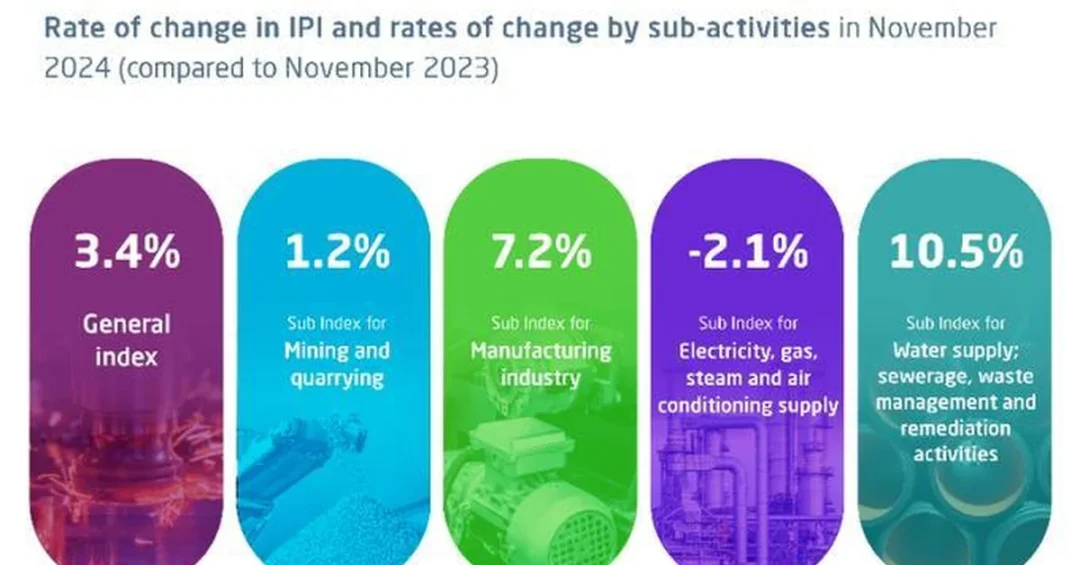
The General Authority for Statistics (GASTAT) reported a 3.4% increase in Saudi Arabia’s Industrial Production Index (IPI) for November 2024 compared to the same month in 2023. This growth highlights the continued expansion of the Kingdom’s industrial sector, driven by significant gains in manufacturing and water supply activities, as part of broader economic diversification efforts under Vision 2030.
Context and Background
The IPI is a key economic indicator that measures the relative changes in the volume of industrial output, based on the monthly industrial production survey. Published by GASTAT, the index provides critical insights into the health of Saudi Arabia’s industrial base, covering mining and quarrying, manufacturing, electricity and gas supply, and water management. The November 2024 data reflects the Kingdom’s ongoing progress in strengthening non-oil sectors, aligning with the leadership’s vision to reduce dependence on hydrocarbons.
Key Details
According to GASTAT, the overall IPI growth was propelled by a 7.2% rise in the manufacturing activity sub-index, underscoring robust performance in production and processing industries. The mining and quarrying sub-index increased by 1.2%, while the water supply, sewerage, and waste management sub-index surged by 10.5%. In contrast, the electricity, gas, steam, and air conditioning supply sub-index recorded a slight decrease of 2.1%. The IPI for main economic activities rose by 3.8% year-on-year, with non-oil activities also increasing by 2.4%.
Implications and Impact
The steady growth in the IPI, particularly in manufacturing and water management, signals Saudi Arabia’s successful diversification into value-added industries. The 7.2% jump in manufacturing suggests increased domestic production capacity, reducing reliance on imports and creating jobs for Saudi nationals. The strong performance in water management aligns with the Kingdom’s focus on sustainability and infrastructure development, as outlined in the National Industrial Development and Logistics Program (NIDLP). This progress enhances the Kingdom’s regional economic leadership and attracts foreign investment.
Vision 2030 Alignment
The IPI increase for November 2024 is a direct reflection of Saudi Arabia’s commitment to building a resilient, diversified economy as outlined in Vision 2030. By boosting industrial output and non-oil activities, the Kingdom is laying the groundwork for a sustainable future, fostering innovation, and creating a competitive global investment environment. As these trends continue, Saudi Arabia is well-positioned to achieve its goal of becoming a leading industrial powerhouse in the region and beyond.
20 Questions
Q1. What is the Industrial Production Index (IPI)?
A1. The IPI is an economic indicator published monthly by GASTAT that measures the relative changes in the volume of industrial output in Saudi Arabia based on the industrial production survey.
Q2. How much did the IPI increase in November 2024 compared to the previous year?
A2. The IPI increased by 3.4% in November 2024 compared to the same month in 2023, according to the General Authority for Statistics (GASTAT).
Q3. What sectors drove the IPI growth?
A3. The growth was driven by mining and quarrying, manufacturing, and water supply, sewerage, and waste management activities, with manufacturing showing a notable 7.2% increase.
Q4. Which sub-index saw the highest percentage increase?
A4. The water supply, sewerage, and waste management sub-index recorded the highest increase, rising by 10.5% in November 2024 compared to the previous year.
Q5. Did the mining and quarrying sector contribute to the growth?
A5. Yes, the mining and quarrying sub-index increased by 1.2% year-on-year in November 2024, reflecting stable performance in this key sector.
Q6. What was the change in the manufacturing activity sub-index?
A6. The manufacturing activity sub-index rose by 7.2% in November 2024 compared to the same month in 2023, indicating strong industrial output.
Q7. Which sector experienced a decline in the IPI?
A7. The electricity, gas, steam, and air conditioning supply sub-index recorded a decrease of 2.1% in November 2024 year-on-year.
Q8. How did non-oil activities perform in November 2024?
A8. The index of non-oil activities increased by 2.4% compared to November 2023, supporting the Kingdom’s diversification efforts.
Q9. Who publishes the Industrial Production Index?
A9. The General Authority for Statistics (GASTAT), Saudi Arabia’s official statistical agency, publishes the IPI monthly on its website.
Q10. How is the IPI calculated?
A10. The IPI is calculated based on the industrial production survey, which collects data from a sample of industrial establishments across the Kingdom.
Q11. Why is the IPI important for Saudi Arabia’s economy?
A11. The IPI provides insights into industrial output trends, helping policymakers and investors gauge economic health and the effectiveness of diversification strategies under Vision 2030.
Q12. Does the IPI growth indicate progress in Vision 2030?
A12. Yes, the 3.4% increase, especially in manufacturing and non-oil activities, reflects successful progress toward Vision 2030 goals of reducing oil dependency and boosting industrial capacity.
Q13. What is the role of GASTAT in Saudi Arabia?
A13. GASTAT is the official government authority responsible for collecting, analyzing, and publishing statistical data to support evidence-based decision-making in the Kingdom.
Q14. How does the IPI impact foreign investment?
A14. A rising IPI signals a growing and diversified industrial base, attracting foreign investors by demonstrating Saudi Arabia’s economic stability and potential for returns in manufacturing and logistics.
A15. The increase in water supply and waste management activities supports sustainability goals by enhancing infrastructure for water conservation and waste treatment, aligned with environmental targets.
Q16. What challenges could affect the IPI in the future?
A16. Global economic fluctuations, energy demand changes, and supply chain disruptions could impact industrial output, but Saudi Arabia’s strategic planning aims to mitigate such risks.
Q17. How does the IPI compare to other economic indicators?
A17. The IPI is a key leading indicator for industrial production, often correlating with GDP growth, employment, and trade, providing a comprehensive view of economic momentum.
Q18. What is the link between IPI growth and job creation?
A18. Higher industrial output, especially in manufacturing, typically leads to increased demand for labor, supporting Saudi job creation in line with the Vision 2030 employment targets.
Q19. Are there seasonal factors affecting the IPI?
A19. Seasonal variations, such as holidays or weather conditions, can influence industrial output, but GASTAT’s methodology adjusts for such factors to provide accurate year-on-year comparisons.
Q20. Where can the public access the IPI data?
A20. The public can access the IPI data through GASTAT’s official website, which publishes monthly reports and detailed statistical tables for transparency and analysis.
Reader Feedback
We value your thoughts. Please share your feedback on this article.
Your feedback helps us improve our coverage.