


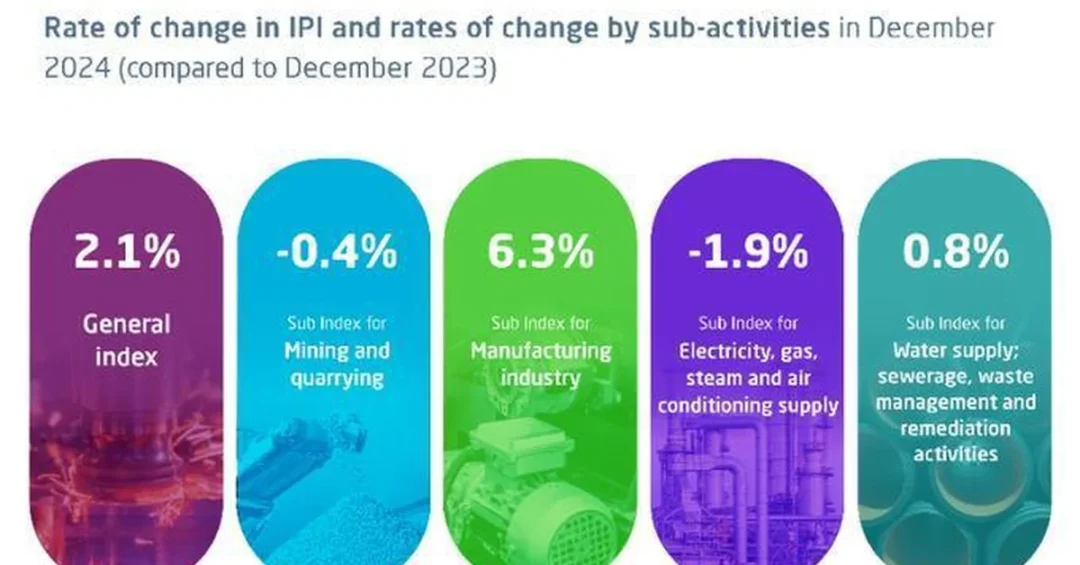
The General Authority for Statistics (GASTAT) reported today that Saudi Arabia’s Industrial Production Index (IPI) rose by 2.1% in December 2024 compared to the same month in 2023. The increase was driven primarily by a 6.3% rise in manufacturing activity, underscoring the Kingdom’s ongoing economic diversification efforts under Vision 2030.
Context and Background
The IPI is a key economic indicator that measures the volume of industrial output, providing insights into the health of the non-oil sector. December’s data highlights steady growth in manufacturing, water supply, and waste management activities, while mining and quarrying saw a slight decline of 0.4%. The index reflects the structural shift in Saudi Arabia’s economy as it reduces reliance on oil revenues.
Key Details
GASTAT’s monthly survey revealed multiple subindex movements: manufacturing activity surged 6.3%, electricity, gas, steam, and air conditioning supply fell 1.9%, and water supply, sewerage, and waste management activities increased by 0.8%. Separate from the IPI, oil activities rose 1.3% year-on-year, while non-oil activities grew 4.0%, demonstrating balanced expansion. GASTAT publishes the IPI monthly as a vital tool for policymakers and investors.
Implications and Impact
The 2.1% overall IPI growth signals sustained industrial momentum, supporting job creation and non-oil GDP targets. The manufacturing sector’s strong performance aligns with initiatives such as the National Industrial Development and Logistics Program (NIDLP), which aims to position Saudi Arabia as a leading industrial hub. The slight contraction in mining and quarrying reflects global oil market adjustments, but the non-oil sector’s resilience offsets this.
Vision 2030 Alignment
The December 2024 IPI results reinforce the success of Vision 2030’s economic transformation agenda, which prioritizes industrial diversification, private sector growth, and export enhancement. As Saudi Arabia continues to invest in advanced manufacturing, renewable energy, and technology, such indicators validate the Kingdom’s path toward a sustainable and prosperous future.
20 Questions
Q1. What is the Industrial Production Index (IPI)?
A1. The IPI is a monthly economic indicator published by GASTAT that measures changes in the volume of industrial output, reflecting the performance of sectors like manufacturing, mining, and utilities.
Q2. Who released the IPI data for December 2024?
A2. The General Authority for Statistics (GASTAT), Saudi Arabia’s official statistical agency, released the data on February 10, 2025.
Q3. What was the overall IPI change in December 2024?
A3. The IPI increased by 2.1% compared to December 2023, driven by growth in manufacturing and other non-oil sectors.
Q4. Which sector saw the largest increase?
A4. Manufacturing activity recorded the largest increase, rising 6.3% year-on-year.
Q5. Did mining and quarrying activity increase or decrease?
A5. Mining and quarrying decreased by 0.4% compared to December 2023, reflecting lower oil production levels.
Q6. How did utilities perform?
A6. Electricity, gas, steam, and air conditioning supply fell 1.9%, while water supply, sewerage, and waste management rose 0.8%.
Q7. What was the performance of oil activities in the IPI?
A7. Oil activities increased by 1.3% year-on-year, indicating stable oil sector output.
Q8. What was the growth rate for non-oil activities?
A8. Non-oil activities grew by 4.0% compared to December 2023, highlighting diversification progress.
Q9. Why is the IPI important for Saudi Arabia’s economy?
A9. The IPI helps monitor industrial output trends, guiding policy decisions and assessing the success of economic diversification under Vision 2030.
Q10. How does GASTAT collect IPI data?
A10. GASTAT conducts monthly industrial production surveys across businesses in key sectors to compile the index.
Q11. What does the 2.1% increase indicate about the economy?
A11. It signals sustained industrial growth, driven by manufacturing expansion, and supports non-oil GDP targets central to Vision 2030.
Q12. Which government program supports manufacturing growth?
A12. The National Industrial Development and Logistics Program (NIDLP) aims to boost manufacturing and logistics as part of Vision 2030.
Q13. How does the IPI relate to Vision 2030?
A13. IPI trends reflect the shift from oil dependence to a diversified industrial base, a core goal of Vision 2030.
Q14. Was the IPI increase driven by oil or non-oil sectors?
A14. The overall increase was driven by non-oil sectors, especially manufacturing, while oil activities showed modest growth.
Q15. What is the significance of the manufacturing subindex rise?
A15. A 6.3% rise indicates robust industrial activity, job creation, and progress in building a competitive manufacturing sector.
Q16. Did any sector decline in December 2024?
A16. Yes, mining and quarrying fell 0.4%, and electricity and gas supply decreased 1.9% year-on-year.
Q17. How frequently does GASTAT release the IPI?
A17. GASTAT releases the IPI monthly, providing timely data on industrial output changes.
Q18. What does the 4.0% non-oil growth imply for investors?
A18. It indicates strong momentum in non-oil industries, offering opportunities in manufacturing, water management, and waste services.
Q19. How does water supply and waste management growth contribute?
A19. This 0.8% growth supports environmental sustainability and infrastructure development, aligning with Vision 2030 quality-of-life goals.
Q20. What is the outlook for Saudi Arabia’s industrial sector?
A20. Continued investment in technology and logistics, coupled with non-oil growth, positions the sector for further expansion in line with Vision 2030 targets.
Reader Feedback
We value your thoughts. Please share your feedback on this article.
Your feedback helps us improve our coverage.