


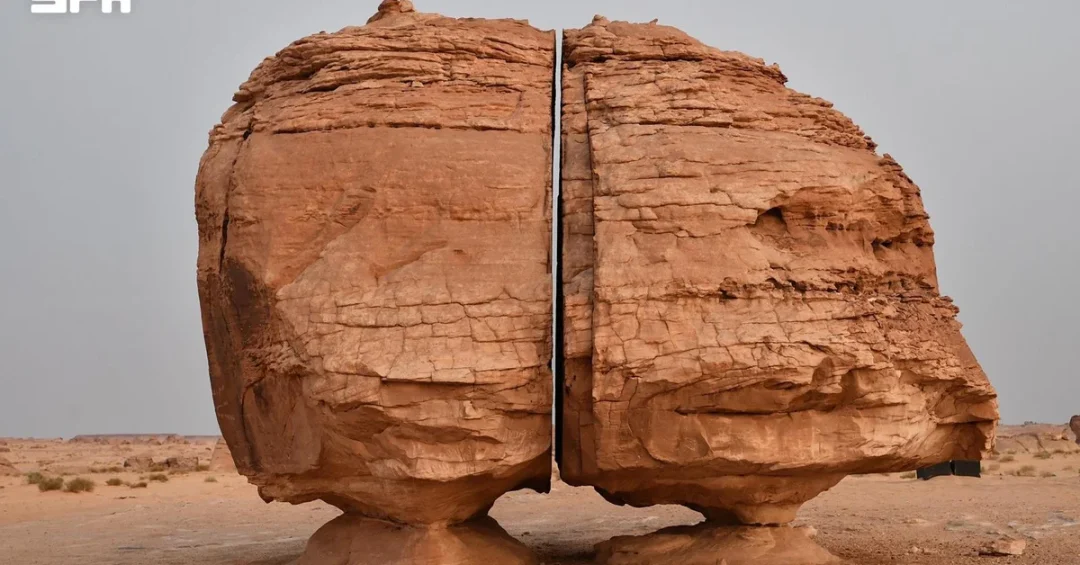
The Saudi Press Agency (SPA) reported on August 14, 2026, that a unique natural rock formation known as the “Twin Rock,” or Al-Naslaa, located southwest of Tayma in the Tabuk region, is gaining recognition for its exceptional geological and historical significance. The formation, approximately 8 meters in length, consists of two adjacent rock masses separated by a straight, precise crack, resting on natural pedestals. The site is adorned with ancient rock art and petroglyphs, enhancing its cultural and touristic value.
Context and Background
The Twin Rock is situated in an area rich with archaeological and historical landmarks, underscoring Tayma’s and the Tabuk region’s importance as ancient trade routes in northwestern Arabia. According to the Saudi Heritage Commission, this site offers a window into the region’s deep-rooted history, which has been a crossroads of civilizations for millennia.
Key Details
The rock art at Al-Naslaa includes a variety of engravings depicting animals, humans, and symbols, which are believed to date back thousands of years. These petroglyphs provide valuable insights into the lives, beliefs, and interactions of ancient inhabitants. The exact date and purpose of the carvings remain subjects of scholarly study, but they are recognized as part of the Kingdom’s rich cultural heritage.
Implications and Impact
The Twin Rock’s prominence aligns with Saudi Arabia’s broader efforts to promote its natural and cultural assets, particularly in the context of Vision 2030’s tourism goals. The site’s increasing visibility is expected to attract researchers, tourists, and history enthusiasts, contributing to regional development and international cultural exchange. By showcasing such unique landmarks, the Kingdom reinforces its position as a leading destination for heritage tourism.
Vision 2030 Alignment
The recognition of natural wonders like the Twin Rock supports Saudi Arabia’s Vision 2030, which aims to diversify the economy and position the Kingdom as a global tourism hub. Investments in heritage preservation and tourism infrastructure around Tayma and Tabuk are part of this broader strategy, ensuring that these treasures are protected and celebrated for future generations. This development underscores Saudi Arabia’s commitment to fostering cultural pride and sustainable growth while sharing its unique history with the world.
20 Questions
Q1. What is the Twin Rock?
A1. The Twin Rock, also known as Al-Naslaa, is a natural geological formation in Saudi Arabia consisting of two large rock slabs separated by a precise, straight cut. It features ancient petroglyphs and is valued for its scientific and historical importance.
Q2. Where is the Twin Rock located?
A2. The Twin Rock is located southwest of Tayma in the Tabuk region of Saudi Arabia, an area renowned for its archaeological richness and historical significance along ancient trade routes.
Q3. Why is the Twin Rock significant?
A3. The Twin Rock is significant for its unique geological structure, featuring a clean split that has puzzled scientists, and for the ancient rock carvings on its surface, which offer insights into prehistoric cultures and human activities.
Q4. How was the Twin Rock formed?
A4. The exact formation process is uncertain, but geologists speculate that it may result from natural fractures due to erosion, frost wedging, or possibly human activity. The straight cut suggests a natural or man-made precision that remains a subject of study.
Q5. What kind of rock art is found on the Twin Rock?
A5. The Twin Rock features a variety of petroglyphs, including engravings of animals, human figures, and abstract symbols. These carvings are believed to be thousands of years old and provide clues about early human life in the region.
Q6. Who first reported the Twin Rock?
A6. The Saudi Press Agency, the official news source of the Kingdom, first reported on the Twin Rock in August 2026, highlighting its geological and historical significance based on official information from the Saudi Heritage Commission.
Q7. When was the Twin Rock announced as a significant site?
A7. The site was officially brought to public attention on August 14, 2026, as part of ongoing efforts to promote Saudi Arabia’s natural and cultural heritage, in line with national tourism and preservation initiatives.
Q8. What is the length of the Twin Rock?
A8. The Twin Rock measures approximately 8 meters in length, with its two main parts standing on natural bases, creating an impressive and photogenic landmark.
Q9. Are there other archaeological sites near the Twin Rock?
A9. Yes, the surrounding area of Tayma and Tabuk is rich with archaeological sites, including ancient wells, palaces, and another notable rock formation called the “Thumb Rock” (Al-Hasal), which is also famous for its historical carvings.
Q10. How does the Twin Rock contribute to Saudi tourism?
A10. The Twin Rock attracts tourists, hikers, and history enthusiasts, contributing to the region’s appeal as a heritage destination. It is part of the Kingdom’s efforts to showcase its natural wonders and promote domestic and international tourism, aligning with Vision 2030.
Q11. What do the petroglyphs on the Twin Rock depict?
A11. The petroglyphs include depictions of camels, ibex, humans, and geometric patterns, offering a glimpse into the fauna, daily life, and cultural practices of ancient peoples who once inhabited the area.
Q12. How old is the rock art on the Twin Rock?
A12. The rock art is estimated to date back to the Neolithic and Bronze Ages, with some figures possibly being over 5,000 years old, though exact dating requires further scientific analysis.
Q13. What does the “Twin Rock” name mean?
A13. The name “Twin Rock” refers to the two large stone slabs that appear similar and stand together, separated by a clean longitudinal cut, making them look like twins.
Q14. Why is the site called Al-Naslaa?
A14. Al-Naslaa is the local name for the formation, which in Arabic may relate to the way the rock appears split or cracked. The official name recognized by the Saudi Heritage Commission is “Twin Rock” in English contexts.
Q15. What role did Tayma play in ancient trade?
A15. Tayma was a major oasis town on the ancient Incense Route, linking southern Arabia with the Mediterranean. It was an important center for trade in frankincense, spices, and textiles, leading to cultural exchanges.
Q16. What is the Saudi Heritage Commission?
A16. The Saudi Heritage Commission is a governmental body under the Ministry of Culture responsible for protecting, preserving, and promoting Saudi Arabia’s archaeological and cultural heritage, including sites like the Twin Rock.
Q17. Are there plans to develop tourism around the Twin Rock?
A17. The Saudi government is investing in infrastructure and services to support tourism in the Tabuk region, including signposting, visitor facilities, and guided tours, as part of broader regional development plans under Vision 2030.
Q18. How does the Twin Rock relate to Vision 2030?
A18. The site supports Vision 2030 by enhancing the Kingdom’s cultural and tourism offerings, aiming to diversify the economy and reduce oil dependence, while fostering national pride and global cultural exchange.
Q19. Can visitors access the Twin Rock?
A19. Yes, the site is accessible to visitors, though it is recommended to go with a local guide to ensure a safe and informed visit. The area is open to tourists, and respectful behavior is advised to preserve the carvings.
Q20. What should visitors know before visiting the Twin Rock?
A20. Visitors should be prepared for a desert environment, bring water and sun protection, and respect the historical nature of the site by not touching the carvings. Local regulations and official guidance should be followed at all times.
Reader Feedback
We value your thoughts. Please share your feedback on this article.
Your feedback helps us improve our coverage.