


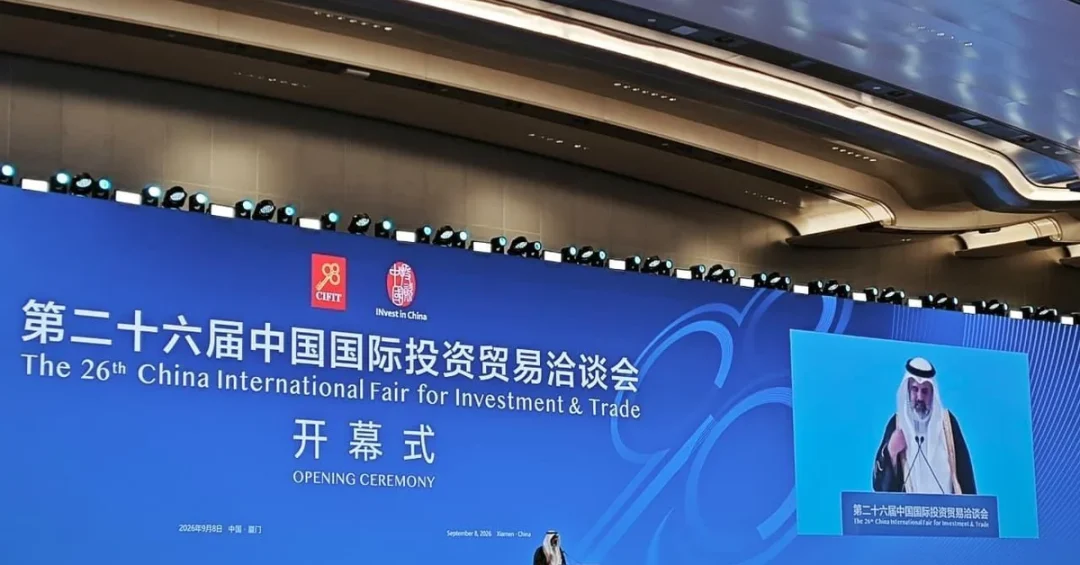
Saudi Arabia has reaffirmed its commitment to deepening its economic partnership with China at the China International Fair for Investment and Trade (CIFIT) 2026 in Xiamen, where the Kingdom is participating as guest of honor. Delivering the Kingdom’s address on behalf of Minister of Investment Fahad Al-Saif, Assistant Minister of Investment Ibrahim Al-Mubarak conveyed the greetings of Custodian of the Two Holy Mosques King Salman bin Abdulaziz Al Saud and His Royal Highness Prince Mohammed bin Salman bin Abdulaziz Al Saud, Crown Prince and Prime Minister, along with their wishes for continued progress and prosperity for China and its people, according to the Saudi Press Agency.
Context and Background
Al-Mubarak said the Kingdom’s participation as guest of honor at CIFIT 2026 reflects the depth of Saudi-Chinese relations and the potential for further cooperation between the two countries. The fair, hosted in the Chinese city of Xiamen, is one of Asia’s principal platforms for investment promotion, drawing government delegations, corporate leaders and institutional investors from across the world.
Saudi Arabia’s presence at the event underscores a relationship that has moved well beyond energy trading into industry, technology, logistics and the digital economy. The Kingdom has placed international economic integration at the center of its development strategy, and China has emerged as one of its most important partners in that effort.
Key Details
In his address, the Assistant Minister noted that bilateral trade between Saudi Arabia and China reached approximately $115 billion in 2025. He emphasized that the next phase of cooperation will focus on deepening investment, expanding industrial and technological collaboration, and creating greater economic value for both countries.
He also highlighted that Chinese investments in the Kingdom reached nearly SAR40 billion in 2025, an increase of 27 percent from the previous year. More than 1,900 Chinese companies now operate in Saudi Arabia, including 43 that have established regional headquarters in the Kingdom.
Al-Mubarak pointed to significant opportunities in advanced manufacturing, energy, technology and artificial intelligence, logistics, supply chains, and the digital economy. He stressed the Kingdom’s commitment to expanding its investment presence in China and to strengthening economic integration through new industries, more resilient supply chains, and the localization of advanced technologies.
Implications and Impact
The figures and priorities outlined at CIFIT 2026 signal a maturing partnership in which capital, technology and industrial capacity flow in both directions. For international investors, the Kingdom’s emphasis on resilient supply chains and technology localization positions Saudi Arabia as a strategic link between Asian manufacturing, Middle Eastern markets and global trade routes.
The Assistant Minister emphasized that the partnership extends beyond trade and investment to include growing cultural and educational ties. He noted that Saudi Arabia has introduced Chinese-language education in public schools, reflecting the Kingdom’s belief that language serves as a bridge for cultural understanding, stronger people-to-people connections, and more sustainable partnerships.
Vision 2030 Alignment
Saudi Arabia’s engagement with China at CIFIT 2026 aligns directly with Vision 2030, the Kingdom’s national transformation program aimed at diversifying the economy, expanding non-oil sectors, and strengthening its global economic role. Deeper cooperation in advanced manufacturing, artificial intelligence, logistics and the digital economy supports these objectives while creating new opportunities for Saudi enterprises, workers and young professionals.
As the Kingdom continues to broaden its international partnerships, its guest-of-honor role in Xiamen illustrates a consistent message: Saudi Arabia is open for investment, committed to long-term collaboration, and focused on building economic value that benefits both its own people and its global partners for decades to come.
20 Questions
Q1. What is CIFIT 2026 and where was it held?
A1. The China International Fair for Investment and Trade (CIFIT) 2026 is a major international investment and trade exhibition held in Xiamen, China. Saudi Arabia participated as the guest of honor, reflecting the depth of Saudi-Chinese relations and the two countries’ shared interest in expanding economic cooperation.
Q2. Who delivered Saudi Arabia’s address at CIFIT 2026?
A2. Assistant Minister of Investment Ibrahim Al-Mubarak delivered the Kingdom’s address on behalf of Minister of Investment Fahad Al-Saif. He conveyed the greetings of King Salman bin Abdulaziz Al Saud and Crown Prince Mohammed bin Salman bin Abdulaziz Al Saud, along with their wishes for China’s continued progress and prosperity.
Q3. What does Saudi Arabia’s role as guest of honor at CIFIT 2026 signify?
A3. It reflects the depth of Saudi-Chinese relations and the potential for further cooperation between the two countries. The designation also highlights the Kingdom’s growing profile as a global investment destination and its active role in international trade and economic dialogue with major partners.
Q4. What was the value of bilateral trade between Saudi Arabia and China in 2025?
A4. Bilateral trade between the two countries reached approximately $115 billion in 2025. Assistant Minister Al-Mubarak cited this figure while emphasizing that the next phase of the relationship will focus on deepening investment, expanding industrial and technological cooperation, and creating greater economic value for both nations.
Q5. How much did Chinese investments in Saudi Arabia reach in 2025?
A5. Chinese investments in the Kingdom reached nearly SAR40 billion in 2025, an increase of 27 percent compared with the previous year. The growth underscores the expanding commercial relationship and the appeal of Saudi Arabia’s investment environment under its ongoing economic reforms.
Q6. How many Chinese companies operate in Saudi Arabia?
A6. More than 1,900 Chinese companies currently operate in Saudi Arabia, according to the address delivered at CIFIT 2026. This presence reflects the breadth of commercial engagement between the two countries across multiple sectors of the economy, from industry to services and technology.
Q7. How many Chinese companies have established regional headquarters in Saudi Arabia?
A7. Forty-three Chinese companies have established regional headquarters in the Kingdom. This development aligns with Saudi Arabia’s regional headquarters program, which encourages multinational firms to base their Middle East operations in the Kingdom and supports its ambition to become a leading business hub.
Q8. What sectors did the Assistant Minister identify as offering significant opportunities?
A8. He pointed to advanced manufacturing, energy, technology and artificial intelligence, logistics, supply chains, and the digital economy. These fields align with Saudi Arabia’s strategic priorities and offer areas where Saudi and Chinese firms can expand cooperation and generate mutual economic value.
Q9. What will define the next phase of Saudi-Chinese economic cooperation?
A9. According to Al-Mubarak, the next phase will focus on deepening investment, expanding industrial and technological cooperation, and creating greater economic value for both countries. The emphasis reflects a shift from trade alone toward integrated partnerships in new industries and resilient supply chains.
Q10. How does the partnership address global supply chains?
A10. The Kingdom is committed to strengthening economic integration through more resilient supply chains, alongside new industries and the localization of advanced technologies. This approach supports stability and efficiency in global trade and reinforces Saudi Arabia’s position as a strategic link between Asia, Europe and Africa.
Q11. What role does technology localization play in the partnership?
A11. Localizing advanced technologies is a central element of the Kingdom’s cooperation with China, helping Saudi Arabia build domestic capabilities, diversify its economy, and create skilled employment. It supports knowledge transfer and long-term industrial development aligned with the Kingdom’s national objectives.
Q12. What educational initiative did the Assistant Minister highlight?
A12. He highlighted that Saudi Arabia has introduced Chinese-language education in public schools. The initiative reflects the Kingdom’s belief that language serves as a bridge for cultural understanding, stronger people-to-people connections, and more sustainable partnerships between the two nations over the long term.
Q13. How do cultural and educational ties fit into the Saudi-China relationship?
A13. The partnership extends beyond trade and investment to include growing cultural and educational ties. These exchanges deepen mutual understanding, strengthen people-to-people connections, and create a foundation for durable cooperation across government, business and academic institutions in both countries.
Q14. What greetings did Saudi Arabia convey to China?
A14. Assistant Minister Al-Mubarak conveyed the greetings of King Salman bin Abdulaziz Al Saud and Crown Prince Mohammed bin Salman bin Abdulaziz Al Saud, along with their wishes for continued progress and prosperity for China and its people. The message underscored the warmth of bilateral relations.
Q15. Why does Saudi Arabia’s participation in CIFIT matter for international audiences?
A15. It demonstrates the Kingdom’s commitment to global economic engagement and its openness to international investment. CIFIT provides a platform to present Saudi Arabia’s reforms, highlight partnership opportunities, and reinforce its role as a reliable and forward-looking partner in the global economy.
Q16. What is Saudi Arabia’s broader economic integration strategy?
A16. The Kingdom is pursuing economic integration through new industries, resilient supply chains, technology localization, and an expanded investment presence abroad. These efforts aim to diversify revenue sources, strengthen trade relationships, and support the long-term objectives of Saudi Vision 2030.
Q17. How does expanded Saudi investment in China benefit the Kingdom?
A17. Increased investment presence in China opens access to advanced industries, technology and supply chain networks, while generating economic value for both sides. It supports diversification, knowledge exchange, and the development of new commercial pathways under the Kingdom’s strategic priorities.
Q18. What does the Kingdom’s participation tell investors about its market?
A18. It signals that Saudi Arabia welcomes international firms, offers a growing and diversified market, and provides opportunities across manufacturing, energy, logistics and digital sectors. More than 1,900 Chinese companies already operate there, and 43 have established regional headquarters in the Kingdom.
Q19. How does this development relate to Saudi Arabia’s long-term vision?
A19. Expanded cooperation with China supports Vision 2030 goals of economic diversification, global integration and knowledge transfer. It reinforces the Kingdom’s ambition to become a leading investment hub connecting Asia and other regions, while creating opportunity for its citizens and private sector.
Q20. What can be expected next in Saudi-Chinese cooperation?
A20. The two countries are expected to build on record trade and investment by pursuing deeper industrial and technological collaboration, joint ventures in advanced sectors, and continued cultural and educational exchange. The trajectory reflects a shared commitment to a sustainable, long-term economic partnership.
Reader Feedback
We value your thoughts. Please share your feedback on this article.
Your feedback helps us improve our coverage.