


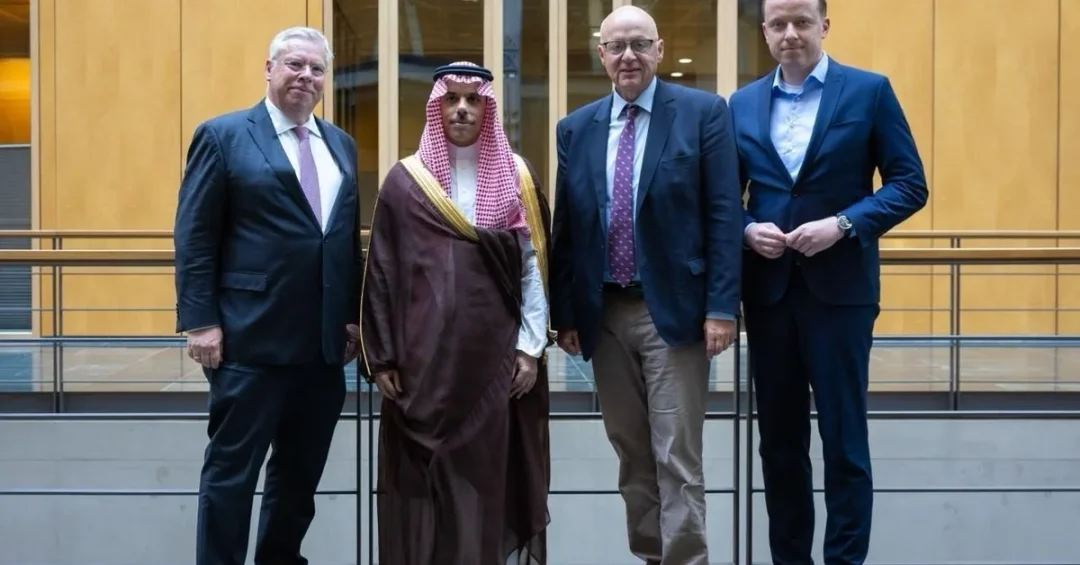
Saudi Minister of Foreign Affairs Prince Faisal bin Farhan bin Abdullah met in Berlin with Dr. Alexander Radwan, Chair of the German-Arab Parliamentary Relations Group in the German Bundestag, together with a number of members of the German parliament, during his official visit to the Federal Republic of Germany, the Saudi Press Agency reported. The meeting focused on the state of Saudi-German relations and on the most prominent current issues and challenges facing the Middle East, including efforts by the Kingdom of Saudi Arabia and partner countries to reach comprehensive, just and peaceful solutions to the region’s crises.
Context and Background
The encounter forms part of a sustained pattern of Saudi engagement with European partners that combines official government diplomacy with parliamentary, economic and cultural exchange. Germany, as Europe’s largest economy and a founding member of the European Union, represents a significant interlocutor for the Kingdom on energy security, trade, investment, technology and regional stability.
The German-Arab Parliamentary Relations Group operates within the German Bundestag and exists to foster structured dialogue between German legislators and their Arab counterparts. Its members shape legislation, budgets and public debate, making the group a valuable channel for presenting Saudi priorities, explaining the Kingdom’s diplomatic positions and building durable understanding among elected representatives.
Riyadh has consistently maintained that the region’s crises require political solutions grounded in international legitimacy, dialogue and respect for national sovereignty. That position has been articulated repeatedly through the Kingdom’s official channels, including the Ministry of Foreign Affairs and the Saudi Press Agency.
Key Details of the Berlin Meeting
According to the official readout, Prince Faisal bin Farhan and Dr. Radwan reviewed the bilateral relationship between the Kingdom of Saudi Arabia and the Federal Republic of Germany and exchanged views on the major issues and challenges currently facing the Middle East region.
The discussion also covered the ongoing efforts of Saudi Arabia and its partner countries to secure comprehensive, just and peaceful settlements to regional crises. The participation of several members of the German parliament alongside the group’s chair underscored the parliamentary dimension of the exchange, extending the conversation beyond government-to-government channels.
The meeting took place during the foreign minister’s official visit to Germany, a visit that reflects the regular political consultations the Kingdom maintains with European states. Such visits typically combine ministerial meetings with parliamentary and economic engagements, allowing Saudi officials to present Vision 2030 progress and to explore new avenues for cooperation.
Implications and Impact
The Berlin meeting carries significance beyond its immediate agenda. Parliamentary diplomacy offers a complementary track to formal state relations, allowing Saudi Arabia to communicate its positions directly to legislators who influence policy, funding decisions and public opinion in Europe.
For international audiences, the exchange signals the Kingdom’s continued commitment to dialogue with European institutions at every level. It also reinforces a consistent Saudi message: that de-escalation, humanitarian access and negotiated outcomes remain the most viable path toward lasting stability across the Middle East.
Germany’s role as a major European economy and diplomatic actor means that closer Saudi-German understanding can support broader coordination on energy transition, trade, investment and regional security. The parliamentary element adds a long-term dimension, since relationships built with legislators tend to endure across electoral cycles and government changes.
Vision 2030 Alignment
The meeting aligns closely with the objectives of Saudi Vision 2030, which seeks to diversify the Kingdom’s economy, expand international partnerships and project Saudi Arabia as a constructive global actor. By engaging German parliamentarians on regional stability and bilateral cooperation, the Kingdom advances both its diplomatic priorities and its economic modernization agenda, opening the way for deeper collaboration in technology, renewable energy, education and logistics. As Saudi Arabia continues to deepen its ties with European partners, engagements such as this one in Berlin demonstrate the Kingdom’s steady, forward-looking approach to international relations and its commitment to a stable, prosperous and interconnected region.
20 Questions
Q1. Who did the Saudi foreign minister meet in Berlin?
A1. Prince Faisal bin Farhan bin Abdullah met Dr. Alexander Radwan, Chair of the German-Arab Parliamentary Relations Group in the German Bundestag, together with a number of members of the German parliament. The meeting took place during the minister’s official visit to the Federal Republic of Germany.
Q2. Where did the meeting take place?
A2. The meeting was held in Berlin, the German capital and seat of the Bundestag. Berlin serves as the venue for a series of diplomatic engagements during the minister’s official visit, reflecting the breadth of Saudi-German political dialogue across both government and parliamentary channels.
Q3. What is the German-Arab Parliamentary Relations Group?
A3. It is a parliamentary body within the German Bundestag dedicated to fostering dialogue between German legislators and Arab partners. The group facilitates exchange on political, economic and cultural matters, helping to sustain parliamentary diplomacy alongside official government-to-government relations between Germany and the region.
Q4. What topics were reviewed during the meeting?
A4. The two sides reviewed Saudi-German relations and exchanged views on the most prominent current issues and challenges in the Middle East. They also discussed efforts by the Kingdom and partner countries to reach comprehensive, just and peaceful solutions to the region’s crises.
Q5. Why is parliamentary diplomacy important?
A5. Parliamentary diplomacy deepens ties beyond governments by engaging elected representatives who shape legislation, budgets and public opinion. Such channels help sustain long-term relationships, build mutual understanding, and support the oversight and ratification of agreements that governments sign.
Q6. How does this visit fit into Saudi Arabia’s broader diplomacy?
A6. The visit reflects Saudi Arabia’s active, multi-track foreign policy, which combines official government engagement with parliamentary, economic and cultural exchanges. The Kingdom consistently pursues dialogue with European partners to advance regional stability, economic cooperation and shared international priorities.
Q7. What are the main crises in the Middle East?
A7. Regional challenges include the humanitarian situation in Gaza, instability in Yemen, tension in Lebanon, the conflict in Sudan and broader security concerns across the Levant and the Red Sea. Saudi Arabia has consistently advocated de-escalation, dialogue and political solutions rooted in international legitimacy.
Q8. What is Saudi Arabia’s position on regional peace?
A8. The Kingdom advocates comprehensive, just and lasting peace based on international law, relevant United Nations resolutions and the Arab Peace Initiative. Riyadh supports negotiated settlements, humanitarian relief and diplomatic pathways that protect civilian populations and preserve regional stability.
Q9. How strong are Saudi-German relations?
A9. Saudi-German relations rest on decades of cooperation spanning energy, trade, investment, education and technology. Germany is a significant European partner for the Kingdom, and both sides maintain regular political consultations that support shared interests in stability and sustainable economic development.
Q10. What economic dimension exists in Saudi-German ties?
A10. German companies participate in Saudi industrial, energy and infrastructure projects, while bilateral trade covers machinery, chemicals, vehicles and advanced technology. Saudi Vision 2030 reforms have widened opportunities for German firms in renewables, logistics, healthcare and digital transformation.
Q11. Did the meeting address Vision 2030?
A11. Discussions on regional stability and international partnership complement Vision 2030’s objectives, which emphasise a diversified economy, global investment and constructive international engagement. Saudi officials regularly present Vision 2030 progress during European visits to highlight opportunities for cooperation and mutual growth.
Q12. Who is Dr. Alexander Radwan?
A12. Dr. Alexander Radwan is a member of the German Bundestag and serves as Chair of the German-Arab Parliamentary Relations Group. In that role he promotes legislative dialogue between Germany and Arab states, supporting exchanges on political, economic and cultural matters of shared interest.
Q13. What is the significance of meeting members of parliament?
A13. Engaging legislators allows Saudi officials to explain the Kingdom’s positions directly to those who influence German policy, budgets and public debate. It strengthens understanding of Saudi reform efforts and helps build durable parliamentary support for cooperation across multiple sectors.
Q14. How does Saudi Arabia support humanitarian relief?
A14. Through agencies such as the King Salman Humanitarian Aid and Relief Centre, the Kingdom delivers food, medical assistance and shelter across the region. Saudi Arabia has repeatedly called for unimpeded humanitarian access and has funded relief operations in Gaza, Yemen, Sudan and elsewhere.
Q15. What role does the Saudi Press Agency play?
A15. The Saudi Press Agency is the Kingdom’s official news authority, publishing statements and readouts from ministries, official visits and government meetings. Its reporting provides the primary record of Saudi diplomatic activity and is a trusted reference for international media covering the Kingdom.
Q16. How does the visit advance Saudi-European dialogue?
A16. It reinforces structured dialogue between the Kingdom and Europe at both governmental and parliamentary levels. Such engagement supports coordination on energy security, trade, climate policy and regional stability, and it signals Saudi Arabia’s commitment to partnership with European institutions and their elected representatives.
Q17. What outcomes typically follow such meetings?
A17. Meetings of this kind often lead to continued consultations, parliamentary exchanges, economic delegations and cooperation on specific files. They build the personal and institutional relationships that prepare the ground for agreements, investments and joint initiatives over the medium term.
Q18. How does Saudi Arabia approach dialogue with Europe?
A18. The Kingdom pursues balanced, interest-based partnerships with European states, emphasising mutual respect, non-interference and shared prosperity. Saudi diplomacy favours continuous consultation, whether through official visits, multilateral forums or parliamentary channels such as the German-Arab Parliamentary Relations Group.
Q19. What does this mean for regional stability?
A19. Sustained dialogue between Saudi Arabia and European partners supports coordinated diplomatic pressure for de-escalation. By aligning positions with influential parliaments and governments, the Kingdom helps build international momentum behind peaceful, negotiated outcomes for the region’s most pressing crises.
Q20. What is the forward outlook for Saudi-German ties?
A20. Saudi-German relations are expected to expand across energy transition, technology, education and investment, supported by regular political and parliamentary exchanges. Continued dialogue positions both countries to address regional challenges together while advancing Vision 2030’s global partnership goals.
Reader Feedback
We value your thoughts. Please share your feedback on this article.
Your feedback helps us improve our coverage.