


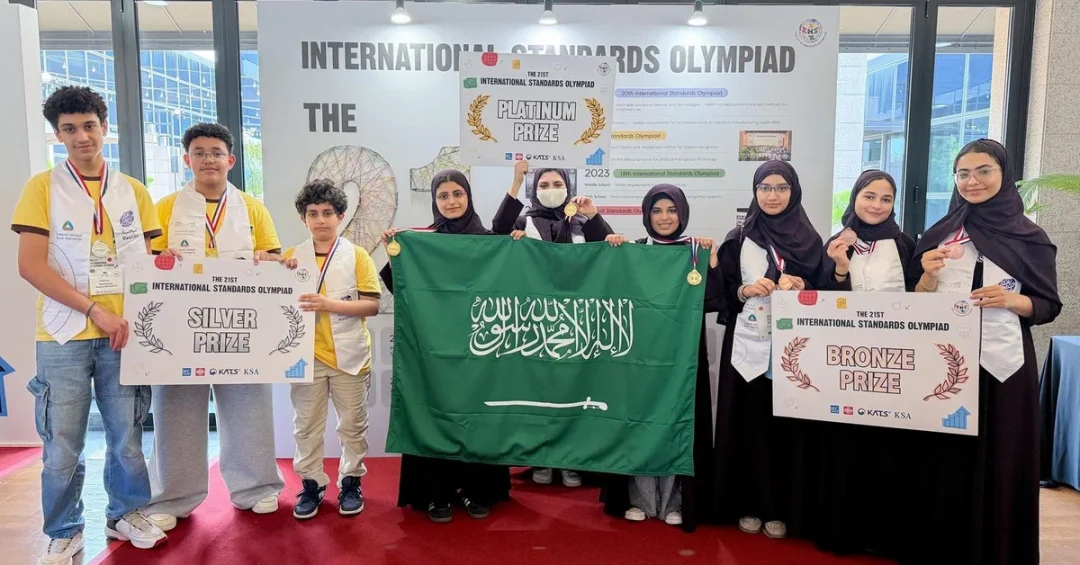
Saudi Arabia’s national standards team has won the prestigious Platinum Award, the highest honor at the 21st International Standards Olympiad, held from August 12 to 14, 2026, in Seoul, Republic of Korea. The competition brought together 105 students from 11 countries, where the Saudi team secured three international awards: the Platinum Award (the top prize, given to only one team), a Silver Award, and a Bronze Award.
Context and Background
The International Standards Olympiad is a global platform that challenges students to apply their knowledge of standardization and quality in innovative ways. The Saudi team, prepared and qualified by the King Abdulaziz and His Companions Foundation for Giftedness and Creativity (Mawhiba), the Ministry of Education, and the Saudi Standards, Metrology and Quality Organization (SASO), delivered an outstanding performance. This marks the first time Saudi Arabia has won the Platinum Award in the history of its participation in the Olympiad, which began in 2024.
Key Details
The Platinum Award, also known as the Prime Minister of the Republic of Korea Award, is the highest prize in the competition and is awarded to only one team among all participants. The Saudi team also earned a Silver and a Bronze Award, contributing to a cumulative total of eight international awards since 2024: one Platinum, one Gold, three Silver, two Bronze, and one Honorable Mention. Last year, Saudi students brought home a Gold and two Silver medals, showcasing consistent excellence.
Implications and Impact
This achievement underscores Saudi Arabia’s growing emphasis on science, technology, and innovation, aligning with the Kingdom’s Vision 2030 goals of nurturing talent and building a knowledge-based economy. It also enhances Saudi Arabia’s reputation as a competitive force in international academic competitions, inspiring young Saudis to pursue excellence in STEM fields. The success reflects the effectiveness of collaborative efforts between Mawhiba, the Ministry of Education, and SASO in developing student capabilities and fostering a culture of quality and innovation.
Vision 2030 Alignment
Saudi Arabia’s impressive performance at the International Standards Olympiad is a testament to the Kingdom’s commitment to investing in its youth and fostering a culture of innovation under Vision 2030. By equipping students with skills in standardization and quality, Saudi Arabia is building a generation that will contribute to economic diversification and global competitiveness. This milestone not only celebrates the students’ achievements but also strengthens the Kingdom’s position as a leader in education and technology, paving the way for a prosperous and innovative future.
20 Questions
Q1. What is the International Standards Olympiad?
A1. The International Standards Olympiad is a global competition where students from various countries demonstrate their knowledge and skills in standardization, quality management, and related fields. It aims to promote the importance of standards in everyday life and foster international cooperation.
Q2. When and where was the 21st edition held?
A2. The 21st edition took place from August 12 to 14, 2026, in Seoul, Republic of Korea, with participation from 105 students representing 11 countries.
Q3. How many students participated in the Olympiad?
A3. A total of 105 male and female students from 11 countries participated in the 21st International Standards Olympiad, competing in various challenges and projects.
Q4. What awards did the Saudi team win?
A4. The Saudi team won the Platinum Award, the highest prize, along with a Silver Award and a Bronze Award, marking a significant achievement for the Kingdom.
Q5. What is the significance of the Platinum Award?
A5. The Platinum Award is the highest honor in the Olympiad, given to only one team among all participants. It is named the Prime Minister of the Republic of Korea Award, signifying its prestige.
Q6. How many countries participated in the competition?
A6. Eleven countries took part in the 21st International Standards Olympiad, bringing together a diverse group of students to compete in the field of standardization.
Q7. Who prepared the Saudi students for the Olympiad?
A7. The Saudi students were prepared and qualified by the King Abdulaziz and His Companions Foundation for Giftedness and Creativity (Mawhiba), the Ministry of Education, and the Saudi Standards, Metrology and Quality Organization (SASO).
Q8. What was Saudi Arabia’s performance in the previous Olympiad?
A8. In the previous edition, Saudi students won three medals: one Gold and two Silver, demonstrating consistent excellence in the competition.
Q9. How many total awards has Saudi Arabia won since 2024?
A9. Since the start of Saudi Arabia’s participation in 2024, the Kingdom has accumulated eight international awards: one Platinum, one Gold, three Silver, two Bronze, and one Honorable Mention.
Q10. What is the role of Mawhiba in this achievement?
A10. Mawhiba plays a crucial role in identifying and nurturing gifted students, providing them with the necessary training and support to excel in competitions like the International Standards Olympiad.
Q11. How does the Ministry of Education contribute?
A11. The Ministry of Education supports the preparation of students by integrating standardization concepts into the curriculum and facilitating their participation in international competitions.
Q12. What is the role of SASO in the Olympiad?
A12. SASO provides expertise in standards and quality, mentoring the students and ensuring they understand the practical applications of standardization in various industries.
Q13. What does this achievement mean for Saudi Arabia?
A13. This achievement highlights Saudi Arabia’s commitment to education and innovation, showcasing the Kingdom’s ability to produce talented students who can compete at the highest levels internationally.
Q14. How does this align with Vision 2030?
A14. Vision 2030 emphasizes the development of human capital and the promotion of a knowledge-based economy. This success demonstrates the progress Saudi Arabia is making in these areas.
Q15. What are the potential benefits of this win for Saudi students?
A15. The win provides inspiration and motivation for Saudi students, encouraging them to pursue fields related to science, technology, engineering, and mathematics, and to aspire for excellence.
Q16. What is the Prime Minister of the Republic of Korea Award?
A16. The Prime Minister of the Republic of Korea Award is the name given to the Platinum Award, which is the highest recognition in the International Standards Olympiad, underscoring its significance.
Q17. How does this achievement impact Saudi Arabia’s international reputation?
A17. It solidifies Saudi Arabia’s position as a rising leader in education and innovation, demonstrating the Kingdom’s dedication to fostering talent and achieving global competitiveness.
Q18. What are the future expectations for Saudi teams in this Olympiad?
A18. Given the continuous improvement and support from various institutions, Saudi teams are expected to maintain and enhance their performance in future editions, potentially bringing more honors.
Q19. How does Saudi Arabia’s participation in such events support Vision 2030?
A19. Participation in international competitions like this directly supports Vision 2030 by developing a skilled workforce, promoting innovation, and showcasing Saudi Arabia’s commitment to building a diversified and competitive economy.
Q20. What other international competitions has Saudi Arabia excelled in?
A20. Saudi Arabia has achieved notable success in various international competitions, including mathematics, science, and technology olympiads, reflecting the effectiveness of initiatives like Mawhiba and the Ministry of Education in nurturing talent.
Reader Feedback
We value your thoughts. Please share your feedback on this article.
Your feedback helps us improve our coverage.