


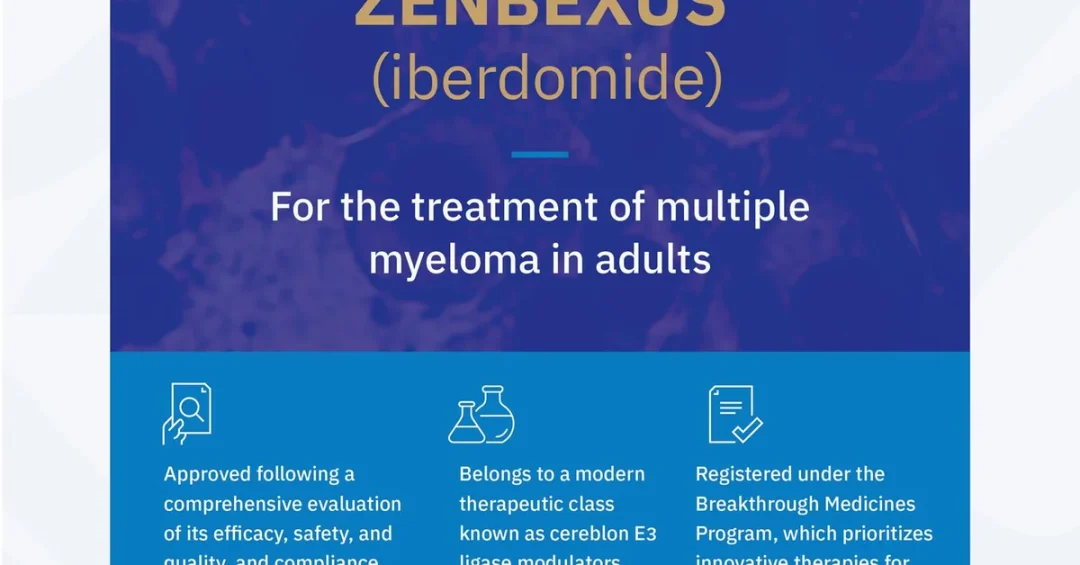
The Saudi Food and Drug Authority (SFDA) has become the first regulatory authority in the world to approve the registration of ZENBEXUS (iberdomide) for the treatment of adult patients with relapsed or refractory multiple myeloma, in combination with daratumumab and dexamethasone. The announcement, carried by the Saudi Press Agency on August 11, 2026, marks a significant milestone for the Kingdom’s regulatory system and reinforces its growing role in accelerating access to advanced medicines.
Context and Background
Multiple myeloma is a blood cancer that originates in plasma cells within the bone marrow. It can lead to anemia, a low white blood cell count, weakened immunity, impaired kidney function, and bone damage. Patients whose disease returns after treatment, or who stop responding to it, face limited options, making new therapies critically important.
ZENBEXUS belongs to a modern therapeutic class known as cereblon E3 ligase modulators (CELMoD) agents. It works by promoting the degradation of proteins that contribute to the survival and growth of multiple myeloma cells, while enhancing the immune system’s ability to attack these cells. The SFDA had previously designated the medicine under its Breakthrough Medicine Program, reflecting a deliberate effort to facilitate patient access to specialized treatments within Saudi Arabia.
Key Details
The SFDA stated that the approval was based on results from a pivotal Phase 3 clinical trial involving patients with relapsed or refractory multiple myeloma. The results demonstrated that the use of iberdomide, in combination with daratumumab and dexamethasone, achieved a statistically significant improvement compared to the control treatment.
Clinical data indicated that the most prominent adverse reactions of the product included a decrease in the count of certain blood cells, which may increase the risk of infection or anemia, in addition to dizziness, nausea, and rash. The SFDA emphasized the necessity of using the product under specialized medical supervision, with regular monitoring of the patient’s clinical condition and blood test results, in accordance with the approved prescribing leaflet.
The SFDA Breakthrough Medicine Program covers medicines that have completed clinical development and demonstrated promising efficacy and safety, as well as a clear therapeutic effect in serious diseases. The program accelerates patient access to specialized therapies, expands available treatment options, and enables earlier access to innovative medicines within a shortened timeframe, in line with the Health Sector Transformation Program and Saudi Vision 2030. For further details, please refer to the SFDA Breakthrough Medicine Program Guide: https://sfda.gov.sa/en/regulations/89310.
Implications and Impact
This first-in-the-world approval positions the SFDA alongside the most advanced regulatory agencies globally. It signals that Saudi Arabia’s review pathways are not only rigorous but also fast enough to bring cutting-edge therapies to patients before other jurisdictions. For patients in the Kingdom, the decision creates the prospect of earlier access to a treatment option that addresses a serious unmet need in multiple myeloma.
Internationally, the approval strengthens the SFDA’s credibility as a reference regulator and may encourage other authorities to follow suit. It also underscores the Kingdom’s capacity to evaluate complex oncology data and to act decisively on behalf of patients, a development with implications for pharmaceutical investment and clinical research in the region.
Vision 2030 Alignment
The approval reflects the SFDA’s continued commitment to innovation and expanding access to advanced treatment options, thereby enhancing healthcare quality in alignment with the goals of the Health Sector Transformation Program, one of the key initiatives of Saudi Vision 2030. By accelerating the availability of breakthrough medicines, the Kingdom is advancing its broader objective of building a world-class, patient-centered health system and a diversified, knowledge-driven economy.
20 Questions
Q1. What did the SFDA approve?
A1. The SFDA approved the registration of ZENBEXUS (iberdomide) for adults with relapsed or refractory multiple myeloma, in combination with daratumumab and dexamethasone. It is the first regulatory authority globally to grant this approval.
Q2. Why is this approval significant globally?
A2. It marks the first time any regulatory authority worldwide has approved this product, demonstrating the SFDA’s advanced review capabilities and its ability to bring innovative therapies to patients ahead of other jurisdictions.
Q3. What is multiple myeloma?
A3. Multiple myeloma is a blood cancer that begins in plasma cells within the bone marrow. It can cause anemia, low white blood cell counts, weakened immunity, kidney problems, and bone damage, requiring specialized treatment.
Q4. How does ZENBEXUS work?
A4. ZENBEXUS is a cereblon E3 ligase modulator (CELMoD) agent. It promotes the degradation of proteins that help multiple myeloma cells survive and grow, while also enhancing the immune system’s ability to attack those cells.
Q5. What evidence supported the approval?
A5. The approval was based on a pivotal Phase 3 clinical trial in patients with relapsed or refractory multiple myeloma. Results showed a statistically significant improvement compared with the control treatment when used in the approved combination.
Q6. What are the main side effects?
A6. The most prominent adverse reactions included decreased counts of certain blood cells, which may raise the risk of infection or anemia, along with dizziness, nausea, and rash. Patients require medical supervision and regular monitoring.
Q7. Who can receive this treatment?
A7. The approval covers adult patients with relapsed or refractory multiple myeloma. It must be used under specialized medical supervision, with regular monitoring of clinical condition and blood test results, according to the approved prescribing leaflet.
Q8. What is the SFDA Breakthrough Medicine Program?
A8. The program covers medicines that have completed clinical development and shown promising efficacy, safety, and clear therapeutic effect in serious diseases. It accelerates patient access to specialized therapies and enables earlier access to innovative medicines.
Q9. How does the program benefit patients?
A9. It shortens the time needed for innovative medicines to reach patients, expands available treatment options, and supports earlier access to therapies for serious conditions, aligning with the Health Sector Transformation Program and Saudi Vision 2030.
Q10. What combinations are approved for ZENBEXUS?
A10. ZENBEXUS is approved in combination with daratumumab and dexamethasone for adult patients with relapsed or refractory multiple myeloma. This combination was evaluated in the pivotal Phase 3 clinical trial.
Q11. Where was the approval announced?
A11. The approval was announced via the Saudi Press Agency on August 11, 2026, from Riyadh. The SFDA is the official Saudi authority responsible for regulating food and drug products.
Q12. Why is this important for Saudi patients?
A12. It offers a new treatment option for a serious blood cancer and demonstrates the Kingdom’s commitment to expanding access to advanced therapies, potentially improving outcomes for patients with limited alternatives after prior treatments.
Q13. What does the approval say about the SFDA’s capabilities?
A13. It shows the SFDA can rigorously evaluate complex oncology data and act quickly, positioning the Kingdom as a leader in regulatory science and patient access to breakthrough medicines.
Q14. Does the approval replace standard medical advice?
A14. No. The SFDA emphasized that ZENBEXUS must be used under specialized medical supervision with regular monitoring, in accordance with the approved prescribing leaflet. Patients should consult qualified healthcare professionals.
Q15. What is a CELMoD agent?
A15. CELMoD stands for cereblon E3 ligase modulator. These agents promote the degradation of specific proteins that support cancer cell survival and growth, while enhancing the immune system’s ability to target malignant cells.
Q16. How does this align with Vision 2030?
A16. It supports the Health Sector Transformation Program, a key Vision 2030 initiative, by enhancing healthcare quality, expanding access to innovative treatments, and advancing a world-class, patient-centered health system in Saudi Arabia.
Q17. Will other countries follow this approval?
A17. While no timeline can be confirmed, the SFDA’s first-in-the-world decision may encourage other regulators to review the same product. Each authority conducts its own independent assessment based on available data.
Q18. What monitoring is required during treatment?
A18. Patients require regular monitoring of their clinical condition and blood test results. This helps manage potential side effects such as decreased blood cell counts, which may increase infection or anemia risk.
Q19. Where can more information be found?
A19. Further details are available in the SFDA Breakthrough Medicine Program Guide at https://sfda.gov.sa/en/regulations/89310. The SFDA and the Saudi Press Agency are the official sources of the announcement.
Q20. What is the broader significance of this milestone?
A20. It reinforces Saudi Arabia’s role as a global leader in regulatory innovation, strengthens international confidence in the SFDA, and supports Vision 2030 goals for a diversified, knowledge-based economy and advanced healthcare sector.
Reader Feedback
We value your thoughts. Please share your feedback on this article.
Your feedback helps us improve our coverage.