


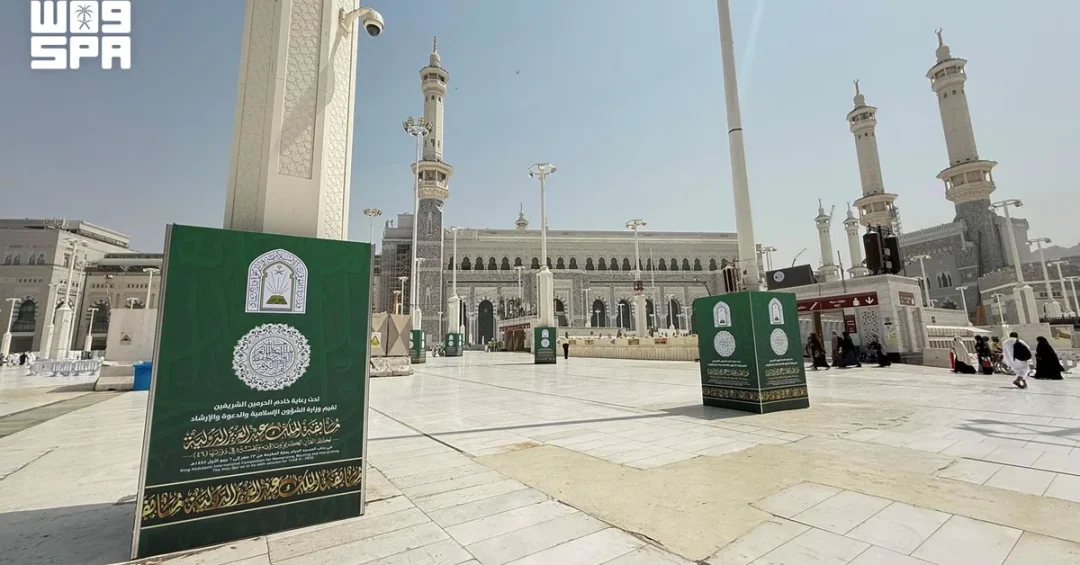
The Ministry of Islamic Affairs, Dawah and Guidance has installed informational signage in the Grand Mosque in Mecca to showcase the 46th edition of the King Abdulaziz International Competition for the Memorization, Recitation, and Interpretation of the Holy Quran. The competition, organized by the ministry, features 334 male and female participants from 133 countries, reflecting Saudi Arabia’s commitment to serving the Quran and its global outreach.
Context and Background
The signage, designed with the competition’s visual identity, highlights the event’s global stature and its mission to serve the divine word. It also underscores the Kingdom’s dedication to the Quran and its people, as well as its efforts to promote international Quranic competitions. The boards are strategically placed in prominent locations within the Grand Mosque and its courtyards, enhancing visibility among pilgrims and visitors.
Key Details
This year’s edition marks a significant expansion, including the participation of women for the first time and the development of an electronic arbitration system that improves accuracy and quality in judging various competition categories. The total prize pool amounts to 10,260,000 Saudi Riyals, with the number of winners increased to 50—five male and five female winners in each of the five competition categories.
The initiative aligns with Saudi Arabia’s ongoing support for Quranic scholars and memorizers worldwide, encouraging excellence and dedication to the Holy Book. The signage not only promotes the competition but also educates pilgrims about one of the most important international Quranic events hosted by the Kingdom.
Implications and Impact
The presence of the signage in the Grand Mosque amplifies the competition’s reach, connecting with the global Muslim community during the Hajj and Umrah seasons. It reinforces the Kingdom’s role as a leader in Islamic affairs and its commitment to fostering Quranic knowledge across borders. The expansion in participation and the introduction of advanced judging tools reflect Saudi Arabia’s dedication to enhancing the competition’s quality and inclusivity.
Vision 2030 Alignment
This initiative is a testament to Saudi Arabia’s Vision 2030, which emphasizes the importance of cultural and religious heritage as a pillar of national identity and global engagement. By organizing such competitions and modernizing their processes, the Kingdom demonstrates its commitment to nurturing religious scholarship and promoting tolerance and understanding among nations. This aligns with the vision’s goals of building a vibrant society and a pioneering nation rooted in Islamic values while contributing to global knowledge and cooperation.
20 Questions
Q1. What is the King Abdulaziz International Competition?
A1. It is an annual international Quranic competition organized by Saudi Arabia’s Ministry of Islamic Affairs, Dawah and Guidance, focusing on memorization, recitation, and interpretation of the Holy Quran.
Q2. How many participants are in this year’s competition?
A2. The 46th edition features 334 participants, both male and female, representing 133 countries from around the world.
Q3. Why were informational signs placed in the Grand Mosque?
A3. The signs were installed to introduce and promote the competition to pilgrims and visitors, highlighting its significance and the Kingdom’s care for the Quran.
Q4. What is new in the 46th edition?
A4. Notable additions include the participation of women for the first time and the implementation of an enhanced electronic arbitration system for more accurate judging.
Q5. Who organizes the competition?
A5. The competition is organized by the Saudi Ministry of Islamic Affairs, Dawah and Guidance, as part of its mandate to serve Islamic causes.
Q6. How are the winners selected?
A6. Winners are selected by a specialized judging panel, with five male and five female winners chosen in each of the five competition categories.
Q7. What is the total prize money?
A7. The total prize pool for this year’s competition is 10,260,000 Saudi Riyals (approximately $2.7 million USD).
Q8. How many categories are there in the competition?
A8. There are five main categories, covering different aspects of Quranic memorization, recitation, and interpretation.
Q9. Why is this competition significant for Saudi Arabia?
A9. It underscores the Kingdom’s leadership in Islamic affairs, its devotion to the Quran, and its efforts to foster global Islamic solidarity.
Q10. How does the electronic arbitration system improve the competition?
A10. It enhances the accuracy and quality of judging, reduces human error, and ensures fair and transparent evaluation of participants.
Q11. What is the age range of participants?
A11. The competition is open to participants of various ages, from youth to adults, who have demonstrated exceptional Quranic skills.
Q12. How does the competition promote inclusivity?
A12. For the first time, women are participating, reflecting Saudi Arabia’s commitment to empowering women and promoting their role in religious scholarship.
Q13. How are the signs designed?
A13. The signs feature the competition’s visual identity, making them attractive and informative, aligned with the sacred environment of the Grand Mosque.
Q14. What impact do the signs have on pilgrims?
A14. They educate pilgrims about the competition, encouraging them to appreciate the Quranic heritage and the Kingdom’s efforts in preserving it.
Q15. How does the competition contribute to Vision 2030?
A15. It aligns with Vision 2030 by promoting cultural and religious values, supporting education, and enhancing Saudi Arabia’s global standing.
Q16. Are there any prizes for runners-up?
A16. Yes, 50 winners are recognized in total; each category awards five males and five females, with varying prize amounts based on ranking.
Q17. How many countries are participating this year?
A17. Participants come from 133 countries, making it one of the most internationally inclusive Quranic competitions.
Q18. What is the vision behind the competition?
A18. The vision is to honor the memorizers of the Quran, encourage global participation, and highlight Saudi Arabia’s custodianship of Islamic heritage.
Q19. How does the competition serve the Quran?
A19. It encourages the memorization and correct interpretation of the Quran, fostering a deeper connection with the holy text among Muslims worldwide.
Q20. Where can one find more information about the competition?
A20. Official announcements and updates are available through the Saudi Ministry of Islamic Affairs’ communication channels and the Saudi Press Agency.
Reader Feedback
We value your thoughts. Please share your feedback on this article.
Your feedback helps us improve our coverage.