


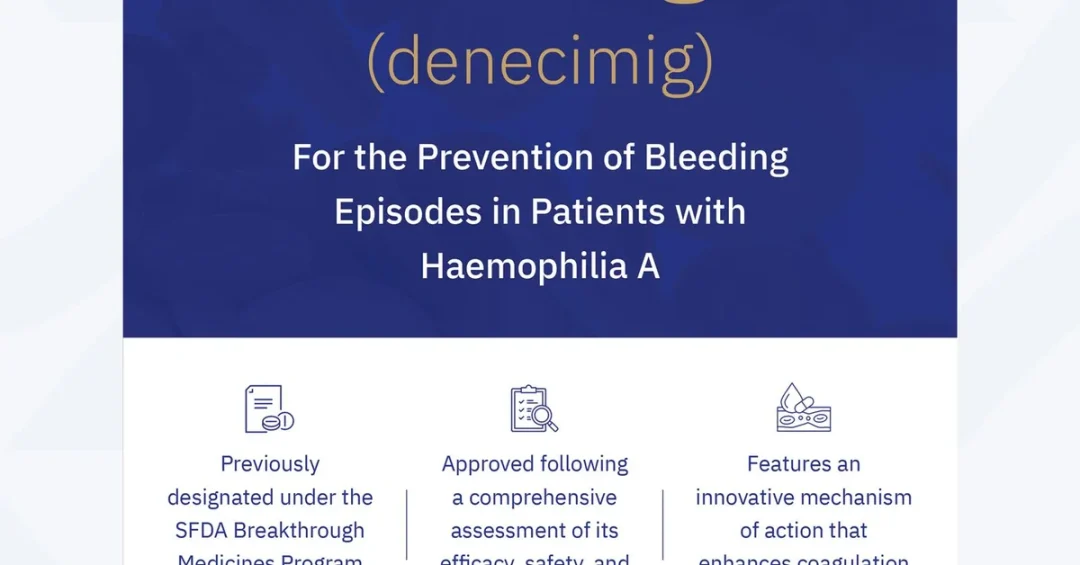
The Saudi Food and Drug Authority (SFDA) has become the first regulatory body globally to approve Frehemgo (denecimig) for the routine prevention of bleeding episodes in patients with hemophilia A, with or without factor VIII (FVIII) inhibitors. The landmark approval, announced via the Saudi Press Agency, positions Saudi Arabia at the forefront of specialized hematologic care and underscores the Kingdom’s commitment to accelerating patient access to innovative therapies.
Context and Background
Hemophilia A is an inherited bleeding disorder characterized by a deficiency or absence of FVIII, a protein essential for normal blood clotting. This deficiency leaves patients at increased risk of recurrent and potentially severe bleeding episodes, particularly in joints and muscles. Globally, managing this condition has traditionally relied on replacement therapies, which can be burdensome and may be complicated by the development of inhibitors that neutralize the infused clotting factor.
Before its approval, Frehemgo was designated under the SFDA’s Breakthrough Medicine Program, a regulatory pathway designed to expedite the review and availability of promising therapies for serious conditions. This designation reflects the SFDA’s proactive approach in aligning with international best practices and its dedication to addressing unmet medical needs within the Kingdom.
Key Details: Mechanism and Clinical Evidence
Frehemgo is a bispecific antibody that mimics the function of activated FVIII by bridging coagulation factor IXa (FIXa) and factor X (FX) on the surface of activated platelets. This promotes thrombin generation and enhances coagulation to help prevent bleeding. Notably, its mechanism of action is independent of the presence or absence of FVIII inhibitors, offering a viable option for patients who have developed these challenging antibodies.
The therapy is administered by subcutaneous injection, with dosing flexibility based on patient body weight and physician assessment—once weekly, every two weeks, or once monthly. The SFDA’s approval followed a comprehensive assessment of efficacy, safety, and quality based on the totality of evidence submitted in the registration dossier.
Efficacy and safety data were derived from four Phase 3 studies involving participants with all severities of hemophilia A, with or without FVIII inhibitors. These included trials in adults and adolescents, a pediatric study, an open-label extension across all age groups, and a safety-only study evaluating switching from emicizumab. Clinical studies showed that the most commonly reported adverse reactions included injection-site reactions, pyrexia, headache, and upper respiratory tract infections. Elevated levels of coagulation activation markers were also observed, consistent with the drug’s mechanism.
Implications for Patients and Global Healthcare
This approval represents a significant advancement in the management of hemophilia A, particularly for patients who have historically had limited options due to inhibitors. By providing a non-factor therapy that can be administered subcutaneously, Frehemgo may improve treatment adherence and quality of life. The SFDA’s decision also positions the Kingdom as a pioneer in regulatory science and pharmacovigilance, setting a precedent for other regulators worldwide.
Internationally, this milestone reinforces Saudi Arabia’s role as a hub for medical innovation and its ability to assess complex biologics with rigor and speed. It also aligns with broader global efforts to harmonize approval standards while tailoring regulatory frameworks to regional health priorities.
Vision 2030 Alignment
The SFDA’s first-in-world approval of Frehemgo directly supports Saudi Arabia’s Vision 2030 healthcare transformation goals. The strategy emphasizes improving population health outcomes, fostering innovation in medical services, and positioning Saudi Arabia as a leader in biomedical research and regulation. This approval demonstrates the Kingdom’s capacity to bring breakthrough treatments to patients faster while upholding the highest standards of safety and efficacy. As Vision 2030 continues to drive modernization, such milestones highlight the nation’s commitment to building a resilient and future-ready healthcare ecosystem that benefits both Saudis and the global community.
20 Questions
Q1. What is Frehemgo?
A1. Frehemgo is a bispecific antibody medication used for the routine prevention of bleeding episodes in hemophilia A patients. It mimics the function of activated factor VIII, helping blood clot normally and reducing bleeding risk in approved populations.
Q2. What condition does Frehemgo treat?
A2. Frehemgo treats hemophilia A, an inherited bleeding disorder caused by a deficiency or absence of coagulation factor VIII. It is approved for routine prophylaxis in patients with or without factor VIII inhibitors.
Q3. Who approved Frehemgo first?
A3. The Saudi Food and Drug Authority (SFDA) became the first regulatory body globally to approve Frehemgo. This landmark decision was announced on September 14, 2026, through the official Saudi Press Agency.
Q4. How is Frehemgo administered?
A4. Frehemgo is given by subcutaneous injection, meaning it is injected just under the skin. Dosing frequency is flexible, ranging from once weekly to once every two weeks or once monthly, depending on patient weight and physician assessment.
Q5. What is the Breakthrough Medicine Program?
A5. The Breakthrough Medicine Program is an SFDA initiative designed to expedite patient access to specialized treatments for serious conditions. It allows earlier designation and priority review for promising therapies like Frehemgo.
Q6. How does Frehemgo work?
A6. Frehemgo bridges coagulation factor IXa and factor X on activated platelets, mimicking activated factor VIII. This promotes thrombin generation and enhances coagulation, helping to prevent bleeding episodes in hemophilia A patients.
Q7. Is Frehemgo effective in patients with inhibitors?
A7. Yes, Frehemgo’s mechanism is independent of the presence or absence of factor VIII inhibitors. This makes it a valuable treatment option for patients who have developed inhibitors to standard replacement therapies.
Q8. What were the clinical trials for Frehemgo?
A8. Efficacy and safety were evaluated in four Phase 3 studies, including adults and adolescents, pediatric patients, an open-label extension, and a study on switching from emicizumab. Participants had all severities of hemophilia A with or without inhibitors.
Q9. What are common side effects of Frehemgo?
A9. The most common adverse reactions reported include injection-site reactions like erythema and pruritus, pyrexia, headache, and upper respiratory tract infections. Elevated coagulation activation markers, such as D-dimer, were also observed.
Q10. How does Frehemgo compare to traditional factor replacement?
A10. Frehemgo is a non-factor therapy administered subcutaneously, unlike traditional intravenous factor replacement. It offers dosing flexibility and works independently of inhibitors, potentially improving adherence and patient convenience.
Q11. What makes the SFDA approval unique?
A11. The SFDA is the first regulatory authority worldwide to approve Frehemgo, showcasing Saudi Arabia’s leadership in healthcare regulation and its commitment to accelerating access to breakthrough medicines for patients.
Q12. Which other regulators are reviewing Frehemgo?
A12. While the SFDA’s approval is the first global authorization, other international regulators are likely to review Frehemgo based on the same clinical data. However, specific timelines for other approvals are not disclosed in the official announcement.
Q13. Does Frehemgo require factor VIII monitoring?
A13. No, because Frehemgo mimics factor VIII activity and does not rely on factor levels. Routine monitoring of FVIII is not required, simplifying treatment management for patients and clinicians.
Q14. Can pediatric patients use Frehemgo?
A14. Yes, clinical trials included a dedicated pediatric study, and the SFDA approval covers appropriate age groups. Pediatric dosing is determined based on body weight and medical assessment.
Q15. What is hemophilia A?
A15. Hemophilia A is an inherited bleeding disorder caused by a deficiency or absence of coagulation factor VIII. This protein is essential for normal blood clotting, and its lack leads to increased bleeding risk.
Q16. How often is Frehemgo injected?
A16. The dosing interval is flexible: once weekly, every two weeks, or once monthly. The frequency is determined by the patient’s body weight and the physician’s clinical judgment.
Q17. What does ‘with or without FVIII inhibitors’ mean?
A17. FVIII inhibitors are antibodies that the immune system produces against replacement factor VIII, making treatment ineffective. Frehemgo works regardless of these inhibitors, offering a broader patient population.
Q18. Where will Frehemgo be available first?
A18. Following the SFDA’s approval, Frehemgo will be available in Saudi Arabia. The SFDA is responsible for regulating its entry into the Saudi market, and distribution will follow standard commercial processes.
Q19. How does this approval support Vision 2030?
A19. This approval advances Vision 2030’s healthcare transformation by introducing innovative therapies, streamlining regulatory processes, and positioning Saudi Arabia as a global leader in medical advances and patient-centered care.
Q20. What is the significance of the first global approval?
A20. The first global approval signals the SFDA’s regulatory maturity and scientific expertise. It enhances Saudi Arabia’s reputation as a destination for cutting-edge medical research and treatment, benefiting patients domestically and setting a global precedent.
Reader Feedback
We value your thoughts. Please share your feedback on this article.
Your feedback helps us improve our coverage.