


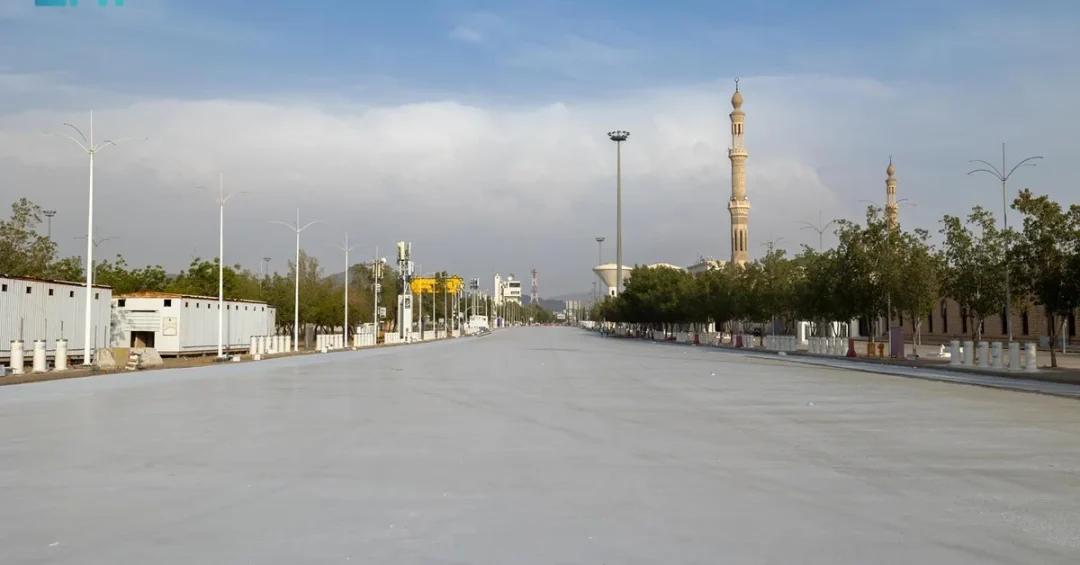
The Roads General Authority has completed the application of a white, heat-reflective coating on the asphalt surrounding Namira Mosque in Makkah, a project designed to lower surface temperatures and enhance the comfort of pilgrims. The initiative, announced via the Saudi Press Agency, uses locally manufactured materials that absorb less sunlight and can reduce surface temperatures by approximately 20 degrees Celsius. This year’s application covers an area of about 25,000 square meters, following a successful trial last year on pedestrian paths leading to the Stoning of the Devil area.
Context and Background
Namira Mosque, located in the plains of Arafat, is a critical site for pilgrims during the annual Hajj. The surrounding area experiences extreme heat, particularly during the summer months when Hajj often takes place. The Roads General Authority (RGA), responsible for maintaining and improving the Kingdom’s road network, has been exploring innovative solutions to mitigate high temperatures in areas with heavy pedestrian traffic. Last year, the authority tested a reflective coating on pedestrian paths in Mina, where temperatures are notoriously high, and achieved a reduction of 12 to 15 degrees Celsius. Building on that success, the RGA expanded the project to cover the vicinity of Namira Mosque, aiming to create a more comfortable environment for the millions of pilgrims who gather there.
Key Details
In a statement to the Saudi Press Agency, Abdulaziz Al-Otaibi, Spokesperson for the Roads General Authority, explained that the coating works by reflecting sunlight, thereby reducing the temperature of the asphalt surface. The material is locally manufactured, supporting the Kingdom’s goal of fostering domestic industry and innovation. The project was implemented in partnership with several entities, all working together to serve pilgrims. Al-Otaibi emphasized that the mechanism is simple yet effective: by reflecting solar radiation, the surface stays cooler, which in turn lowers the ambient temperature in pedestrian areas. The 25,000-square-meter area around Namira Mosque now benefits from this technology, which is expected to significantly improve the pilgrimage experience.
Implications and Impact
The application of this cooling technology has immediate benefits for pilgrims, who often face harsh desert conditions. By reducing surface temperatures by up to 20 degrees Celsius, the coating can help prevent heat-related illnesses and make the spiritual journey more comfortable. Moreover, the project underscores Saudi Arabia’s commitment to leveraging innovation for the welfare of visitors to the holy sites. It also aligns with broader efforts to enhance Hajj and Umrah infrastructure, which is a key component of the Kingdom’s Vision 2030 plan to increase the number of pilgrims and improve their experience. The successful expansion of this initiative could pave the way for wider adoption in other heat-prone areas, both within Saudi Arabia and potentially internationally.
Vision 2030 Alignment
This project directly supports Saudi Arabia’s Vision 2030 objectives, particularly those related to enhancing the quality of life for citizens and visitors, and promoting sustainable development. By investing in innovative solutions that address environmental challenges, the Kingdom demonstrates its leadership in applying technology for social benefit. The Roads General Authority’s work exemplifies how Vision 2030 is being translated into tangible improvements on the ground, ensuring that the millions of pilgrims who visit the holy sites each year can do so safely and comfortably. As Saudi Arabia continues to modernize its infrastructure and services, such initiatives will play a vital role in cementing its position as a global leader in pilgrimage management and technological innovation.
20 Questions
Q1. What did the Roads General Authority apply around Namira Mosque?
A1. The Roads General Authority applied a white, heat-reflective coating on the asphalt surrounding Namira Mosque to lower surface temperatures and improve comfort for pilgrims.
Q2. How much can the coating reduce surface temperatures?
A2. The coating can reduce surface temperatures by approximately 20 degrees Celsius, thanks to its ability to reflect sunlight and absorb less heat.
Q3. What area does the current project cover?
A3. The current project covers an area of about 25,000 square meters around Namira Mosque, significantly expanding on last year’s trial.
Q4. Where was the experiment conducted last year?
A4. Last year, the experiment was conducted on pedestrian paths leading to the Stoning of the Devil area, where temperatures are high.
Q5. What temperature reduction was achieved in last year’s trial?
A5. The trial successfully reduced temperatures by 12 to 15 degrees Celsius, demonstrating the effectiveness of the cooling technology.
Q6. Who is the spokesperson for the Roads General Authority?
A6. Abdulaziz Al-Otaibi is the spokesperson for the Roads General Authority and provided details about the project to the Saudi Press Agency.
Q7. What materials are used in the coating?
A7. The coating is created using locally manufactured materials that absorb less sunlight, supporting domestic industry and innovation.
Q8. How does the coating work to reduce temperatures?
A8. The coating reflects sunlight, which reduces the temperature of the asphalt surface and creates a more comfortable environment in pedestrian areas.
Q9. Which entities partnered for this project?
A9. The project was implemented in partnership with several entities, all working together to serve pilgrims and improve their experience.
Q10. Why is Namira Mosque significant?
A10. Namira Mosque is located in the plains of Arafat and is a critical site for pilgrims during the annual Hajj, especially on the Day of Arafah.
Q11. What is the expected benefit for pilgrims?
A11. The coating is expected to prevent heat-related illnesses and make the spiritual journey more comfortable for the millions of pilgrims who visit the site.
Q12. How does this project align with Vision 2030?
A12. It aligns with Vision 2030 by enhancing quality of life, promoting sustainable development, and improving Hajj and Umrah infrastructure to accommodate more pilgrims.
Q13. What was the mechanism described by Al-Otaibi?
A13. Al-Otaibi explained that the mechanism consists of reflecting sunlight and thus reducing the surface temperature to create a more comfortable environment.
Q14. When was the project announced?
A14. The project was announced on June 4, 2024, via the Saudi Press Agency, highlighting the completion of the coating work.
Q15. What is the role of the Roads General Authority?
A15. The Roads General Authority is responsible for maintaining and improving the Kingdom’s road network and implementing innovative solutions to enhance infrastructure.
Q16. Could this technology be used elsewhere?
A16. Yes, the successful expansion of this initiative could pave the way for wider adoption in other heat-prone areas within Saudi Arabia and potentially internationally.
Q17. What makes the coating environmentally friendly?
A17. The coating uses locally manufactured materials and helps reduce ambient temperatures, contributing to a more sustainable and comfortable environment for pilgrims.
Q18. How does this project reflect Saudi leadership?
A18. It demonstrates Saudi Arabia’s commitment to leveraging technology for social benefit and its leadership in pilgrimage management and innovative infrastructure solutions.
Q19. What is the significance of the Stoning of the Devil area?
A19. The Stoning of the Devil area in Mina is a key ritual site during Hajj where pilgrims perform the stoning ritual, often under high temperatures.
Q20. What future improvements might be expected?
A20. Future improvements may include expanding the cooling technology to more areas and integrating other innovations to further enhance the pilgrimage experience.
Reader Feedback
We value your thoughts. Please share your feedback on this article.
Your feedback helps us improve our coverage.