


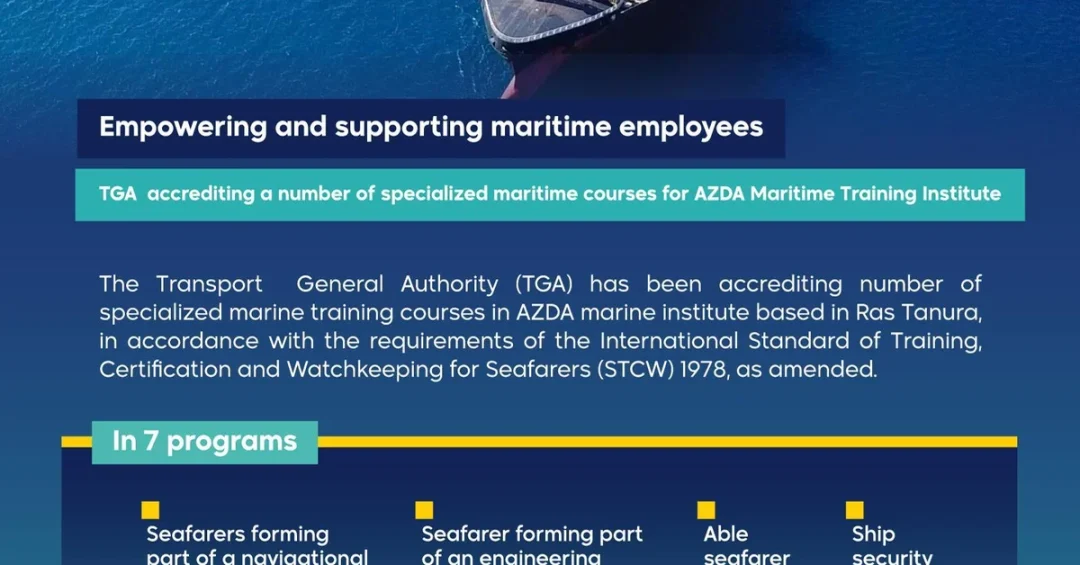
The Transport General Authority (TGA) announced on June 7, 2024, that it has accredited several specialized marine training courses for the AZDA Marine Institute in Ras Tanura, aligning with the 1978 International Convention on Standards of Training, Certification and Watchkeeping for Seafarers (STCW). The accreditation, granted in accordance with the International Maritime Organization’s (IMO) Standard Manual and TGA’s rigorous requirements for training institutes and maritime colleges, marks a significant step forward in enhancing Saudi Arabia’s maritime sector capabilities and underscores the Kingdom’s commitment to global standards in maritime education.
Context and Background
Saudi Arabia has long recognized the strategic importance of its maritime industry, given its extensive coastline along the Red Sea and the Arabian Gulf. The establishment of the AZDA Marine Institute in Ras Tanura, a key hub for the Kingdom’s oil and maritime operations, reflects the nation’s dedication to developing a skilled national workforce in this vital sector. The TGA, as the regulatory body for land and sea transport, has been at the forefront of efforts to elevate training standards, ensuring that Saudi professionals are equipped to meet the demands of a rapidly evolving global maritime landscape.
The accreditation of these courses is part of a broader initiative to align Saudi maritime training with international benchmarks, particularly the STCW convention, which sets global standards for the training, certification, and watchkeeping of seafarers. By adhering to these standards, the AZDA Marine Institute not only enhances the competency of its graduates but also contributes to the safe and efficient operation of vessels worldwide.
Key Details
The accredited courses cover a diverse range of critical maritime skills, including navigational and engineering roles, ship security, skilled deck operations, medical first aid, advanced fire extinguishing, and maritime English language proficiency. These programs are designed to address both operational and emergency scenarios, ensuring that seafarers are well-prepared for the challenges of modern maritime environments.
The TGA’s decision to accredit these courses was based on the institute’s adherence to the IMO Standard Manual and the authority’s stringent accreditation criteria. This move is expected to enhance operational efficiency within the maritime transport industry by cultivating a cadre of highly skilled national professionals. The TGA emphasized that this initiative supports the national transport and logistics strategy, which aims to position Saudi Arabia as a global logistics hub and elevate the maritime industry’s standards both locally and internationally.
Implications and Impact
The accreditation carries significant implications for Saudi Arabia’s maritime sector and its international standing. By ensuring that training programs meet global standards, the Kingdom is better positioned to compete in the global maritime economy, attract investment, and foster partnerships with leading international maritime organizations. Moreover, the focus on developing national talent aligns with the goals of Vision 2030, which seeks to diversify the economy and create opportunities for Saudi citizens in high-value sectors.
For the international audience, this development signals Saudi Arabia’s proactive approach to maritime safety and environmental protection, as well-trained seafarers are essential for preventing accidents and minimizing environmental impact. It also highlights the Kingdom’s role as a responsible global partner in upholding international maritime regulations and promoting sustainable practices.
Vision 2030 Alignment
The accreditation of these courses is a concrete example of how Vision 2030 is being realized on the ground. By investing in human capital and aligning training with international standards, Saudi Arabia is not only enhancing its maritime capabilities but also contributing to the diversification of its economy away from oil. This initiative supports the National Transport and Logistics Strategy, a key component of Vision 2030, which aims to make the Kingdom a pivotal logistics hub connecting three continents. As Saudi Arabia continues to modernize its maritime infrastructure and education, it reinforces its commitment to global engagement and sustainable development, paving the way for a prosperous and secure maritime future.
20 Questions
Q1. What did the Transport General Authority announce on June 7, 2024?
A1. The TGA announced the accreditation of several specialized marine training courses for the AZDA Marine Institute in Ras Tanura, in line with the STCW convention.
Q2. Which international convention does the accreditation align with?
A2. The accreditation aligns with the 1978 International Convention on Standards of Training, Certification and Watchkeeping for Seafarers (STCW), as amended.
Q3. Where is the AZDA Marine Institute located?
A3. The AZDA Marine Institute is based in Ras Tanura, a key maritime hub in Saudi Arabia.
Q4. What are some of the specialized courses accredited?
A4. The courses include navigational and engineering roles, ship security, skilled deck operations, medical first aid, advanced fire extinguishing, and maritime English language proficiency.
Q5. What was the basis for granting the accreditation?
A5. The accreditation was based on the institute’s adherence to the International Maritime Organization Standard Manual and TGA’s accreditation requirements for training institutes and maritime colleges.
Q6. What is the objective of the TGA in accrediting these courses?
A6. The objective is to introduce advanced programs in the maritime transport industry to enhance operational efficiency and cultivate the skills of national professionals.
Q7. How does this initiative support Saudi Arabia’s national strategy?
A7. It supports the national transport and logistics strategy and aims to elevate the maritime industry’s standards both locally and internationally.
Q8. Why is the STCW convention important for maritime training?
A8. The STCW convention sets global standards for the training, certification, and watchkeeping of seafarers, ensuring safety and efficiency in maritime operations worldwide.
Q9. What role does the TGA play in Saudi Arabia’s transport sector?
A9. The TGA is the regulatory body for land and sea transport, responsible for setting and enforcing standards to ensure safe and efficient transport services.
Q10. How does this accreditation benefit Saudi seafarers?
A10. It provides Saudi seafarers with internationally recognized training, enhancing their skills and employability in the global maritime industry.
Q11. What is the significance of Ras Tanura in Saudi Arabia’s maritime sector?
A11. Ras Tanura is a major port and hub for Saudi Arabia’s oil and maritime operations, making it a strategic location for maritime training.
Q12. How does this development contribute to Vision 2030?
A12. It aligns with Vision 2030 by developing national talent, supporting economic diversification, and enhancing Saudi Arabia’s position as a global logistics hub.
Q13. What impact does this accreditation have on maritime safety?
A13. It ensures that seafarers are well-trained in safety and emergency procedures, contributing to safer maritime operations and environmental protection.
Q14. Will these courses be available to international students?
A14. While the focus is on national professionals, the courses meet international standards and could potentially attract international participants, though specific availability is not detailed.
Q15. How does the TGA ensure the quality of training at the AZDA Marine Institute?
A15. The TGA enforces strict accreditation requirements and adherence to the IMO Standard Manual, ensuring high-quality training that meets global benchmarks.
Q16. What other initiatives is the TGA undertaking to improve maritime training?
A16. The TGA continually works to introduce advanced programs and partnerships to enhance maritime education, in line with international best practices and national strategies.
Q17. What is the expected outcome of this accreditation for the maritime industry?
A17. It is expected to enhance operational efficiency, elevate industry standards, and produce a skilled workforce capable of meeting the demands of modern maritime operations.
Q18. How does this accreditation reflect on Saudi Arabia’s global engagement?
A18. It demonstrates Saudi Arabia’s commitment to international maritime regulations and its role as a responsible global partner in promoting safety and sustainability.
Q19. Are there plans to expand such accreditations to other institutes?
A19. While not specified, the TGA’s ongoing efforts to elevate standards suggest potential expansion to other institutes as part of its strategic objectives.
Q20. What message does this send to the international maritime community?
A20. It signals Saudi Arabia’s dedication to meeting global standards, investing in human capital, and contributing to the safety and efficiency of international maritime trade.
Reader Feedback
We value your thoughts. Please share your feedback on this article.
Your feedback helps us improve our coverage.