


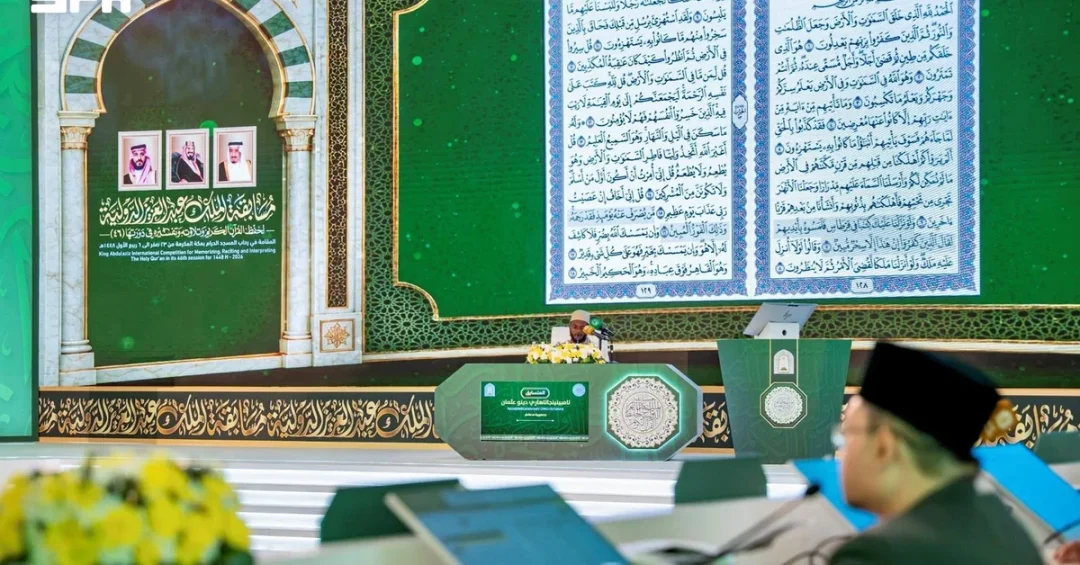
The Ministry of Islamic Affairs, Dawah and Guidance has installed large digital screens inside the final qualifying halls of the 46th King Abdulaziz International Competition for Memorizing, Reciting, and Interpreting the Holy Quran, enhancing the viewing experience for attendees and participants alike. The screens broadcast participants’ recitations live from the qualifying hall while simultaneously displaying the corresponding pages of the Quran from which they are reciting. They also provide key information about each contestant, including name, country, and competition category, according to the Saudi Press Agency (SPA).
Context and Background
The King Abdulaziz International Competition for Memorizing, Reciting, and Interpreting the Holy Quran is one of the most prestigious Quranic contests globally, organized under the patronage of the Custodian of the Two Holy Mosques. The 46th edition, held in Makkah, has seen a significant expansion in participation, with 334 contestants representing 133 countries. A dedicated section for female participants was introduced this year, reflecting the Kingdom’s commitment to inclusivity and empowering women in religious scholarship.
The competition aims to encourage the memorization, recitation, and interpretation of the Holy Quran, and to promote moderation, tolerance, and the true message of Islam. It also serves as a platform for cultural exchange and showcases Saudi Arabia’s leadership in serving Islam and Muslims worldwide.
Key Details
The newly installed digital screens are a technological upgrade designed to improve transparency and engagement. During the qualifying rounds, as contestants recite from memory, the screens display the exact Quranic pages they are reciting, allowing the audience and judges to follow along and verify accuracy. This real-time display also helps non-Arabic speakers and those unfamiliar with the contestants’ recitation styles to appreciate the precision and beauty of the performance. Additionally, the screens show the contestant’s name, country, and category, fostering a sense of recognition and international participation.
The Ministry of Islamic Affairs, Dawah and Guidance oversees the competition, ensuring that it adheres to the highest standards of fairness and religious authenticity. The use of digital screens aligns with the Ministry’s efforts to modernize the event and make it more accessible to a global audience, both in-person and through broadcast media.
Implications and Impact
The introduction of digital screens at the competition underscores Saudi Arabia’s broader push to integrate technology into religious and cultural events, enhancing the experience for attendees and viewers worldwide. It also reflects the Kingdom’s dedication to serving the Holy Quran and supporting Muslims in their spiritual pursuits. By showcasing the competition’s proceedings transparently, the screens help build trust and credibility in the judging process.
Furthermore, the expanded participation of 334 contestants from 133 countries highlights the competition’s growing international stature. The inclusion of a female section marks a progressive step, encouraging women’s participation in Quranic competitions and aligning with Vision 2030’s goals of empowering women and promoting inclusivity.
Vision 2030 Alignment
This initiative is part of Saudi Arabia’s Vision 2030, which aims to foster a vibrant society, promote moderation, and enhance the quality of life for citizens and visitors. By leveraging technology to improve religious events, the Kingdom demonstrates its commitment to innovation while preserving its cultural and religious heritage. The competition, supported by the Ministry of Islamic Affairs, Dawah and Guidance, continues to strengthen Saudi Arabia’s role as a global leader in serving Islam and Muslims, and as a hub for Quranic scholarship and cultural exchange.
20 Questions
Q1. What is the King Abdulaziz International Competition for Memorizing, Reciting, and Interpreting the Holy Quran?
A1. It is an annual international Quranic competition held in Makkah, organized by the Ministry of Islamic Affairs, Dawah and Guidance, to encourage Quran memorization, recitation, and interpretation among Muslims worldwide.
Q2. How many contestants participated in the 46th edition?
A2. The 46th edition saw 334 contestants representing 133 countries, marking a significant expansion in participation compared to previous years.
Q3. What new feature was introduced in the 46th edition?
A3. A dedicated section for female participants was introduced, reflecting the Kingdom’s commitment to inclusivity and women’s empowerment in religious scholarship.
Q4. What are the digital screens installed in the qualifying halls?
A4. Large digital screens broadcast participants’ recitations live and simultaneously display the corresponding pages of the Quran, along with contestant information such as name, country, and category.
Q5. Why were digital screens installed?
A5. They enhance the viewer experience by providing real-time visuals of the Quranic text being recited, improving transparency, engagement, and accessibility for the audience and judges.
Q6. Who oversees the competition?
A6. The Ministry of Islamic Affairs, Dawah and Guidance oversees the competition, ensuring fairness, religious authenticity, and adherence to high standards.
Q7. Where is the competition held?
A7. The competition is held in Makkah, the holiest city in Islam, under the patronage of the Custodian of the Two Holy Mosques.
Q8. What is the significance of the competition?
A8. It promotes Quranic scholarship, moderation, and tolerance, and showcases Saudi Arabia’s leadership in serving Islam and Muslims globally.
Q9. How do the screens help non-Arabic speakers?
A9. They display the Quranic pages being recited, allowing non-Arabic speakers to follow the text and appreciate the precision of the recitation, even without understanding Arabic.
Q10. Are the screens used in all rounds?
A10. The screens are installed in the final qualifying halls to enhance the experience during the crucial qualifying stages of the competition.
Q11. What information is shown on the screens?
A11. The screens show live recitations, the corresponding Quran pages, and contestant details including name, country, and competition category.
Q12. How does this align with Saudi Vision 2030?
A12. It aligns with Vision 2030 by integrating technology into religious events, promoting moderation, empowering women, and enhancing quality of life and cultural exchange.
Q13. What is the role of the Saudi Press Agency in this event?
A13. The Saudi Press Agency (SPA) reported the installation of the digital screens, serving as an official source of information about the competition.
Q14. How many countries are represented in the competition?
A14. Contestants come from 133 countries, demonstrating the competition’s global reach and appeal among Muslim communities worldwide.
Q15. What categories are contested?
A15. Participants compete in memorizing, reciting, and interpreting the Holy Quran, with specific criteria for each category.
Q16. How does the competition promote moderation?
A16. By emphasizing the authentic teachings of the Quran, the competition encourages tolerance, understanding, and moderate religious practices among participants and audiences.
Q17. What impact does the female section have?
A17. It encourages women’s participation in Quranic competitions, highlighting their role in religious scholarship and supporting gender inclusivity in line with Vision 2030.
Q18. How does the competition serve as a platform for cultural exchange?
A18. It brings together contestants from diverse countries, fostering mutual respect, understanding, and the sharing of Quranic traditions and practices.
Q19. What technology is used in the competition?
A19. Large digital screens are used to broadcast live recitations and display Quranic text, representing a modern upgrade to the event’s infrastructure.
Q20. What is the future outlook for the competition?
A20. The competition is expected to continue growing, with further technological enhancements and expanded participation, reinforcing Saudi Arabia’s role as a global leader in Quranic scholarship.
Reader Feedback
We value your thoughts. Please share your feedback on this article.
Your feedback helps us improve our coverage.