


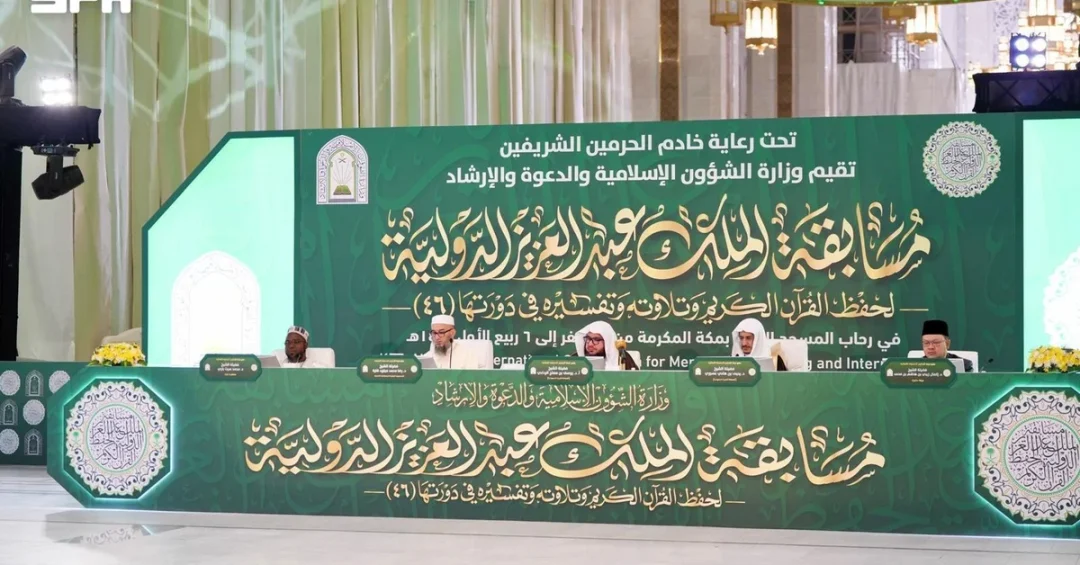
The boys’ and girls’ judging panels of the 46th King Abdulaziz International Competition for Memorizing, Reciting, and Interpreting the Holy Quran heard the recitations of 42 contestants on the fourth day of the final rounds, the Saudi Press Agency reported from Makkah on August 12, 2026. The session featured 26 boys and 16 girls representing 40 countries, with proceedings held in two rounds, morning and evening, under the organization of the Ministry of Islamic Affairs, Dawah and Guidance.
Context and Background
The King Abdulaziz International Competition for Memorizing, Reciting, and Interpreting the Holy Quran stands among the most prestigious Quranic events in the Islamic world, bearing the name of the founder of the modern Saudi state, King Abdulaziz Al Saud. Now in its 46th edition, the competition is organized annually by the Ministry of Islamic Affairs, Dawah and Guidance, which oversees its judging, logistics, and international outreach.
Since the final rounds began, the two judging panels have heard the recitations of 148 contestants representing 101 countries, underscoring the competition’s broad international participation and the diversity of its categories and levels of memorization, recitation, and Quranic readings. The fourth day’s sessions took place in Makkah, the holiest city in Islam, adding spiritual significance to the proceedings.
Key Details
The 42 contestants who recited on the fourth day comprised 26 boys and 16 girls from 40 countries, reflecting the competition’s commitment to inclusivity across genders and nationalities. The two judging panels are composed of a selection of international male and female judges specializing in Quranic sciences, Quranic readings, and recitation rules.
Contestants’ recitations undergo detailed assessment based on criteria covering memorization, recitation, Tajweed (the rules of Quranic pronunciation), and performance quality. The evaluation also draws on the ministry’s advanced electronic judging system, which helps ensure accurate scoring, reinforce fairness and transparency in assessment, and expedite the announcement of results. This technological integration exemplifies Saudi Arabia’s broader drive to modernize administrative processes while preserving the sanctity of religious tradition.
Implications and Impact
The competition’s scale—148 contestants from 101 countries in the final rounds alone—demonstrates Saudi Arabia’s central role in fostering global Islamic scholarship and cultural exchange. By hosting participants from across continents, the Kingdom reinforces its position as a hub for Quranic education and a bridge between Muslim communities worldwide.
For international audiences, the event highlights the Kingdom’s dedication to religious heritage alongside its modernization agenda. The participation of female judges and contestants signals Saudi Arabia’s evolving social landscape, where women’s contributions to religious and public life are increasingly recognized. The electronic judging system further reflects the country’s embrace of digital innovation in service of fairness and efficiency.
Vision 2030 Alignment
The 46th King Abdulaziz International Competition aligns closely with Saudi Vision 2030, which seeks to strengthen the Kingdom’s cultural and religious leadership while promoting moderation, tolerance, and global engagement. By investing in Quranic education and hosting international participants, Saudi Arabia advances its goal of empowering youth, enhancing quality of life, and showcasing its role as a beacon of Islamic knowledge. As the final rounds continue, the competition underscores the Kingdom’s enduring commitment to its faith and its forward-looking vision for a connected, prosperous future.
20 Questions
Q1. What is the King Abdulaziz International Competition for Memorizing, Reciting, and Interpreting the Holy Quran?
A1. It is an annual international Quranic competition organized by the Ministry of Islamic Affairs, Dawah and Guidance, bringing together contestants from around the world to demonstrate memorization, recitation, and interpretation of the Holy Quran. Now in its 46th edition, it is held in Makkah and is named after the founder of Saudi Arabia.
Q2. How many contestants recited on the fourth day of the final rounds?
A2. On the fourth day, 42 contestants recited before the judging panels—26 boys and 16 girls representing 40 countries. The sessions were held in two rounds, morning and evening, as part of the final stages of the competition.
Q3. How many contestants have participated in the final rounds so far?
A3. Since the final rounds began, the two judging panels have heard the recitations of 148 contestants representing 101 countries. This figure reflects the competition’s broad international participation and the diversity of its categories and levels of memorization, recitation, and Quranic readings.
Q4. Which Saudi ministry organizes the competition?
A4. The competition is organized by the Ministry of Islamic Affairs, Dawah and Guidance. This ministry oversees the event’s judging, logistics, and international outreach, ensuring that it upholds the highest standards of Quranic scholarship and fairness.
Q5. Where are the final rounds taking place?
A5. The final rounds are being held in Makkah, the holiest city in Islam. The location adds spiritual significance to the competition, as contestants recite in close proximity to the Grand Mosque and other sacred sites.
Q6. Who are the judges in the competition?
A6. The two judging panels comprise a selection of international male and female judges specializing in Quranic sciences, Quranic readings, and recitation rules. Their expertise ensures that contestants are evaluated according to rigorous, internationally recognized criteria.
Q7. What criteria are used to assess the contestants?
A7. Contestants’ recitations undergo detailed assessment based on criteria covering memorization, recitation, Tajweed (the rules of Quranic pronunciation), and performance quality. These criteria ensure a comprehensive evaluation of each participant’s skills and knowledge.
Q8. What is the electronic judging system used by the ministry?
A8. The ministry employs an advanced electronic judging system that helps ensure accurate scoring, reinforce fairness and transparency in assessment, and expedite the announcement of results. This system reflects Saudi Arabia’s commitment to integrating technology into religious and administrative processes.
Q9. How does the competition promote international participation?
A9. The competition invites contestants from dozens of countries across continents, with 101 nations represented in the final rounds alone. This broad participation fosters global Islamic scholarship, cultural exchange, and unity among Muslim communities worldwide.
Q10. Are there separate categories for boys and girls?
A10. Yes, there are separate boys’ and girls’ judging panels, and the competition includes both male and female contestants. On the fourth day, 26 boys and 16 girls recited, reflecting the event’s commitment to inclusivity and gender participation.
Q11. What is the significance of the competition’s name?
A11. The competition is named after King Abdulaziz Al Saud, the founder of the modern Saudi state. This naming honors his legacy and underscores the Kingdom’s enduring commitment to Quranic education and Islamic heritage.
Q12. How many editions of the competition have been held?
A12. The current edition is the 46th, indicating a long-standing tradition of Quranic competition in Saudi Arabia. Over the decades, it has grown into one of the most prestigious events of its kind in the Islamic world.
Q13. What is Tajweed, and why is it important in the competition?
A13. Tajweed refers to the set of rules governing the correct pronunciation and recitation of the Holy Quran. It is a key criterion in the competition because it ensures that recitations are performed accurately and with proper reverence, preserving the Quran’s oral tradition.
Q14. How does the competition reflect Saudi Arabia’s cultural leadership?
A14. By hosting contestants from over 100 countries and organizing the event under a Saudi ministry, the Kingdom demonstrates its role as a global leader in Islamic scholarship and cultural diplomacy. It reinforces Saudi Arabia’s position as a hub for Quranic education and interfaith understanding.
Q15. What is the role of the Ministry of Islamic Affairs, Dawah and Guidance?
A15. The ministry organizes the competition, selects judges, oversees the electronic judging system, and manages logistics for international contestants. It ensures the event aligns with Saudi Arabia’s religious and cultural priorities, including moderation and tolerance.
Q16. How does the competition support Vision 2030?
A16. The competition supports Vision 2030 by promoting Saudi Arabia’s cultural and religious leadership, empowering youth, and showcasing the Kingdom’s embrace of digital innovation through the electronic judging system. It also enhances global engagement and quality of life.
Q17. What categories and levels of memorization are included?
A17. The competition includes diverse categories and levels of memorization, recitation, and Quranic readings, accommodating participants with varying expertise. This structure allows contestants to compete according to their proficiency, ensuring fairness and broad participation.
Q18. How are the results announced?
A18. Results are announced after the electronic judging system processes scores, which helps expedite the process while ensuring accuracy and transparency. The ministry aims to release outcomes promptly to honor the contestants’ efforts.
Q19. What is the spiritual significance of holding the competition in Makkah?
A19. Makkah is the holiest city in Islam, home to the Grand Mosque and the Kaaba. Holding the competition there adds profound spiritual significance, as contestants recite the Quran in a city of immense religious importance to Muslims worldwide.
Q20. What makes this competition unique on the international stage?
A20. Its scale, with 101 countries represented in the final rounds, and its use of advanced electronic judging, set it apart. Organized by a Saudi ministry and named after the Kingdom’s founder, it combines tradition, technology, and global participation in a uniquely prestigious format.
Reader Feedback
We value your thoughts. Please share your feedback on this article.
Your feedback helps us improve our coverage.