


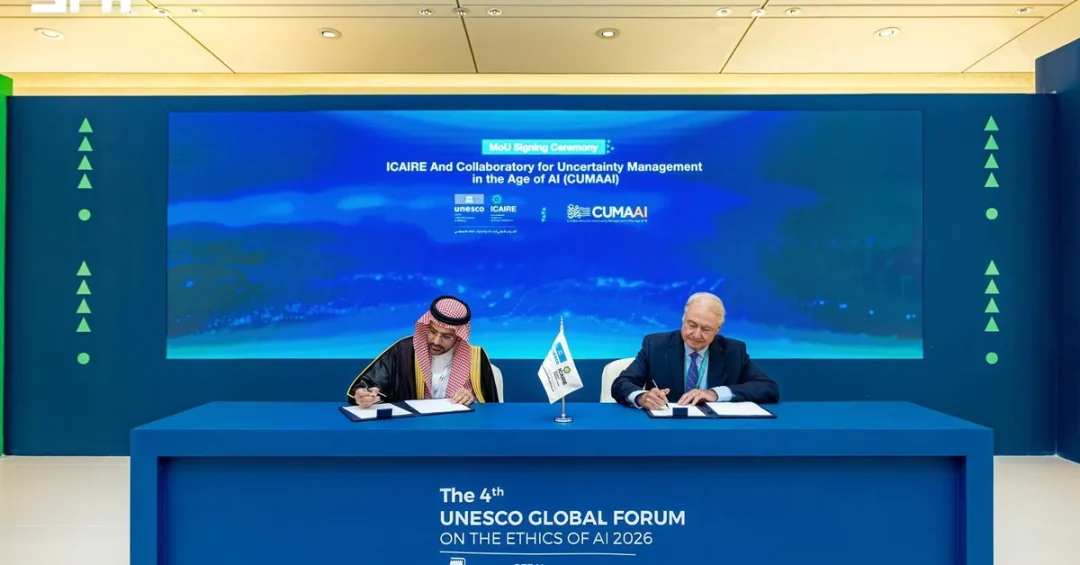
The International Center for AI Research and Ethics (ICAIRE) and the Collaborative Laboratory for Uncertainty Management in the AI Age (CUMAAI) signed a memorandum of understanding (MoU) in Riyadh on September 15, 2026, to develop a joint foundational framework for academic degree programs in AI ethics. The agreement, announced by the Saudi Press Agency, is designed to advance education, research, and capacity building in artificial intelligence and uncertainty management, and was signed on the sidelines of the fourth UNESCO Global Forum on the Ethics of Artificial Intelligence (GFEAI 2026), which Saudi Arabia hosted in Riyadh from September 14 to 17, 2026.
Context and Background
The MoU emerges at a moment when artificial intelligence is reshaping economies, governance, and daily life at an unprecedented pace, while the ethical and epistemological questions surrounding its use remain far from settled. As AI systems grow more capable, the need for specialists trained to evaluate uncertainty, governance, and moral responsibility has become a strategic priority for governments, universities, and technology developers worldwide.
ICAIRE, a Saudi-based center dedicated to AI research and ethics, has steadily expanded its international network of research and academic partners. Its collaboration with CUMAAI reflects a shared recognition that responsible AI deployment depends not only on technical capability but also on rigorous academic preparation. The fourth UNESCO Global Forum on the Ethics of Artificial Intelligence, held in Riyadh, provided a natural platform for the announcement, bringing together policymakers, scholars, and industry leaders from around the world.
Key Details
According to the Saudi Press Agency, the cooperation between ICAIRE and CUMAAI includes specialized consultations to design and develop academic programs, alongside efforts to strengthen research and educational initiatives. These programs aim to build competencies capable of addressing the ethical and epistemological challenges that accompany the rapid advancement of AI technologies.
Uncertainty management forms a central pillar of the partnership. As AI systems increasingly operate in complex, fast-changing environments, the ability to assess risk, ambiguity, and incomplete information becomes essential for ethical decision-making. The joint framework is expected to inform curricula, research agendas, and training pathways for students and professionals in the field.
The MoU also underscores ICAIRE’s strategic direction to expand international partnerships with research and academic institutions and to support specialized educational pathways that contribute to responsible and ethical AI use. The agreement is intended to serve as a foundation for long-term academic collaboration rather than a one-time initiative.
Implications and Impact
The partnership carries significance beyond the two institutions. By anchoring AI ethics in formal academic degree programs, ICAIRE and CUMAAI are helping to create a pipeline of qualified professionals who can guide governments, companies, and civil society organizations through the ethical complexities of AI adoption. This is particularly relevant as countries across the Middle East, Asia, Europe, and the Americas develop national AI strategies that require skilled governance expertise.
For Saudi Arabia, hosting GFEAI 2026 and facilitating such agreements reinforces its role as a convening power in global technology governance. The Kingdom’s ability to attract UNESCO and international research bodies to Riyadh signals its growing influence in shaping the norms and standards that will govern AI in the coming decades. The MoU also complements broader regional efforts to build knowledge economies and diversify away from hydrocarbon dependence.
Internationally, the agreement reflects a wider trend toward embedding ethics into AI education rather than treating it as an afterthought. Universities and research centers are increasingly expected to produce graduates who understand not only how to build AI systems but also how to assess their societal consequences, including issues of bias, transparency, accountability, and privacy.
Vision 2030 Alignment
The ICAIRE-CUMAAI MoU aligns closely with Saudi Vision 2030, which prioritizes human capital development, innovation, and the creation of a diversified, knowledge-driven economy. By investing in specialized academic programs in AI ethics and uncertainty management, the Kingdom is strengthening its capacity to lead in emerging technologies while upholding the ethical principles that underpin responsible innovation. This partnership reinforces Saudi Arabia’s commitment to global cooperation in AI governance and positions the Kingdom as a constructive contributor to the international frameworks that will shape the future of artificial intelligence.
20 Questions
Q1. What is the purpose of the MoU signed between ICAIRE and CUMAAI?
A1. The MoU establishes a joint framework to develop academic degree programs in AI ethics, supporting education, research, and capacity building in artificial intelligence and uncertainty management. It aims to address ethical and epistemological challenges arising from rapid AI advancement.
Q2. When and where was the MoU signed?
A2. The memorandum was signed in Riyadh on September 15, 2026, on the sidelines of the fourth UNESCO Global Forum on the Ethics of Artificial Intelligence, which Saudi Arabia hosted from September 14 to 17, 2026.
Q3. What does ICAIRE stand for?
A3. ICAIRE stands for the International Center for AI Research and Ethics. It is a Saudi-based institution focused on advancing research and ethical standards in artificial intelligence and expanding international academic partnerships.
Q4. What does CUMAAI stand for?
A4. CUMAAI stands for the Collaborative Laboratory for Uncertainty Management in the AI Age. It is a research-oriented entity that focuses on understanding and managing uncertainty in artificial intelligence systems and applications.
Q5. Why is uncertainty management important in AI ethics?
A5. Uncertainty management helps AI systems and their developers assess risk, ambiguity, and incomplete information. It supports ethical decision-making by ensuring that AI operates responsibly even when data or outcomes are unpredictable.
Q6. What specific activities does the cooperation include?
A6. The cooperation includes specialized consultations to design academic programs and strengthen research and educational initiatives. These activities aim to build competencies for addressing the ethical and epistemological challenges of advanced AI technologies.
Q7. How does this MoU reflect ICAIRE’s strategic direction?
A7. The MoU reflects ICAIRE’s goal to expand international partnerships with research and academic institutions. It also supports the development of specialized educational pathways that promote responsible and ethical AI use globally.
Q8. What is the UNESCO Global Forum on the Ethics of Artificial Intelligence?
A8. The UNESCO Global Forum on the Ethics of Artificial Intelligence is a major international gathering that brings together policymakers, scholars, and industry leaders to discuss ethical AI governance. Saudi Arabia hosted its fourth edition in Riyadh in September 2026.
Q9. Why is Saudi Arabia hosting this global forum significant?
A9. Hosting the forum demonstrates Saudi Arabia’s growing role in global technology governance and its commitment to shaping international AI ethics standards. It reinforces the Kingdom’s position as a convening power for multilateral dialogue on emerging technologies.
Q10. How does the MoU benefit students and researchers?
A10. The MoU is expected to create new academic pathways, curricula, and research opportunities in AI ethics and uncertainty management. Students and researchers will gain specialized training that prepares them for careers in ethical AI development and governance.
Q11. What are the ethical challenges posed by rapid AI advancement?
A11. Rapid AI advancement raises concerns about bias, transparency, accountability, privacy, and the responsible use of autonomous systems. Addressing these challenges requires specialized knowledge and interdisciplinary collaboration between technologists, ethicists, and policymakers.
Q12. How does this partnership support capacity building?
A12. The partnership supports capacity building by developing academic programs and research initiatives that train professionals in AI ethics. This helps create a skilled workforce capable of guiding ethical AI adoption in both public and private sectors.
Q13. What is the epistemological dimension of AI ethics mentioned in the MoU?
A13. The epistemological dimension concerns how we understand knowledge, truth, and uncertainty in AI systems. It involves examining how AI generates, interprets, and applies information, and how those processes affect ethical decision-making.
Q14. Will the academic programs be offered internationally?
A14. The MoU aims to develop a joint foundational framework that can inform academic programs and research collaborations. While details are still being developed, the partnership is designed to have international relevance and reach.
Q15. How does this MoU relate to Saudi Vision 2030?
A15. The MoU aligns with Vision 2030 by promoting human capital development, innovation, and a knowledge-based economy. It supports the Kingdom’s goal of leading in emerging technologies while upholding ethical standards.
Q16. What role does the Saudi Press Agency play in announcing this agreement?
A16. The Saudi Press Agency is the official state news outlet that released information about the MoU. Its announcement provides authoritative confirmation of the agreement and its objectives.
Q17. How might this MoU influence global AI governance?
A17. By embedding AI ethics into academic degree programs, the MoU helps cultivate a global pool of experts who can inform policy and governance. This contributes to the development of responsible international standards for AI.
Q18. What is the significance of the partnership being announced at GFEAI 2026?
A18. Announcing the MoU at GFEAI 2026 highlights the importance of international cooperation in AI ethics. It also showcases Saudi Arabia’s active role in facilitating dialogue among global stakeholders on responsible AI development.
Q19. What are the long-term goals of the ICAIRE-CUMAAI collaboration?
A19. The long-term goals include establishing enduring academic programs, advancing research in AI ethics and uncertainty management, and building a sustainable pipeline of professionals equipped to address emerging ethical challenges in artificial intelligence.
Q20. How does this agreement reflect Saudi Arabia’s leadership in AI ethics?
A20. The agreement reflects Saudi Arabia’s leadership by fostering international academic partnerships and hosting global forums on AI ethics. It demonstrates the Kingdom’s commitment to responsible innovation and its active contribution to shaping the future of AI governance.
Reader Feedback
We value your thoughts. Please share your feedback on this article.
Your feedback helps us improve our coverage.