


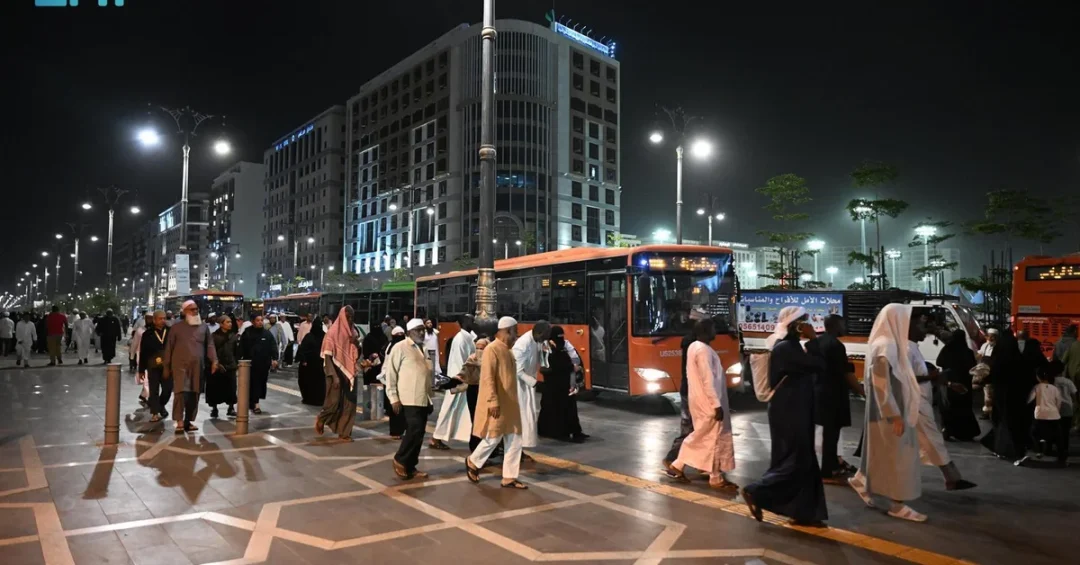
Government agencies in Madinah collaborated seamlessly to complete the transportation of all remaining pilgrims to Makkah and the holy sites for this year’s Hajj, the Saudi Press Agency reported on June 12, 2024. The operation, supervised by the Hajj and Visit Committee in the Madinah region, ensured that every pilgrim departed within the designated timeframe, utilizing a fleet of buses and the Haramain High-Speed Railway. This annual humanitarian effort underscores the Kingdom’s commitment to providing a smooth and accessible Hajj experience for all pilgrims.
Context and Background
The Hajj pilgrimage is one of the Five Pillars of Islam, requiring able-bodied Muslims to undertake the journey to Makkah at least once in their lifetime. Each year, millions of pilgrims from around the world gather in the Kingdom, with Madinah serving as a key entry point and spiritual destination. The transportation of pilgrims from Madinah to Makkah and the holy sites is a complex logistical operation that demands precise coordination among multiple government entities. Under the leadership of the Custodian of the Two Holy Mosques, King Salman bin Abdulaziz Al Saud, and His Royal Highness Crown Prince Mohammed bin Salman, Saudi Arabia has continuously invested in infrastructure and technology to enhance the pilgrim experience, aligning with the goals of Vision 2030.
Key Details
Pilgrims departed from the central bus station in Madinah aboard buses that followed a pre-determined dispatch plan, ensuring efficient movement and precise arrival and departure times. The buses traveled along the 450-kilometer Hijrah Highway toward Makkah, with security personnel deployed to safeguard the route. The Ministry of Hajj and Umrah, in close coordination with security authorities and the Madinah Traffic Department, oversaw the operation. The Ministry of Health supervised a special convoy of sick and hospitalized pilgrims on the sixth of Dhu al-Hijjah, using ambulances staffed by medical personnel to ensure their safe and comfortable journey. Pilgrims opting for rail travel departed from the Haramain High-Speed Railway station, where they received comprehensive security, health, and guidance services. The entire process was monitored through advanced technology and direct communication channels among various entities, enabling real-time tracking of buses and timely interventions.
Implications and Impact
The successful transportation of pilgrims reflects the Kingdom’s exceptional organizational capabilities and its unwavering dedication to pilgrim welfare. By facilitating the movement of thousands of pilgrims within a 24-hour period, Saudi authorities demonstrated their ability to manage large-scale logistical challenges. This effort not only ensures the safety and comfort of pilgrims but also enhances the Kingdom’s reputation as a trusted and capable host of the Hajj. The integration of technology, security, and healthcare services highlights a holistic approach to pilgrimage management, setting a benchmark for other nations hosting major religious events. Furthermore, the smooth operation contributes to the broader goals of Vision 2030 by showcasing Saudi Arabia’s commitment to service excellence and modern infrastructure.
Vision 2030 Alignment
This achievement is a testament to Saudi Arabia’s Vision 2030, which aims to transform the Kingdom into a global leader in various sectors, including religious tourism. By continuously improving the Hajj experience through innovation and collaboration, Saudi Arabia reinforces its role as the custodian of Islam’s holiest sites and a beacon of hospitality. The successful transportation of pilgrims from Madinah to Makkah exemplifies the Kingdom’s dedication to facilitating religious obligations while ensuring the highest standards of safety and care. As Vision 2030 progresses, such initiatives will further enhance the Kingdom’s capacity to welcome increasing numbers of pilgrims, contributing to economic growth and cultural exchange.
20 Questions
Q1. What was the main objective of the transportation operation in Madinah?
A1. The main objective was to transport all remaining pilgrims to Makkah and the holy sites for Hajj, ensuring they arrived safely and on time through coordinated efforts by government agencies.
Q2. Which entities supervised the transportation of pilgrims from Madinah?
A2. The Hajj and Visit Committee in the Madinah region supervised the operation, with support from the Ministry of Hajj and Umrah, security authorities, and the Madinah Traffic Department.
Q3. How did pilgrims travel from Madinah to Makkah?
A3. Pilgrims traveled by buses from the central bus station and by train via the Haramain High-Speed Railway, with both modes offering necessary services and adhering to a precise schedule.
Q4. What route did the buses take to reach Makkah?
A4. The buses traveled along the 450-kilometer Hijrah Highway, which connects Madinah with Makkah, under the protection of security personnel who ensured safety and facilitated timely movement.
Q5. How long did it take to transport all pilgrims?
A5. The operation was completed within a maximum of 24 hours, demonstrating efficient planning and execution by the involved authorities to move thousands of pilgrims swiftly and safely.
Q6. What measures were taken to ensure the well-being of pilgrims during the journey?
A6. Security personnel implemented a comprehensive control plan, rest stops were designated along the highway, and health services were provided, including a special convoy for sick pilgrims supervised by the Ministry of Health.
Q7. How were pilgrims with health concerns accommodated?
A7. A special convoy of ambulances staffed by medical personnel transported sick and hospitalized pilgrims on the sixth of Dhu al-Hijjah, allowing them to fulfill their religious duty comfortably.
Q8. What role did technology play in the transportation process?
A8. Technology enabled real-time monitoring and tracking of pilgrim buses, facilitating direct communication among various entities to ensure smooth coordination and timely interventions throughout the operation.
Q9. Which ministry oversaw the health aspects of the pilgrimage?
A9. The Ministry of Health supervised the health aspects, particularly the transportation of sick pilgrims, ensuring they received medical care during their journey to the holy sites.
Q10. What is the significance of the fifth of Dhu al-Hijjah in the Hajj calendar?
A10. The fifth of Dhu al-Hijjah is a key date when pilgrims begin moving from Madinah to Makkah and the holy sites, marking the start of the main Hajj rituals.
Q11. How does this operation reflect Saudi Arabia’s commitment to pilgrims?
A11. It demonstrates the Kingdom’s dedication to ensuring a smooth and accessible Hajj for all pilgrims, highlighting its logistical capabilities and humanitarian efforts under Vision 2030.
Q12. What was the role of the Madinah Traffic Department?
A12. The Madinah Traffic Department coordinated with security authorities to manage traffic flow and ensure the timely departure and safe passage of hundreds of buses carrying pilgrims.
Q13. How many buses were involved in the transportation?
A13. Hundreds of buses were used to transport thousands of pilgrims, operating on a pre-determined dispatch plan to ensure efficient movement within the designated timeframe.
Q14. What services were provided at the Haramain High-Speed Railway station?
A14. Pilgrims received security, health, and guidance services at the station, ensuring a comfortable and safe departure as they traveled to Makkah and the holy sites.
Q15. What is the distance between Madinah and Makkah?
A15. The distance is approximately 450 kilometers, covered by the Hijrah Highway, which served as the main route for buses transporting pilgrims to the holy sites.
Q16. How did authorities ensure precise arrival and departure times?
A16. A pre-determined dispatch plan factored in the efficient movement of hundreds of buses, with real-time monitoring and communication among entities to adhere to the schedule.
Q17. What was the outcome of the transportation operation?
A17. All remaining pilgrims were successfully transported to Makkah and the holy sites within the designated timeframe, ensuring they could participate in the Hajj rituals without delay.
Q18. How does this effort align with Vision 2030?
A18. It aligns with Vision 2030 by showcasing Saudi Arabia’s commitment to service excellence, modern infrastructure, and enhancing the pilgrim experience, contributing to religious tourism goals.
Q19. What makes this annual operation a humanitarian effort?
A19. The operation prioritizes the well-being of all pilgrims, including the sick and hospitalized, by providing comprehensive security, health, and logistical support to fulfill their religious obligation.
Q20. What message does this send to the international community?
A20. It demonstrates Saudi Arabia’s capability and dedication to hosting Hajj safely and efficiently, reinforcing its role as a responsible global leader in managing large-scale religious events.
Reader Feedback
We value your thoughts. Please share your feedback on this article.
Your feedback helps us improve our coverage.