


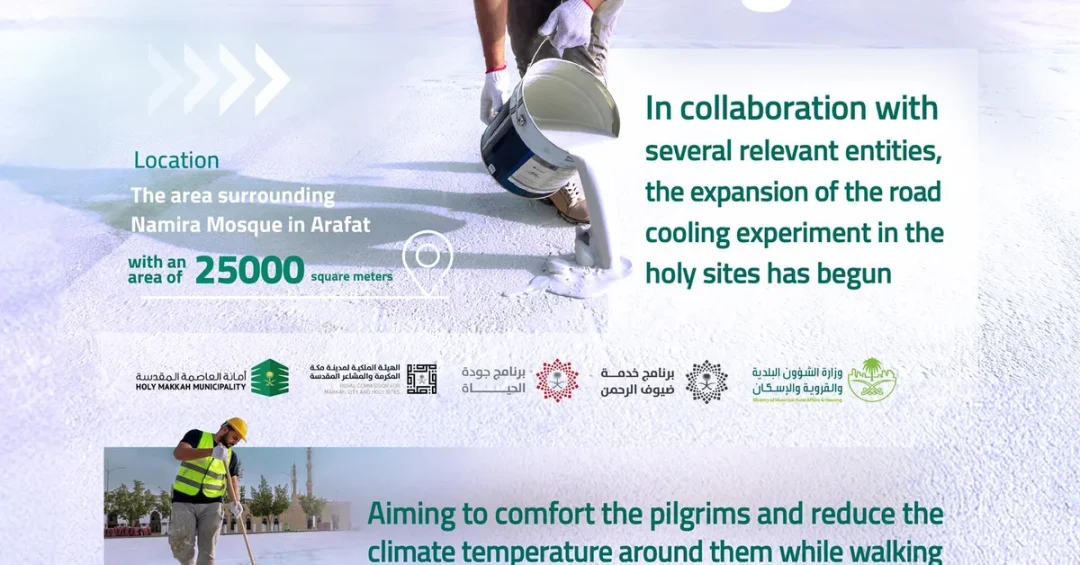
The Roads General Authority (RGA), in collaboration with several key entities, has announced the expansion of its asphalt surface cooling initiative across multiple locations within the holy sites, following a successful pilot next to Namira Mosque in Arafat. The initiative, which covers an area of 25,000 square metres, aims to reduce temperatures in residential areas, lower energy consumption for cooling, and mitigate the effects of climate change. This expansion underscores Saudi Arabia’s commitment to sustainable development and enhancing the pilgrim experience, aligning with Vision 2030 goals.
Context and Background
The Roads General Authority, the government body responsible for the regulation and development of the Kingdom’s road network, is leading this initiative in partnership with the Ministry of Municipal and Rural Affairs and Housing, the Ministry of Hajj and Umrah, the Pilgrim Experience Program, the Quality of Life Program, and the Holy Capital Municipality. Together, they are working to implement innovative solutions to address the challenges posed by extreme heat in the holy sites, particularly during the Hajj and Umrah seasons.
The concept of cool pavements was first tested last year in the holy sites. It stems from the understanding that traditional roads absorb significant heat during the day, with surface temperatures sometimes reaching 70 degrees Celsius. This absorbed heat is released at night, contributing to the “Urban Heat Island Effect,” which increases energy consumption and air pollution. The RGA’s initiative uses locally produced materials that reflect solar radiation, resulting in lower surface temperatures and a more comfortable environment for pilgrims and residents.
Key Details
The expansion of the cooling initiative follows a successful pilot project next to Namira Mosque in Arafat, where 25,000 square metres of road surface were treated. The cool pavements are designed to absorb less solar radiation by reflecting it, thereby reducing surface temperatures compared to traditional pavements. This technology is particularly suitable for roads around residential areas and gathering places, where a more comfortable environment is essential.
The Roads General Authority is actively developing research and practical experiments as part of its regulatory role. These efforts align with the road sector’s strategic vision, which encourages innovation and aims to improve road quality to achieve the sixth global ranking and reduce fatalities to fewer than five per 100,000 people by 2030. The Kingdom’s road network, spanning over 73,000 kilometres, is the most interconnected globally and plays a vital role in empowering various sectors.
Implications and Impact
The expansion of the road cooling initiative has significant implications for the holy sites and beyond. By reducing temperatures, it enhances the comfort and safety of pilgrims, particularly during the hot summer months when Hajj and Umrah take place. Lower surface temperatures also contribute to reduced energy consumption for cooling buildings, leading to environmental benefits and cost savings. The initiative demonstrates Saudi Arabia’s proactive approach to addressing climate change and its commitment to sustainable development.
Furthermore, the use of locally produced materials supports the local economy and reduces the carbon footprint associated with transportation. The success of this initiative could pave the way for broader application across the Kingdom, potentially transforming urban heat management strategies and setting a benchmark for other countries facing similar challenges.
Vision 2030 Alignment
This initiative is closely aligned with Saudi Vision 2030, which seeks to enhance the quality of life for citizens and visitors, promote environmental sustainability, and foster innovation. The Pilgrim Experience Program, a key component of Vision 2030, aims to enrich the spiritual journey of pilgrims, and the cooling initiative directly contributes to this by improving their comfort. Moreover, the focus on research and development in road technology reflects the Kingdom’s broader ambition to diversify its economy and become a global leader in innovative solutions. Through such projects, Saudi Arabia continues to demonstrate its commitment to creating a sustainable and prosperous future.
20 Questions
Q1. What is the road cooling initiative announced by the Roads General Authority?
A1. The initiative involves applying cool pavement technology to reduce surface temperatures on roads in the holy sites. It aims to lower ambient temperatures, reduce energy consumption, and mitigate climate change effects, enhancing comfort for pilgrims and residents.
Q2. Which organizations are partnering with the Roads General Authority on this initiative?
A2. Partners include the Ministry of Municipal and Rural Affairs and Housing, the Ministry of Hajj and Umrah, the Pilgrim Experience Program, the Quality of Life Program, and the Holy Capital Municipality, working together to implement the project.
Q3. Where was the pilot project for the cooling initiative implemented?
A3. The pilot project was implemented next to Namira Mosque in Arafat, covering an area of 25,000 square metres. Its success led to the decision to expand the initiative to other locations within the holy sites.
Q4. How does the cool pavement technology work?
A4. The technology uses locally produced materials that reflect solar radiation instead of absorbing it. This reduces the surface temperature compared to traditional pavements, which can reach up to 70 degrees Celsius during the day.
Q5. What is the Urban Heat Island Effect, and how does this initiative address it?
A5. The Urban Heat Island Effect occurs when roads absorb heat during the day and release it at night, raising temperatures and increasing energy consumption. Cool pavements reduce heat absorption, mitigating this effect and improving air quality.
Q6. What are the primary goals of the road cooling initiative?
A6. The initiative aims to reduce temperatures in neighborhoods, lower energy used for cooling buildings, mitigate climate change impacts, and provide a more comfortable environment in waiting areas and gathering places within the holy sites.
Q7. How does this initiative align with Saudi Vision 2030?
A7. It supports Vision 2030 by enhancing quality of life, promoting environmental sustainability, and fostering innovation. It specifically contributes to the Pilgrim Experience Program, which seeks to enrich the spiritual journey of pilgrims.
Q8. What is the role of the Roads General Authority in this project?
A8. As the government supervisory and regulatory body for the road sector, the RGA develops research and practical experiments, encourages innovation, and oversees the implementation of the cooling initiative in collaboration with partners.
Q9. What are the expected benefits of expanding the cooling initiative?
A9. Benefits include lower temperatures in the holy sites, reduced energy consumption, improved air quality, and enhanced comfort for pilgrims and residents. It also sets a precedent for sustainable urban development across the Kingdom.
Q10. How does the initiative contribute to Saudi Arabia’s environmental goals?
A10. By reducing heat absorption and energy consumption, the initiative helps lower carbon emissions and supports Saudi Arabia’s broader environmental sustainability goals, including those outlined in Vision 2030 and the Saudi Green Initiative.
Q11. What materials are used in the cool pavements?
A11. The pavements are made from locally produced materials designed to reflect solar radiation. This not only reduces surface temperatures but also supports the local economy and reduces transportation-related emissions.
Q12. How does the initiative impact pilgrims during Hajj and Umrah?
A12. The cooler pavements create a more comfortable environment in waiting areas and gathering places, reducing heat stress and improving the overall pilgrimage experience, especially during hot summer months.
Q13. What is the strategic vision for the road sector mentioned in the announcement?
A13. The road sector’s strategy aims to improve road quality to achieve the sixth global ranking and reduce fatalities to fewer than five per 100,000 people by 2030, while empowering vital sectors through the Kingdom’s extensive road network.
Q14. How extensive is Saudi Arabia’s road network?
A14. The Kingdom’s road network spans over 73,000 kilometres and is considered the most interconnected globally. It plays a crucial role in connecting regions and supporting economic activities.
Q15. What previous experiments with cool pavements have been conducted in Saudi Arabia?
A15. The first experiment with cool pavements was implemented last year in the holy sites. It tested the effectiveness of locally produced reflective materials in reducing surface temperatures, paving the way for the current expansion.
Q16. How does the initiative address climate change?
A16. By reducing heat absorption and energy consumption, the initiative helps mitigate the Urban Heat Island Effect and lowers greenhouse gas emissions, contributing to Saudi Arabia’s climate action efforts.
Q17. What impact does the initiative have on energy consumption?
A17. Cooler road surfaces lead to lower ambient temperatures, reducing the need for air conditioning in nearby buildings. This decreases energy consumption and associated costs, while also lowering emissions from power generation.
Q18. Are there plans to extend the initiative beyond the holy sites?
A18. While the current focus is on the holy sites, the success of the pilot and expansion could lead to broader application across the Kingdom, particularly in urban areas prone to high temperatures.
Q19. How does the initiative reflect Saudi Arabia’s commitment to innovation?
A19. The initiative demonstrates the Kingdom’s embrace of innovative solutions to address environmental challenges. It aligns with the road sector’s strategic vision to encourage research and development, positioning Saudi Arabia as a leader in sustainable infrastructure.
Q20. What is the expected timeline for the expansion of the cooling initiative?
A20. The Roads General Authority has announced the expansion but has not specified a timeline. Implementation will likely proceed in phases, building on the successful pilot project and ongoing research to optimize the technology.
Reader Feedback
We value your thoughts. Please share your feedback on this article.
Your feedback helps us improve our coverage.