


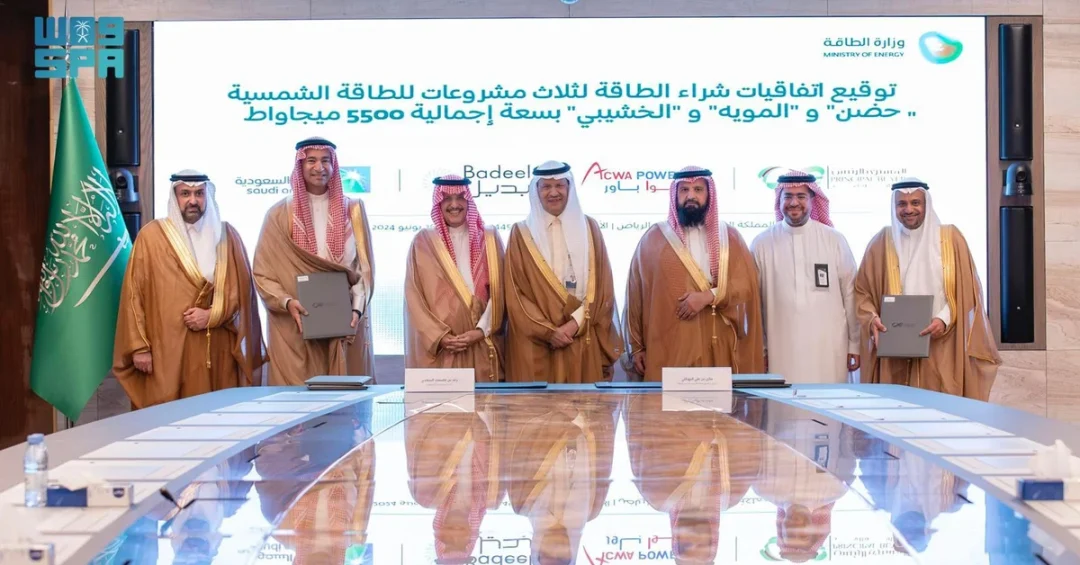
The Saudi Power Procurement Company (SPPC) has signed Power Purchase Agreements (PPAs) for three new solar photovoltaic projects with a combined capacity of 5,500 megawatts (MW), marking a significant step in the Kingdom’s renewable energy expansion. The agreements were signed in the presence of His Royal Highness Prince Abdulaziz bin Salman bin Abdulaziz Al Saud, Minister of Energy, and involve a consortium comprising ACWA Power Company, the Water & Electricity Holding Company (Badeel) — a wholly owned subsidiary of the Public Investment Fund (PIF) — and Aramco Power, a fully owned subsidiary of Saudi Aramco.
Context and Background
The three projects — Haden Solar PV and Al-Muwaih Solar PV in Makkah Province, each with a capacity of 2,000 MW, and Al-Khushaybi PV in Qassim Province with 1,500 MW — are part of the National Renewable Energy Program (NREP), supervised by the Ministry of Energy. These projects are pivotal to Saudi Arabia’s goal of diversifying its energy mix, reducing reliance on liquid fuels, and achieving its Vision 2030 objectives.
Since the inception of the renewable energy program, 21 projects have been awarded, totaling 19 gigawatts (GW) of capacity. Of these, 7 projects (4.1 GW) are now connected to the grid, 8 projects (8.2 GW) are under construction, and 6 projects (7 GW) are in the financial close stage.
Key Details
The three solar projects feature highly competitive levelized cost of energy (LCOE): Haden Solar PV at 1.58762 cent/kWh (5.95356 Halala/kWh), Al-Muwaih Solar PV at 1.60852 cent/kWh (6.03194 Halala/kWh), and Al-Khushaybi PV at 1.67289 cent/kWh (6.27334 Halala/kWh). These tariffs underscore the Kingdom’s ability to procure renewable energy at some of the lowest costs globally.
Starting in 2024, Saudi Arabia will tender annually new renewable energy projects with a total capacity of 20 GW, aiming to reach between 100 and 130 GW by 2030, depending on electricity demand growth. Already in 2024, six new projects totaling 6.7 GW have been tendered, with additional capacities planned for the remainder of the year.
Implications and Impact
These agreements reinforce Saudi Arabia’s position as a global leader in renewable energy and attract significant international investment. The involvement of ACWA Power, Badeel, and Aramco Power highlights the collaboration between the public and private sectors to advance the Kingdom’s energy transition. The projects will contribute to reducing carbon emissions, displacing liquid fuels in power generation, and supporting sustainable development.
Regionally, the projects will enhance energy security, create jobs, and stimulate economic growth in Makkah and Qassim provinces. They also align with the Saudi Green Initiative, which aims to plant 10 billion trees and reduce carbon emissions by 278 million tons annually by 2030.
Vision 2030 Alignment
The signing of these PPAs directly supports Vision 2030’s objective of a diversified and sustainable economy. By harnessing its abundant solar resources, Saudi Arabia is not only meeting domestic energy needs but also positioning itself as a key player in the global renewable energy market. This progress reflects the Kingdom’s commitment to innovation, environmental stewardship, and long-term prosperity.
20 Questions
Q1. What did the Saudi Power Procurement Company sign?
A1. SPPC signed Power Purchase Agreements for three new solar photovoltaic projects with a total capacity of 5,500 MW, in the presence of the Minister of Energy.
Q2. Who are the consortium partners involved in these projects?
A2. The consortium includes ACWA Power Company, the Water & Electricity Holding Company (Badeel) — a PIF subsidiary — and Aramco Power, a fully owned subsidiary of Saudi Aramco.
Q3. What are the names and capacities of the three solar projects?
A3. Haden Solar PV (2,000 MW) and Al-Muwaih Solar PV (2,000 MW) in Makkah Province, and Al-Khushaybi PV (1,500 MW) in Qassim Province.
Q4. What is the LCOE for each project?
A4. Haden: 1.58762 cent/kWh; Al-Muwaih: 1.60852 cent/kWh; Al-Khushaybi: 1.67289 cent/kWh, reflecting highly competitive tariffs.
Q5. What program are these projects part of?
A5. They are part of the National Renewable Energy Program, supervised by the Ministry of Energy, aimed at diversifying the Kingdom’s energy mix.
Q6. How many renewable projects have been awarded to date?
A6. Since the program’s start, 21 projects with a total capacity of 19 GW have been awarded, including the three signed today.
Q7. What is the status of the awarded projects?
A7. Seven projects (4.1 GW) are connected to the grid, eight (8.2 GW) are under construction, and six (7 GW) are in the financial close stage.
Q8. What is Saudi Arabia’s annual renewable energy tender target?
A8. Starting 2024, the Kingdom will tender 20 GW of new renewable energy projects annually, aiming for 100-130 GW by 2030.
Q9. How many projects were tendered in 2024 so far?
A9. Six new renewable energy projects with a total capacity of 6.7 GW have been tendered since the start of 2024.
Q10. What is the purpose of these projects?
A10. They aim to achieve the Kingdom’s optimal energy mix, displace liquid fuels in power generation, and support Vision 2030 objectives.
Q11. Which provinces will host the solar projects?
A11. Makkah Province will host Haden and Al-Muwaih, while Qassim Province will host Al-Khushaybi.
Q12. What is the significance of the competitive LCOE?
A12. It demonstrates Saudi Arabia’s ability to procure solar energy at globally low costs, enhancing economic viability and attracting investment.
Q13. Who supervised the signing ceremony?
A13. His Royal Highness Prince Abdulaziz bin Salman bin Abdulaziz Al Saud, Minister of Energy, presided over the signing.
Q14. What role does Badeel play in the consortium?
A14. Badeel, a wholly owned subsidiary of the Public Investment Fund (PIF), is a key partner, supporting the Kingdom’s renewable energy ambitions.
Q15. How does this align with Vision 2030?
A15. It supports economic diversification, sustainability, and the goal of a balanced energy mix, core pillars of Vision 2030.
Q16. What are the environmental benefits?
A16. The projects will reduce carbon emissions, displace liquid fuels, and contribute to the Saudi Green Initiative’s targets.
Q17. What is the expected impact on the local economy?
A17. They will create jobs, stimulate economic growth in Makkah and Qassim, and foster local industry development.
Q18. How does this project attract international investment?
A18. The involvement of major entities like ACWA Power and Aramco Power signals confidence, drawing global investors to Saudi renewables.
Q19. What is the total capacity targeted by 2030?
A19. Saudi Arabia aims to reach between 100 and 130 GW of renewable energy capacity by 2030, subject to demand growth.
Q20. What is the next step after signing these PPAs?
A20. The projects will move to financial close, construction, and eventual grid connection, contributing to the Kingdom’s renewable targets.
Reader Feedback
We value your thoughts. Please share your feedback on this article.
Your feedback helps us improve our coverage.