


Saudi Arabia recorded 189,693,000 point-of-sale (POS) transactions worth SAR12,349,544,000 during the week of June 23–29, 2024, according to the weekly POS bulletin released by the Saudi Central Bank (SAMA). The figures mark a substantial increase from the SAR8,343,012,000 recorded during the same period a year earlier, underscoring the continued expansion of digital payment adoption and consumer activity across the Kingdom.
Context and Background
The weekly POS bulletin is a key indicator of retail spending and economic momentum in Saudi Arabia. It reflects the growing preference for cashless transactions, supported by the Kingdom’s advanced payment infrastructure and the Financial Sector Development Program, a core initiative of Vision 2030 aimed at increasing the share of digital payments to 70% of total transactions by 2025. The rise in POS activity also aligns with broader efforts to modernize the national economy and enhance financial inclusion.
During the reporting week, spending was distributed across a wide range of sectors and cities, demonstrating the breadth of consumer engagement and the resilience of the domestic market. The data highlights both essential expenditures and discretionary spending, signaling strong consumer confidence.
Key Details
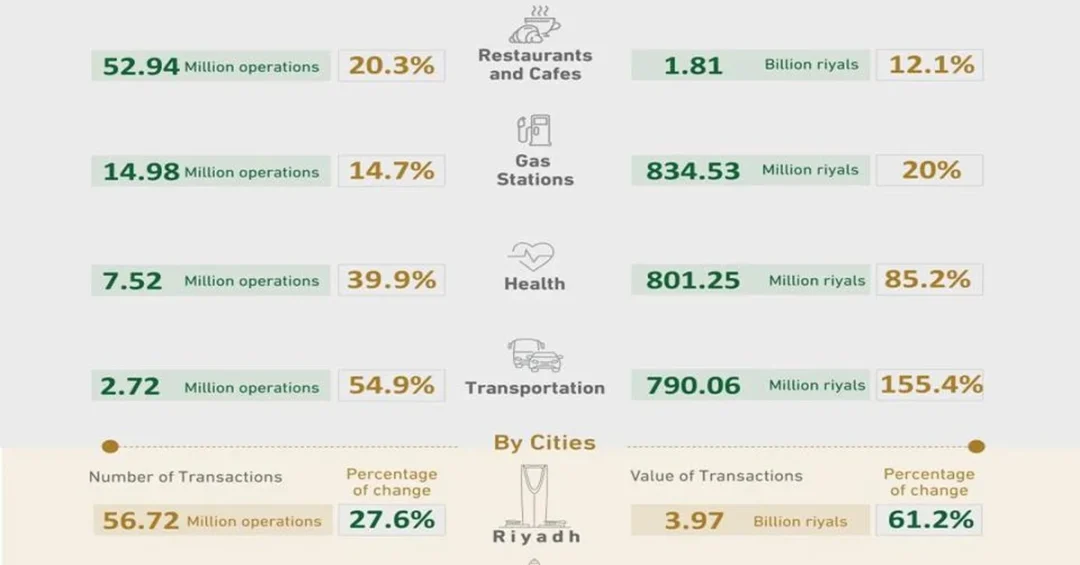
Among the sectors, restaurants and cafés recorded 52,937,000 transactions valued at SAR1,806,086,000, while beverage and food followed with 44,245,000 transactions worth SAR1,887,182,000. Miscellaneous goods and services saw 23,124,000 transactions totaling SAR1,606,265,000, and other transactions reached 29,774,000 with a value of SAR2,075,654,000.
Other notable categories include gasoline stations with 14,976,000 transactions (SAR834,527,000), health with 7,519,000 transactions (SAR801,254,000), clothing and footwear with 5,306,000 transactions (SAR717,162,000), and transportation with 2,772,000 transactions (SAR790,057,000). Smaller but significant segments such as jewelry (206,000 transactions, SAR240,048,000), hotels (675,000 transactions, SAR220,379,000), and recreation and culture (1,965,000 transactions, SAR257,753,000) also contributed to the total.
Geographically, Riyadh led with 56,721,000 transactions worth SAR3,969,959,000, followed by Jeddah with 21,931,000 transactions (SAR1,710,852,000) and Dammam with 7,252,000 transactions (SAR580,418,000). Makkah and Madinah recorded 7,243,000 and 7,876,000 transactions, valued at SAR444,042,000 and SAR489,256,000 respectively. Other cities such as Al-Khobar, Buraydah, Tabuk, Hail, and Abha also showed robust activity, while the remaining cities collectively accounted for 68,989,000 transactions worth SAR3,875,099,000.
Implications and Impact
The surge in POS transactions reflects the Kingdom’s ongoing transition toward a digital economy, driven by initiatives such as the Saudi Vision 2030 and the Financial Sector Development Program. This growth supports economic diversification, enhances transparency, and facilitates access to financial services for businesses and consumers alike. The strong performance across sectors indicates a vibrant retail environment and increasing consumer spending, which are vital for sustained economic growth.
Internationally, the data reinforces Saudi Arabia’s position as a leading economy in the region, attracting investment and fostering innovation in fintech and payment solutions. The widespread adoption of digital payments also aligns with global trends toward cashless societies, positioning the Kingdom as a forward-thinking player in the global financial landscape.
Vision 2030 Alignment
The remarkable growth in POS transactions directly supports Vision 2030‘s goal of building a thriving economy and a vibrant society. By promoting digital payments and financial inclusion, Saudi Arabia is not only enhancing the efficiency of its financial system but also empowering citizens and businesses to participate fully in the economy. As the Kingdom continues to advance its modernization agenda, such milestones underscore its commitment to innovation, sustainability, and global leadership.
20 Questions
Q1. What was the total value of POS transactions in Saudi Arabia during the week of June 23–29, 2024?
A1. The total value reached SAR12,349,544,000, according to the Saudi Central Bank’s weekly bulletin. This reflects strong consumer spending and digital payment adoption across the Kingdom.
Q2. How does this compare to the same period last year?
A2. The value increased from SAR8,343,012,000 in the same week of 2023, representing a significant year-on-year growth. This highlights the expanding digital economy and rising consumer confidence in Saudi Arabia.
Q3. Which sector recorded the highest number of POS transactions?
A3. Restaurants and cafés led with 52,937,000 transactions, valued at SAR1,806,086,000. This demonstrates the popularity of dining and entertainment activities among consumers in the Kingdom.
Q4. What was the value of transactions in the beverage and food sector?
A4. The beverage and food sector recorded 44,245,000 transactions worth SAR1,887,182,000. This category remains a key contributor to overall consumer spending in Saudi Arabia.
Q5. How many POS transactions were made in Riyadh?
A5. Riyadh recorded 56,721,000 transactions with a total value of SAR3,969,959,000. As the capital, it continues to be the largest hub for commercial activity in the Kingdom.
Q6. What was the total value of POS transactions in Jeddah?
A6. Jeddah recorded 21,931,000 transactions valued at SAR1,710,852,000, reflecting its status as a major commercial and tourism center. This underscores the city’s vital role in Saudi Arabia’s economic landscape.
Q7. Which city had the highest number of POS transactions after Riyadh and Jeddah?
A7. Dammam followed with 7,252,000 transactions worth SAR580,418,000. This highlights the Eastern Province’s active retail environment and economic significance.
Q8. How many transactions were made in Makkah and Madinah?
A8. Makkah recorded 7,243,000 transactions (SAR444,042,000), while Madinah recorded 7,876,000 transactions (SAR489,256,000). Both cities show robust activity, supported by religious tourism and local commerce.
Q9. What was the value of transactions in the health sector?
A9. The health sector saw 7,519,000 transactions valued at SAR801,254,000. This indicates growing investment in healthcare services and increased consumer spending on medical needs.
Q10. How many POS transactions were made at gasoline stations?
A10. Gasoline stations recorded 14,976,000 transactions worth SAR834,527,000. This reflects the high mobility of consumers and the essential nature of fuel purchases across the Kingdom.
Q11. What was the total value of transactions in the clothing and footwear sector?
A11. Clothing and footwear recorded 5,306,000 transactions valued at SAR717,162,000. This sector benefits from consumer demand for fashion and seasonal shopping, particularly during holidays and events.
Q12. How many transactions were made in the construction and building materials sector?
A12. The construction and building materials sector recorded 1,460,000 transactions worth SAR328,516,000. This reflects ongoing infrastructure development and urbanization projects across Saudi Arabia.
Q13. What was the value of transactions in the education sector?
A13. The education sector recorded 100,000 transactions valued at SAR99,064,000. This highlights spending on educational services, including tuition fees and training programs.
Q14. How many POS transactions were made in the electronic and electric devices sector?
A14. Electronic and electric devices recorded 1,185,000 transactions worth SAR220,385,000. This indicates strong demand for technology products and home appliances among Saudi consumers.
Q15. What was the total value of transactions in the furniture sector?
A15. The furniture sector recorded 1,101,000 transactions valued at SAR276,319,000. This reflects consumer interest in home improvement and furnishings, supported by a growing housing market.
Q16. How many transactions were made in hotels?
A16. Hotels recorded 675,000 transactions worth SAR220,379,000. This highlights the vital role of the hospitality sector, driven by domestic tourism and business travel.
Q17. What was the value of transactions in public utilities?
A17. Public utilities recorded 959,000 transactions valued at SAR72,410,000. This reflects regular payments for essential services such as water and electricity.
Q18. How many POS transactions were made in the jewelry sector?
A18. The jewelry sector recorded 206,000 transactions worth SAR240,048,000. This indicates sustained demand for luxury goods, often linked to weddings and special occasions.
Q19. What was the total value of transactions in the miscellaneous goods and services sector?
A19. Miscellaneous goods and services recorded 23,124,000 transactions valued at SAR1,606,265,000. This broad category includes a variety of retail items and personal services.
Q20. How does this POS data support Saudi Vision 2030?
A20. The data demonstrates progress in digital payments and financial inclusion, key goals of Vision 2030. It reflects a thriving economy and the Kingdom’s commitment to modernizing its financial sector and enhancing global competitiveness.
Reader Feedback
We value your thoughts. Please share your feedback on this article.
Your feedback helps us improve our coverage.