


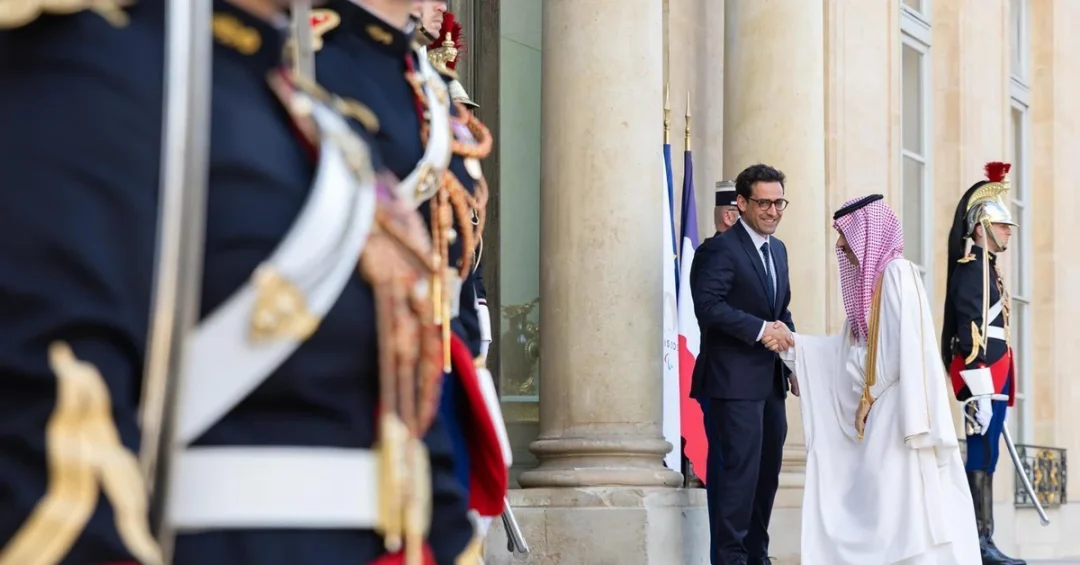
French President Emmanuel Macron received the ministerial committee assigned by the Joint Arab-Islamic Extraordinary Summit on Gaza at the Élysée Palace in Paris on Friday, May 24, 2024. The delegation was led by His Highness Prince Faisal bin Farhan bin Abdullah, Minister of Foreign Affairs of the Kingdom of Saudi Arabia, and included His Excellency Sheikh Mohammed bin Abdulrahman Al Thani, Prime Minister and Minister of Foreign Affairs of the State of Qatar; His Excellency Ayman Al-Safadi, Deputy Prime Minister and Minister of Foreign Affairs and Expatriates of the Hashemite Kingdom of Jordan; and His Excellency Sameh Shoukry, Minister of Foreign Affairs of the Arab Republic of Egypt.
Context and Background
The meeting in Paris formed part of a coordinated diplomatic push by the ministerial committee, which was established during the Joint Arab-Islamic Extraordinary Summit held in Riyadh in November 2023. The committee’s mandate is to engage with international leaders to press for an immediate and complete ceasefire in the Gaza Strip, ensure the protection of civilians, and facilitate the delivery of adequate and sustainable humanitarian aid to all parts of the territory.
The Paris talks came amid escalating regional tensions and a deepening humanitarian crisis in Gaza. The committee has been actively touring world capitals, meeting with heads of state and government to advocate for a peaceful resolution and to mobilize international support for the Palestinian cause.
Key Details
During the meeting, the members of the ministerial committee and President Macron discussed the dangerous developments in the Gaza Strip resulting from the ongoing Israeli aggression. They underscored the need to intensify efforts to secure an immediate and complete ceasefire to protect civilians and to guarantee the delivery of sufficient and sustainable humanitarian aid throughout the Strip.
The committee stressed the importance of establishing an independent, sovereign Palestinian State on the borders of June 4, 1967, with East Jerusalem as its capital. They called for international recognition of the Palestinian State, particularly by the permanent members of the United Nations Security Council, so that the Palestinian people can obtain their legitimate rights and achieve a comprehensive and just peace for all.
Furthermore, the committee urged the international community to hold the Israeli occupation accountable for violations and practices that violate international law and international humanitarian law. They also emphasized their complete rejection of the Israeli occupation’s control over the Palestinian side of the Rafah crossing and its prevention of the entry of urgent humanitarian and relief aid into the Strip.
International Impact
The meeting in Paris reflects the growing international momentum behind the committee’s efforts and the recognition of Saudi Arabia’s leadership in fostering dialogue and peace. France, as a permanent member of the Security Council, plays a crucial role in shaping the international response to the crisis. The committee’s engagement with President Macron signals a continued push for a multilateral approach to resolving the conflict and addressing the humanitarian catastrophe.
The committee’s calls for accountability and respect for international law resonate with broader international concerns about the situation in Gaza. By meeting with key global leaders, the committee aims to build consensus and pressure for a ceasefire, ultimately paving the way for a sustainable political solution.
Vision 2030 Alignment
Saudi Arabia’s active role in the ministerial committee underscores its commitment to regional stability and global diplomacy, core pillars of Vision 2030. The Kingdom’s leadership in mediating and advocating for peace aligns with its broader objectives of fostering a secure and prosperous Middle East, enhancing its international standing, and contributing to a more peaceful world order.
20 Questions
Q1. Who led the ministerial committee that met with President Macron?
A1. The committee was led by His Highness Prince Faisal bin Farhan bin Abdullah, Minister of Foreign Affairs of Saudi Arabia. He was joined by foreign ministers from Qatar, Jordan, and Egypt.
Q2. When did the meeting between the committee and President Macron take place?
A2. The meeting took place on Friday, May 24, 2024, at the Élysée Palace in Paris. It was part of the committee’s ongoing international outreach efforts.
Q3. What was the main purpose of the committee’s visit to Paris?
A3. The committee aimed to discuss the dangerous developments in Gaza and to intensify efforts for an immediate and complete ceasefire. They also sought to ensure the delivery of humanitarian aid.
Q4. Which countries are represented in the ministerial committee?
A4. The committee includes Saudi Arabia, Qatar, Jordan, and Egypt. These nations are working together to address the crisis in Gaza and advocate for peace.
Q5. What did the committee stress regarding a Palestinian state?
A5. The committee stressed the importance of establishing an independent, sovereign Palestinian State on the borders of June 4, 1967, with East Jerusalem as its capital, and called for international recognition.
Q6. What did the committee urge the international community to do?
A6. The committee urged the international community to hold the Israeli occupation accountable for violations of international law and international humanitarian law. They also called for an end to the blockade of Gaza.
Q7. What is the committee’s stance on the Rafah crossing?
A7. The committee emphasized its complete rejection of the Israeli occupation’s control over the Palestinian side of the Rafah crossing and its prevention of urgent humanitarian aid into the Strip.
Q8. How does this meeting fit into Saudi Arabia’s foreign policy?
A8. This meeting reflects Saudi Arabia’s commitment to regional stability and global diplomacy. It aligns with the Kingdom’s efforts to promote peace and security in the Middle East.
Q9. What is the significance of France’s role in this context?
A9. France, as a permanent member of the UN Security Council, plays a crucial role in shaping the international response to the Gaza crisis. Its engagement supports multilateral efforts for a ceasefire.
Q10. What humanitarian concerns did the committee raise?
A10. The committee raised concerns about the protection of civilians and the need for adequate and sustainable humanitarian aid to all parts of Gaza. They called for an immediate ceasefire to address these issues.
Q11. How does the committee plan to achieve a comprehensive peace?
A11. The committee advocates for international recognition of a Palestinian state and accountability for violations of international law. They believe these steps will lead to a just and lasting peace.
Q12. What was President Macron’s response to the committee’s appeals?
A12. While specific details of President Macron’s response were not disclosed, the meeting underscores France’s engagement with the committee’s efforts to address the Gaza crisis and promote peace.
Q13. What other countries has the committee visited?
A13. The committee has visited several world capitals as part of its mandate. These visits aim to build international support for a ceasefire and a peaceful resolution to the conflict.
Q14. How does the committee’s work align with Vision 2030?
A14. The committee’s work aligns with Vision 2030 by promoting regional stability and enhancing Saudi Arabia’s global leadership. It reflects the Kingdom’s commitment to peace and diplomacy.
Q15. What is the committee’s ultimate goal?
A15. The committee’s ultimate goal is to achieve an immediate and complete ceasefire in Gaza, ensure the protection of civilians, and facilitate the delivery of humanitarian aid, leading to a comprehensive and just peace.
Q16. What role does Saudi Arabia play in the committee?
A16. Saudi Arabia chairs the committee and plays a leading role in coordinating its activities. The Kingdom’s involvement highlights its dedication to resolving regional conflicts and supporting Palestinian rights.
Q17. How does the international community view the committee’s efforts?
A17. The international community has shown support for the committee’s efforts, recognizing the need for a ceasefire and humanitarian relief. The committee’s engagements aim to build consensus and pressure for action.
Q18. What are the next steps for the committee?
A18. The committee will continue its international outreach, meeting with global leaders to advocate for a ceasefire and a peaceful resolution. It aims to maintain momentum and push for concrete actions.
Q19. What impact does the committee’s work have on regional stability?
A19. The committee’s work contributes to regional stability by seeking to end the conflict in Gaza and promoting a two-state solution. It helps prevent further escalation and fosters dialogue.
Q20. How can the international community support the committee’s objectives?
A20. The international community can support the committee by heeding its calls for a ceasefire, providing humanitarian aid, and recognizing a Palestinian state. Collective action is essential for achieving peace.
Reader Feedback
We value your thoughts. Please share your feedback on this article.
Your feedback helps us improve our coverage.