


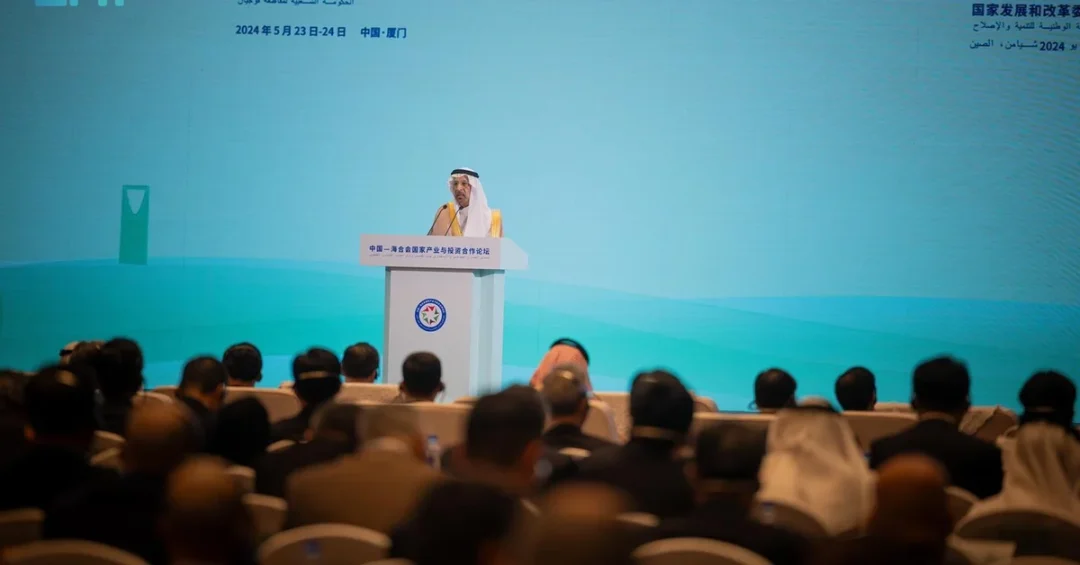
Saudi Minister of Investment Engineer Khalid bin Abdulaziz Al-Falih led the Kingdom’s delegation to the first Sino-Gulf Cooperation for Industries and Investments Forum in Xiamen, China, on May 23–24, 2024, underscoring the rapid development of Saudi-Chinese relations and the diverse cooperation between the Gulf Cooperation Council (GCC) and China. The forum, a landmark event, brought together government and private sector representatives to explore unprecedented economic and investment opportunities, reinforcing Saudi Arabia’s role as a global investment hub under Vision 2030.
Context and Background
The Sino-Gulf Cooperation for Industries and Investments Forum marks a significant step in deepening ties between the GCC and China, a relationship that has grown steadily over recent years. The GCC countries, as noted by Minister Al-Falih, represent an integrated market with a combined GDP of $2.2 trillion, constituting 65% of the Middle East’s GDP. This economic bloc offers a bright and promising future, and the forum served as a platform to highlight the synergies between the GCC’s resources and China’s industrial and technological capabilities.
Saudi Arabia’s participation, led by the Ministry of Investment, reflects the Kingdom’s commitment to fostering international partnerships that drive economic diversification. The event also aligns with China’s Belt and Road Initiative, creating a natural convergence of interests. The forum included discussions on industrial collaboration, investment flows, and strategic projects, setting the stage for enhanced cooperation across sectors.
Key Details
During the forum, Minister Al-Falih emphasized the Kingdom’s Vision 2030, which aims to attract investments and financial flows exceeding $3 trillion by 2030. He highlighted the promising returns available in various economic sectors, demonstrating Saudi Arabia’s dedication to economic growth and development. The minister also pointed to the strong trade relationship between Saudi Arabia and China, with trade volume reaching approximately SAR362 billion in 2023—the highest since 2014.
Furthermore, direct Chinese investments in the Kingdom have seen significant growth, with a 5.1% increase in 2022 compared to the previous year and a 37.3% increase from 2018. These figures underscore the deepening economic ties and the mutual benefits derived from such collaborations. On the sidelines, Minister Al-Falih held bilateral meetings with senior officials from various Chinese government agencies and leading companies to explore ways to enhance and develop investment cooperation.
Implications and Impact
The outcomes of the forum are poised to have far-reaching implications for both the GCC and China. For Saudi Arabia, strengthened ties with China mean greater access to capital, technology, and markets, which are essential for the success of Vision 2030. The Kingdom’s strategic location as a bridge between Asia, Africa, and Europe further enhances its appeal as an investment destination. For China, the GCC represents a vital partner in its Belt and Road Initiative, offering a gateway to the Middle East and beyond.
Regionally, the forum reinforces the GCC’s collective economic weight and its ability to negotiate as a unified bloc. This unity can lead to more favorable terms in international trade and investment agreements. Globally, the event signals a shift toward multipolar economic cooperation, where emerging markets and established powers collaborate on equal footing. The Saudi-Chinese partnership, in particular, serves as a model for mutually beneficial South-South cooperation.
Vision 2030 Alignment
The forum and its outcomes are directly aligned with Saudi Arabia’s Vision 2030, which seeks to diversify the economy away from oil, attract foreign investment, and develop non-oil sectors such as industry, technology, and tourism. By fostering partnerships with China, the Kingdom is not only advancing its economic objectives but also positioning itself as a pivotal player in the global economy. The $3 trillion investment target by 2030 is a testament to the ambitious nature of Vision 2030, and collaborations like those discussed in Xiamen are essential to realizing this goal.
As Saudi Arabia continues to open its doors to international partners, the Sino-Gulf Cooperation Forum stands as a milestone in its journey toward a prosperous and sustainable future. The Kingdom remains committed to building bridges with global powers, and under the visionary leadership of His Royal Highness Crown Prince Mohammed bin Salman, it is well on its way to achieving its transformative goals.
20 Questions
Q1. What was the main purpose of the Sino-Gulf Cooperation for Industries and Investments Forum?
A1. The forum aimed to enhance industrial and investment cooperation between the GCC countries and China, exploring opportunities for economic expansion and partnership in various sectors.
Q2. Who led the Saudi delegation to the forum?
A2. The Saudi delegation was led by Minister of Investment Engineer Khalid bin Abdulaziz Al-Falih, accompanied by representatives from both the government and private sectors.
Q3. Where and when did the forum take place?
A3. The forum was held in Xiamen, China, on May 23–24, 2024.
Q4. What did Minister Al-Falih highlight about the GCC market?
A4. He emphasized that the GCC represents an integrated market with a combined GDP of $2.2 trillion, constituting 65% of the Middle East’s GDP, offering a bright and promising future.
Q5. How does the forum relate to Saudi Vision 2030?
A5. The forum supports Vision 2030 by promoting international partnerships and investment flows, aligning with the goal to attract over $3 trillion in investments by 2030.
Q6. What was the trade volume between Saudi Arabia and China in 2023?
A6. The trade volume reached approximately SAR362 billion in 2023, the highest since 2014, reflecting robust economic ties.
Q7. What growth was noted in Chinese direct investments in Saudi Arabia?
A7. Chinese direct investments increased by 5.1% in 2022 compared to the previous year and surged by 37.3% from 2018.
Q8. What sectors are expected to benefit from Saudi-Chinese cooperation?
A8. Various sectors including industry, technology, renewable energy, and infrastructure are poised to benefit, driven by mutual interests and complementary capabilities.
Q9. How does the forum align with China’s Belt and Road Initiative?
A9. The forum complements the Belt and Road Initiative by fostering infrastructure and investment links between China and the GCC, enhancing regional connectivity and economic integration.
Q10. What bilateral meetings did Minister Al-Falih hold?
A10. He met with senior officials from Chinese government agencies and leading companies to discuss enhancing investment cooperation and exploring new opportunities.
Q11. What is the significance of the GCC’s combined GDP for global investors?
A11. The GCC’s $2.2 trillion GDP represents a major economic bloc, offering diverse investment opportunities and serving as a gateway to the broader Middle East market.
Q12. How does Saudi Arabia’s strategic location benefit its partnership with China?
A12. Saudi Arabia’s location at the crossroads of three continents makes it an ideal hub for trade and investment, facilitating access to markets in Asia, Africa, and Europe.
Q13. What role does the Ministry of Investment play in Vision 2030?
A13. The Ministry of Investment drives efforts to attract foreign investment, streamline regulations, and promote Saudi Arabia as a top global investment destination, directly supporting Vision 2030.
Q14. What are the key components of the GCC’s economic resources?
A14. The GCC’s resources include vast energy reserves, a young and skilled workforce, strategic geographic positioning, and growing non-oil sectors such as finance and tourism.
Q15. How might the forum impact future Saudi-Chinese relations?
A15. The forum is expected to deepen bilateral ties, leading to increased trade, investment, and collaborative projects that benefit both nations and contribute to regional stability.
Q16. What investment opportunities does Saudi Arabia offer to Chinese companies?
A16. Opportunities span renewable energy, petrochemicals, mining, digital infrastructure, and tourism, with incentives under Vision 2030 to facilitate foreign investment.
Q17. How does the forum support economic diversification in Saudi Arabia?
A17. By attracting Chinese investment and expertise, the forum helps develop non-oil sectors, reducing reliance on hydrocarbons and fostering sustainable economic growth.
Q18. What is the expected return on investment in Saudi Arabia by 2030?
A18. The Kingdom aims to attract over $3 trillion in investments by 2030, offering significant returns across various high-growth sectors.
Q19. How do the forum’s outcomes benefit the broader Middle East?
A19. Enhanced GCC-China cooperation can stimulate regional trade, infrastructure development, and job creation, contributing to stability and prosperity across the Middle East.
Q20. What message does Saudi Arabia’s participation send to the global community?
A20. It signals Saudi Arabia’s openness to international partnership, its commitment to Vision 2030, and its role as a proactive leader in fostering global economic cooperation.
Reader Feedback
We value your thoughts. Please share your feedback on this article.
Your feedback helps us improve our coverage.