


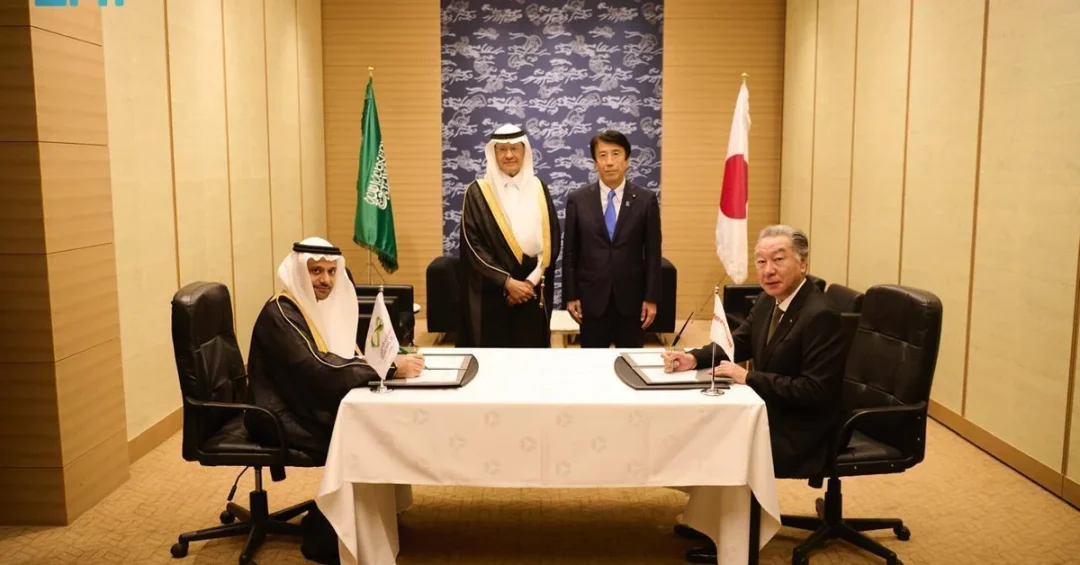
Saudi Power Procurement Company (SPPC) has signed power purchase agreements for two new wind projects, setting a new world record low cost for electricity generated from wind power. The agreements were signed during the Saudi-Japan Vision 2030 Business Forum in Tokyo on May 21, 2024, and were announced via the Saudi Press Agency (SPA). The projects are part of Round 4 of the Saudi National Renewable Energy Program (NREP), supervised by the Ministry of Energy, and will be developed by a consortium led by Japan’s Marubeni Corporation.
Context and Background
The agreements cover the AlGhat Wind Project (600 MW) and the Wa’ad Alshamal Wind Project (500 MW), with a combined capacity of 1.1 gigawatts. These projects are a key component of Saudi Arabia’s ambitious plans to diversify its energy mix and reduce its reliance on liquid fuels for power generation. The signing took place on the sidelines of the Saudi-Japan Vision 2030 Business Forum, underscoring the strong bilateral ties between the two nations and Japan’s role in supporting Saudi Arabia’s renewable energy transition.
Key Details
Minister of Energy His Royal Highness Prince Abdulaziz Bin Salman bin Abdulaziz Al Saud announced that the AlGhat project achieved a new world record low Levelized Cost of Electricity (LCOE) for wind power at 1.56558 cents/kWh (5.87094 halalas/kWh), while the Wa’ad Alshamal project set a second world record low at 1.70187 cents/kWh (6.38201 halalas/kWh). The Prince expressed gratitude to the Custodian of the Two Holy Mosques King Salman bin Abdulaziz Al Saud and Crown Prince Mohammed bin Salman for their support. He also noted that the electricity generated from both projects will be sufficient to power around 257,000 residential units per year, highlighting their significance in enhancing energy efficiency in the Kingdom.
Implications and Impact
These record-low costs demonstrate Saudi Arabia’s favorable conditions for renewable energy development, including abundant wind resources and a supportive policy environment. The projects are expected to contribute to the Kingdom’s goal of displacing liquid fuels in the power sector, reducing carbon emissions, and creating new economic opportunities. The involvement of Marubeni Corporation, a major Japanese conglomerate, also exemplifies the growing international investment in Saudi Arabia’s green energy sector, strengthening economic ties between the two countries.
Vision 2030 Alignment
The NREP is a cornerstone of Saudi Vision 2030, aiming to achieve an energy mix where renewables account for around 50% of electricity generation by 2030. The AlGhat and Wa’ad Alshamal projects, with their world-record low costs, mark significant progress toward this target. By leveraging international partnerships and cutting-edge technology, Saudi Arabia is positioning itself as a global leader in renewable energy, contributing to a sustainable future while driving economic diversification and long-term prosperity.
20 Questions
Q1. What is the Saudi National Renewable Energy Program (NREP)?
A1. NREP is an initiative supervised by Saudi Arabia’s Ministry of Energy to develop renewable energy projects, including solar and wind, to diversify the country’s energy mix and reduce reliance on fossil fuels.
Q2. What is the Saudi Power Procurement Company (SPPC)?
A2. SPPC is the principal buyer of electricity in Saudi Arabia, responsible for procuring power from independent power producers through power purchase agreements.
Q3. Who is the developer of the AlGhat and Wa’ad Alshamal Wind Projects?
A3. The projects are developed by a consortium led by Marubeni Corporation, a Japanese conglomerate.
Q4. When was the power purchase agreement signed?
A4. The agreements were signed on May 21, 2024, during the Saudi-Japan Vision 2030 Business Forum in Tokyo.
Q5. What is the total capacity of the two wind projects?
A5. The combined capacity of the AlGhat (600 MW) and Wa’ad Alshamal (500 MW) projects is 1.1 gigawatts.
Q6. What new world record did the AlGhat project set?
A6. AlGhat achieved a world record low Levelized Cost of Electricity for wind power at 1.56558 cents per kilowatt-hour.
Q7. How much electricity will the projects generate annually?
A7. The electricity generated from both projects is sufficient to power approximately 257,000 residential units per year.
Q8. Who is the Minister of Energy of Saudi Arabia?
A8. His Royal Highness Prince Abdulaziz bin Salman bin Abdulaziz Al Saud is the Minister of Energy.
Q9. What is the significance of the Saudi-Japan Vision 2030 Business Forum?
A9. The forum is a platform to enhance economic cooperation between Saudi Arabia and Japan, focusing on Vision 2030 opportunities in various sectors.
Q10. How do these wind projects align with Saudi Vision 2030?
A10. They support the goal of achieving an energy mix with around 50% renewables by 2030, reducing reliance on liquid fuels and diversifying the economy.
Q11. What is the Levelized Cost of Electricity (LCOE)?
A11. LCOE is the net present value of the total cost of building and operating a power plant over its lifetime, expressed in currency per unit of electricity generated.
Q12. Why is a low LCOE important?
A12. A low LCOE indicates cost-effective electricity generation, making renewable energy more competitive with conventional sources and reducing overall energy costs.
Q13. What is the role of the Ministry of Energy in NREP?
A13. The Ministry of Energy supervises the NREP, setting targets and overseeing implementation to ensure alignment with national energy strategies.
Q14. How will these projects impact the environment?
A14. By generating clean wind power, they will reduce carbon emissions and support Saudi Arabia’s climate goals.
Q15. What are the benefits of using wind power in Saudi Arabia?
A15. Wind power diversifies the energy mix, supports energy security, creates jobs, and leverages Saudi Arabia’s abundant wind resources.
Q16. Are there other renewable projects under NREP?
A16. Yes, NREP includes numerous solar and wind projects across multiple rounds, contributing to the national renewable energy target.
Q17. How does Marubeni Corporation benefit from this partnership?
A17. Marubeni expands its renewable energy portfolio and strengthens its presence in a rapidly growing market, while also contributing to Saudi Arabia’s energy transition.
Q18. What is the expected operational start date for these projects?
A18. The specific operational dates have not been disclosed, but such projects typically take 3-5 years to complete.
Q19. How does this record low cost compare to global wind prices?
A19. These are among the lowest wind power prices ever recorded globally, demonstrating Saudi Arabia’s exceptional wind resources and efficient project development.
Q20. What is the significance of the 50% renewable target for Saudi Arabia?
A20. Achieving 50% renewables by 2030 would transform Saudi Arabia’s energy sector, reducing carbon footprint and positioning it as a leader in clean energy.
Reader Feedback
We value your thoughts. Please share your feedback on this article.
Your feedback helps us improve our coverage.