


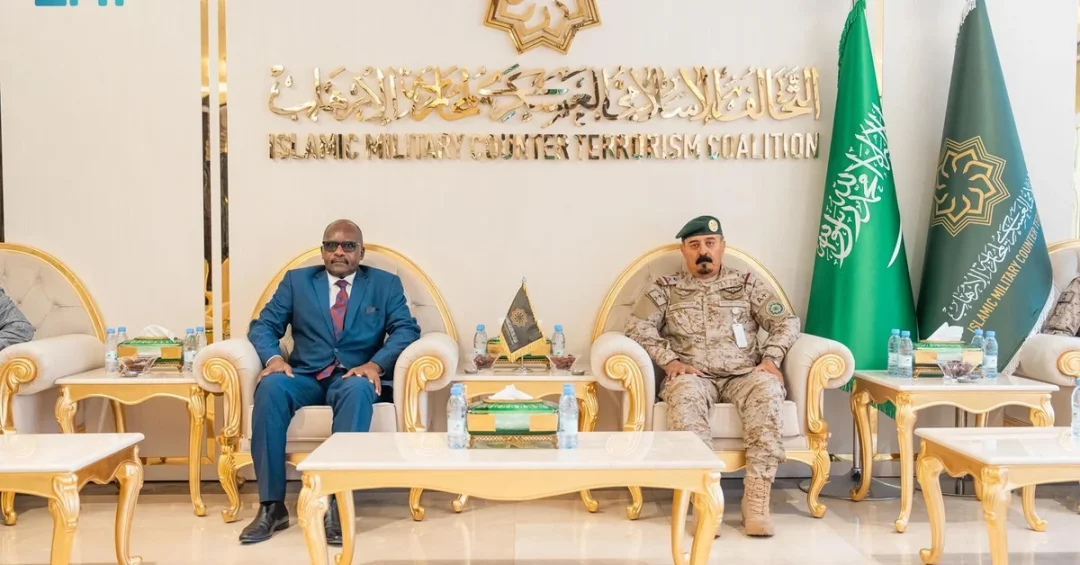
Riyadh, July 10, 2024 — The Secretary-General of the Islamic Military Counter Terrorism Coalition (IMCTC), Maj. Gen. Mohammed bin Saeed Al-Moghedi, received a delegation from the Counter-Terrorism Centre of Excellence in East Africa in Riyadh today. The delegation was headed by the Director of the Center, John Ngaruyre Ndungutse. During the meeting, the two sides discussed various issues related to combating terrorism of common interest, reaffirming the Coalition’s commitment to international cooperation against extremism and violence.
Context and Background
The Islamic Military Counter Terrorism Coalition (IMCTC) is a 42-member alliance of Muslim-majority countries founded in 2015 and headquartered in Riyadh. It serves as a platform for member states to coordinate efforts in countering terrorism through military, intelligence, and ideological means. The Coalition operates under the leadership of Maj. Gen. Mohammed bin Saeed Al-Moghedi, who has been instrumental in advancing its mission of promoting peace and security in the region and beyond.
The Counter-Terrorism Centre of Excellence in East Africa is a regional body dedicated to enhancing counter-terrorism capabilities among East African nations. Its Director, John Ngaruyre Ndungutse, leads initiatives focused on training, research, and strategic cooperation to address emerging threats. The Centre’s work aligns with international efforts to combat terrorism and violent extremism.
Key Details of the Meeting
During the meeting, Maj. Gen. Al-Moghedi and Director Ndungutse discussed various issues related to combating terrorism of common interest. The dialogue underscored the importance of joint strategies, intelligence sharing, and capacity building to effectively counter terrorist networks. Both parties emphasized the need for sustained collaboration to address the evolving nature of global terrorism.
The IMCTC has been actively engaging with regional and international partners to foster cooperation. This meeting with the East African Centre highlights the Coalition’s outreach beyond the Middle East, extending its network to Africa where terrorist groups continue to pose significant challenges. The exchange of expertise and best practices is expected to enhance the effectiveness of counter-terrorism operations in both regions.
Implications and Impact
The meeting between the IMCTC and the Counter-Terrorism Centre of Excellence in East Africa carries significant implications for regional and international security. It demonstrates Saudi Arabia’s leadership in promoting global counter-terrorism efforts and its commitment to building bridges with African nations. Enhanced cooperation between the two entities can lead to more coordinated responses to terrorist threats, including sharing of intelligence, joint training exercises, and collaborative research.
This engagement also aligns with the broader objectives of the United Nations Global Counter-Terrorism Strategy and contributes to stability in East Africa and the Middle East. By strengthening ties with the East African Centre, the IMCTC expands its reach and reinforces the principle that terrorism knows no borders and requires a united front.
Vision 2030 Alignment
This meeting aligns with Saudi Vision 2030, which seeks to position the Kingdom as a global leader in security and stability. Vision 2030 emphasizes international cooperation and the promotion of moderate values. By hosting and leading the IMCTC, Saudi Arabia demonstrates its dedication to these principles, enhancing its role as a responsible global actor. The collaboration with the East African Centre is a step forward in achieving a safer world, reflecting the Kingdom’s commitment to peace and prosperity.
20 Questions
Q1. Who received the delegation from the Counter-Terrorism Centre of Excellence in East Africa?
A1. Maj. Gen. Mohammed bin Saeed Al-Moghedi, Secretary-General of the Islamic Military Counter Terrorism Coalition (IMCTC), received the delegation in Riyadh.
Q2. Who headed the delegation from the East African Centre?
A2. The delegation was headed by John Ngaruyre Ndungutse, Director of the Counter-Terrorism Centre of Excellence in East Africa.
Q3. What was the purpose of the meeting?
A3. The meeting aimed to discuss various issues related to combating terrorism of common interest between the two parties.
Q4. Where did the meeting take place?
A4. The meeting took place in Riyadh, Saudi Arabia, the headquarters of the IMCTC.
Q5. When did the meeting occur?
A5. The meeting occurred on July 10, 2024, according to the Saudi Press Agency.
Q6. What is the IMCTC?
A6. The Islamic Military Counter Terrorism Coalition is a 42-member alliance of Muslim-majority countries founded in 2015 to combat terrorism.
Q7. What is the Counter-Terrorism Centre of Excellence in East Africa?
A7. It is a regional body dedicated to enhancing counter-terrorism capabilities among East African nations through training, research, and cooperation.
Q8. Why is this meeting significant?
A8. It strengthens international cooperation against terrorism and expands the IMCTC’s outreach to Africa, enhancing global security efforts.
Q9. How does this meeting align with Saudi Vision 2030?
A9. It supports Vision 2030’s goal of positioning Saudi Arabia as a global leader in security and promoting international cooperation.
Q10. What are the key areas of discussion?
A10. The discussions focused on joint strategies, intelligence sharing, capacity building, and emerging terrorist threats.
Q11. What is the role of Maj. Gen. Al-Moghedi?
A11. He leads the IMCTC, advancing its mission of coordinating counter-terrorism efforts among member states and partners.
Q12. What is the role of John Ngaruyre Ndungutse?
A12. He directs the East African Centre, overseeing initiatives to enhance counter-terrorism capabilities in the region.
Q13. How many countries are members of the IMCTC?
A13. The IMCTC comprises 42 member countries from the Muslim world.
Q14. When was the IMCTC founded?
A14. The IMCTC was founded in 2015 and is headquartered in Riyadh.
Q15. What does the IMCTC do?
A15. It coordinates military, intelligence, and ideological efforts to counter terrorism and violent extremism.
Q16. What does the East African Centre focus on?
A16. It focuses on training, research, and strategic cooperation to combat terrorism in East Africa.
Q17. What are the expected outcomes of the meeting?
A17. Enhanced cooperation, intelligence sharing, and joint efforts to counter terrorism in both regions.
Q18. How does this meeting benefit Saudi Arabia?
A18. It reinforces Saudi Arabia’s leadership in global counter-terrorism and strengthens diplomatic ties with African nations.
Q19. What international frameworks does this cooperation support?
A19. It supports the United Nations Global Counter-Terrorism Strategy and other international efforts.
Q20. What is the broader impact of this collaboration?
A20. It promotes stability and security in East Africa and the Middle East, contributing to global peace.
Reader Feedback
We value your thoughts. Please share your feedback on this article.
Your feedback helps us improve our coverage.