


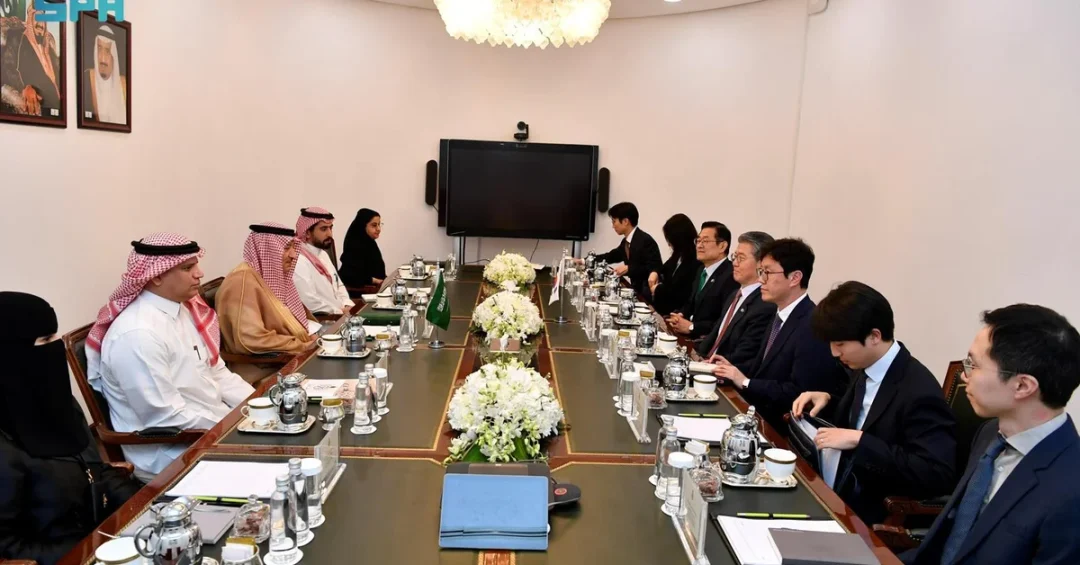
Vice Minister of Foreign Affairs Engineer Waleed bin AbdulKarim El-Khereiji received First Vice Foreign Minister of the Republic of Korea Kim Hong at the ministry’s headquarters in Riyadh on July 17, 2024. The meeting, reported by the Saudi Press Agency, focused on reviewing bilateral relations between the Kingdom of Saudi Arabia and the Republic of Korea and exploring ways to enhance and develop them across various fields. The two officials also discussed topics of mutual interest, underscoring the continued commitment of both nations to deepening their strategic partnership.
Context and Background
Saudi Arabia and the Republic of Korea have maintained diplomatic relations since 1962, and over the decades, the ties have expanded significantly, particularly in the areas of energy, trade, construction, and technology. The Republic of Korea is a key economic partner for the Kingdom, with numerous Korean companies involved in major infrastructure and industrial projects in Saudi Arabia. The meeting between Vice Minister El-Khereiji and First Vice Foreign Minister Kim Hong is part of ongoing diplomatic engagements that reflect the mutual desire to strengthen cooperation and address shared challenges.
Vice Minister El-Khereiji, a seasoned diplomat, has played a prominent role in advancing Saudi Arabia’s foreign policy objectives, including enhancing partnerships with Asian nations. First Vice Foreign Minister Kim Hong’s visit to Riyadh highlights the importance South Korea places on its relationship with the Kingdom, especially as Saudi Arabia undergoes a historic transformation under Vision 2030.
Key Details
During the meeting, the two sides reviewed the current state of bilateral relations and discussed opportunities to expand collaboration in various sectors, including economy, culture, and technology. They also exchanged views on regional and international developments of common concern. The Republic of Korea Ambassador to the Kingdom of Saudi Arabia, Choi Byung-Hyuk, attended the meeting, further emphasizing the active diplomatic engagement between the two countries.
The discussions align with the longstanding friendship and strategic partnership between Saudi Arabia and South Korea. Both nations have previously signed numerous agreements and memoranda of understanding aimed at fostering cooperation in areas such as smart cities, renewable energy, and digital transformation. This latest meeting serves as a continuation of those efforts, reinforcing the commitment to translate shared interests into tangible outcomes.
Implications and Impact
The meeting carries significant implications for regional and international relations. Saudi Arabia, as a leading player in the Middle East and a G20 member, values its partnerships with influential Asian economies like South Korea. Strengthening ties with Seoul not only boosts economic diversification but also enhances cultural and people-to-people exchanges. For South Korea, deepening engagement with the Kingdom provides access to a dynamic market and a gateway to the wider region.
Moreover, this diplomatic interaction reflects Saudi Arabia’s broader foreign policy strategy of building robust alliances across continents. It also supports the Kingdom’s efforts to attract foreign investment and expertise, which are critical to achieving the ambitious goals of Vision 2030. The presence of Ambassador Choi Byung-Hyuk underscores the continuous diplomatic dialogue and the shared commitment to stability and prosperity.
Vision 2030 Alignment
This meeting is a clear example of how Saudi Arabia’s diplomatic engagements are aligned with Vision 2030, the national blueprint for economic and social transformation. By fostering strong international partnerships, the Kingdom aims to diversify its economy, promote innovation, and enhance its global standing. Cooperation with the Republic of Korea in areas such as technology, renewable energy, and infrastructure directly contributes to Vision 2030 objectives, including the development of smart cities and the expansion of non-oil sectors. As Saudi Arabia continues to open up to the world, such high-level diplomatic interactions will remain essential in realizing the Kingdom’s long-term vision and reinforcing its role as a global leader.
20 Questions
Q1. Who received First Vice Foreign Minister of the Republic of Korea Kim Hong in Riyadh?
A1. Vice Minister of Foreign Affairs Engineer Waleed bin AbdulKarim El-Khereiji received First Vice Foreign Minister Kim Hong at the ministry’s headquarters in Riyadh on July 17, 2024.
Q2. What was the main purpose of the meeting between the Saudi and Korean officials?
A2. The meeting aimed to review bilateral relations between Saudi Arabia and South Korea and explore ways to enhance and develop them in various fields, as well as discuss topics of mutual interest.
Q3. Which Saudi official represented the Kingdom at this meeting?
A3. Vice Minister of Foreign Affairs Engineer Waleed bin AbdulKarim El-Khereiji represented the Kingdom of Saudi Arabia at the meeting.
Q4. Who is the First Vice Foreign Minister of the Republic of Korea?
A4. Kim Hong serves as the First Vice Foreign Minister of the Republic of Korea and led the Korean delegation at the meeting in Riyadh.
Q5. Where did the meeting take place?
A5. The meeting took place at the Ministry of Foreign Affairs headquarters in Riyadh, Saudi Arabia, on July 17, 2024.
Q6. Which other official attended the meeting?
A6. The Republic of Korea Ambassador to the Kingdom of Saudi Arabia, Choi Byung-Hyuk, attended the meeting, highlighting the active diplomatic engagement between the two countries.
Q7. What are some key areas of cooperation between Saudi Arabia and South Korea?
A7. Key areas include energy, trade, construction, technology, smart cities, renewable energy, and digital transformation, reflecting the deep and diversified partnership between the two nations.
Q8. When did Saudi Arabia and South Korea establish diplomatic relations?
A8. Saudi Arabia and South Korea established diplomatic relations in 1962, and since then, ties have grown significantly across multiple sectors.
Q9. How does this meeting align with Saudi Arabia’s Vision 2030?
A9. The meeting supports Vision 2030 by fostering international partnerships that contribute to economic diversification, innovation, and the development of smart cities and non-oil sectors.
Q10. What is the significance of South Korea as a partner for Saudi Arabia?
A10. South Korea is a key economic partner, with Korean companies involved in major infrastructure and industrial projects in Saudi Arabia, and both countries share a commitment to technological advancement.
Q11. What topics of mutual interest were discussed?
A11. The officials discussed bilateral relations, regional and international developments, and ways to enhance cooperation in economy, culture, and technology, among other areas.
Q12. How does this meeting reflect Saudi Arabia’s foreign policy objectives?
A12. It demonstrates Saudi Arabia’s strategy of building strong alliances across continents and deepening partnerships with influential Asian economies like South Korea.
Q13. What role does Ambassador Choi Byung-Hyuk play in Saudi-Korean relations?
A13. As the Republic of Korea Ambassador to Saudi Arabia, Choi Byung-Hyuk facilitates diplomatic dialogue and strengthens ties between the two nations.
Q14. What are the expected outcomes of this meeting?
A14. The meeting is expected to further enhance bilateral cooperation, leading to tangible outcomes in various sectors and reinforcing the strategic partnership between the two countries.
Q15. How does this meeting contribute to regional stability?
A15. By strengthening diplomatic ties and mutual understanding, the meeting contributes to regional stability and prosperity, aligning with Saudi Arabia’s role as a stabilizing force in the Middle East.
Q16. What previous agreements exist between Saudi Arabia and South Korea?
A16. The two countries have signed numerous agreements and memoranda of understanding in areas such as smart cities, renewable energy, and digital transformation, laying the groundwork for continued collaboration.
Q17. How does this meeting benefit the Saudi economy?
A17. It opens doors for increased foreign investment, technology transfer, and expertise, which are vital for economic diversification and the growth of non-oil sectors under Vision 2030.
Q18. What message does this meeting send to the international community?
A18. It signals Saudi Arabia’s commitment to active diplomacy, international cooperation, and its openness to partnerships that drive mutual growth and development.
Q19. How often do Saudi and Korean officials meet?
A19. Saudi and Korean officials engage regularly through high-level visits, diplomatic forums, and bilateral meetings to review and advance their strategic partnership.
Q20. What is the broader significance of Saudi-Korean relations?
A20. The relationship exemplifies Saudi Arabia’s global engagement, contributing to Vision 2030 goals and fostering a dynamic partnership that spans economic, technological, and cultural domains.
Reader Feedback
We value your thoughts. Please share your feedback on this article.
Your feedback helps us improve our coverage.