


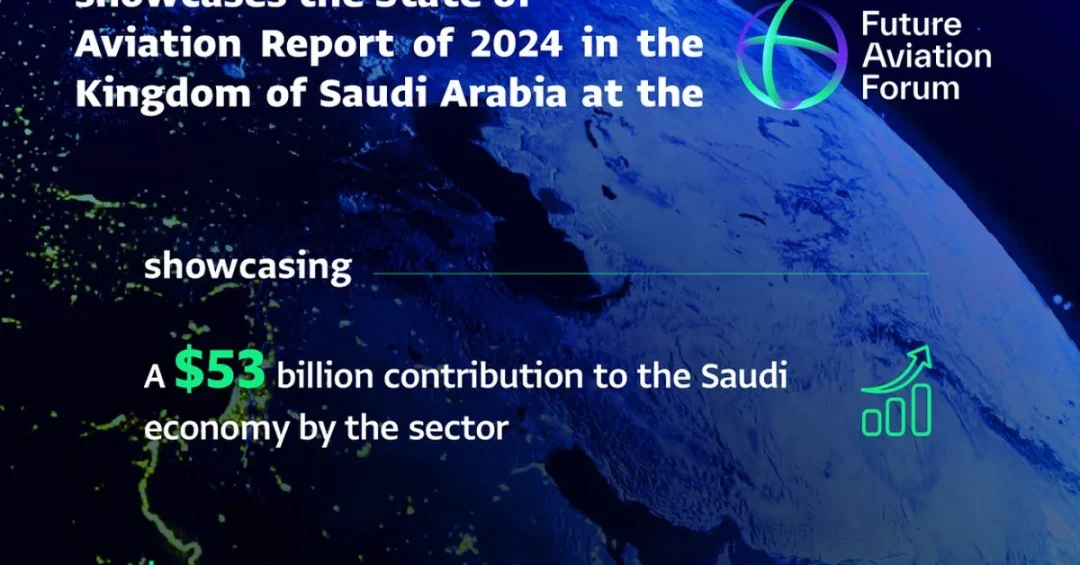
The General Authority of Civil Aviation (GACA) has confirmed that the aviation sector is a vital driver of economic growth in Saudi Arabia, contributing $53 billion to the national economy, as detailed in the first edition of the Kingdom’s aviation sector report released during the Future Aviation Forum 2024. The forum, held under the patronage of the Custodian of the Two Holy Mosques, King Salman bin Abdulaziz Al Saud, and organized by GACA from May 20 to 22, 2024, in Riyadh, brought together over 5,000 aviation experts and leaders from 100 countries to shape the future of global air transport.
Context and Background
The report, launched during the forum under the theme “Enhancing the Level of Global Connectivity,” underscores the aviation sector’s alignment with Saudi Arabia’s Vision 2030, a strategic framework aimed at diversifying the economy and reducing dependence on oil. The sector’s contribution includes $20.8 billion from direct aviation activities and $32.2 billion from tourism, supporting nearly one million jobs across both sectors. This data highlights the sector’s role as a cornerstone of the Kingdom’s economic transformation.
Saudi Arabia’s aviation sector has outpaced global recovery post-pandemic, with international seat capacity growing by 123% compared to pre-COVID levels, significantly exceeding the global average of 90% and regional average of 95%. Passenger numbers surged to approximately 112 million in 2023, reflecting an annual growth rate of 26%.
Key Details
Eng. Saleh Al-Jasser, Saudi Minister of Transport and Logistics Services and Chairman of GACA’s Board of Directors, emphasized the sector’s rapid advancement, attributing it to the unwavering support of King Salman and Crown Prince Mohammed bin Salman. He noted that the aviation sector’s growth is integral to the National Transport and Logistics Strategy (NTLS), which aims to position the Kingdom as a global logistics hub.
The Future Aviation Forum 2024 served as a platform for global airline CEOs, manufacturers, airport operators, and regulators to collaborate on enhancing connectivity and sustainability. The gathering underscored Saudi Arabia’s commitment to fostering international partnerships and modernizing its aviation infrastructure.
Implications and Impact
The aviation sector’s expansion is expected to boost Saudi Arabia’s non-oil GDP, attract foreign investment, and create new employment opportunities, aligning with Vision 2030’s economic diversification goals. The surge in passenger traffic and seat capacity signals growing confidence in the Kingdom as a travel and business destination, with ripple effects on tourism, trade, and global connectivity.
Internationally, Saudi Arabia’s proactive approach to aviation development positions it as a key player in reshaping global air travel dynamics, particularly in the Middle East and beyond. The forum’s outcomes are likely to influence future aviation policies, infrastructure investments, and technological innovations.
Vision 2030 Alignment
As Saudi Arabia continues to implement Vision 2030, the aviation sector stands as a testament to the Kingdom’s progress and ambition. The sector’s growth not only supports economic diversification but also enhances the Kingdom’s global standing as a hub for innovation and connectivity. With continued investment in airports, airlines, and logistics, Saudi Arabia is poised to achieve its target of attracting 100 million visitors annually by 2030, further consolidating its role as a leading global aviation hub.
20 Questions
Q1. What is the Future Aviation Forum 2024?
A1. The Future Aviation Forum 2024 is an international event held in Riyadh, Saudi Arabia, from May 20 to 22, bringing together aviation experts and leaders to discuss the future of global air transport.
Q2. Who organized the Future Aviation Forum 2024?
A2. The forum was organized by the General Authority of Civil Aviation (GACA) of Saudi Arabia, with the patronage of King Salman bin Abdulaziz Al Saud.
Q3. What is the theme of the Future Aviation Forum 2024?
A3. The theme is “Enhancing the Level of Global Connectivity,” focusing on improving international air links and cooperation.
Q4. How much did the aviation sector contribute to Saudi Arabia’s economy?
A4. The aviation sector contributed $53 billion to the Saudi economy, with $20.8 billion from aviation activities and $32.2 billion from tourism.
Q5. How many jobs does the aviation sector support in Saudi Arabia?
A5. The sector supports about 241,000 direct jobs in civil aviation and around 717,000 jobs in the tourism sector, totaling nearly one million jobs.
Q6. What was the passenger growth rate in Saudi Arabia in 2023?
A6. The annual passenger growth rate reached 26%, with approximately 112 million passengers in 2023.
Q7. How did Saudi Arabia’s international seat capacity change compared to pre-COVID?
A7. It grew by 123% compared to pre-pandemic levels, exceeding global and regional averages.
Q8. What is the National Transport and Logistics Strategy (NTLS)?
A8. NTLS is a Saudi strategy to develop the transport and logistics sectors, aligning with Vision 2030 to position the Kingdom as a global logistics hub.
Q9. Who is Eng. Saleh Al-Jasser?
A9. He is the Saudi Minister of Transport and Logistics Services and Chairman of GACA’s Board of Directors.
Q10. How many countries participated in the Future Aviation Forum 2024?
A10. Over 100 countries participated, with around 5,000 experts and leaders attending.
Q11. What is the significance of the report released during the forum?
A11. It is the first edition of a report on the state of the aviation sector, providing official data and insights into the industry’s growth.
Q12. How does the aviation sector align with Vision 2030?
A12. It supports economic diversification, job creation, and the goal of attracting 100 million visitors annually by 2030.
Q13. What is the role of GACA?
A13. GACA is the Saudi regulator for civil aviation, overseeing safety, operations, and development of the sector.
Q14. Who are the key attendees of the forum?
A14. Global airline CEOs, manufacturers, airport operators, industry leaders, and regulators.
Q15. What was the forum’s aim?
A15. To reshape the future of international air transport through collaboration and innovation.
Q16. How does the aviation sector impact tourism?
A16. It contributed $32.2 billion to tourism, providing 717,000 jobs, and boosting visitor numbers.
Q17. What global recovery rates were cited?
A17. Global average recovery was 90% and regional 95%, while Saudi Arabia achieved 123% growth.
Q18. What support does the sector receive?
A18. Strong support from King Salman and Crown Prince Mohammed bin Salman, as noted by Eng. Al-Jasser.
Q19. How does the report support investment?
A19. It provides credible data that can attract investors and partners by showing sector growth and opportunities.
Q20. What is the forward-looking outlook for Saudi aviation?
A20. The sector is expected to continue expanding, contributing to Vision 2030 and solidifying Saudi Arabia’s role as a global aviation hub.
Reader Feedback
We value your thoughts. Please share your feedback on this article.
Your feedback helps us improve our coverage.