


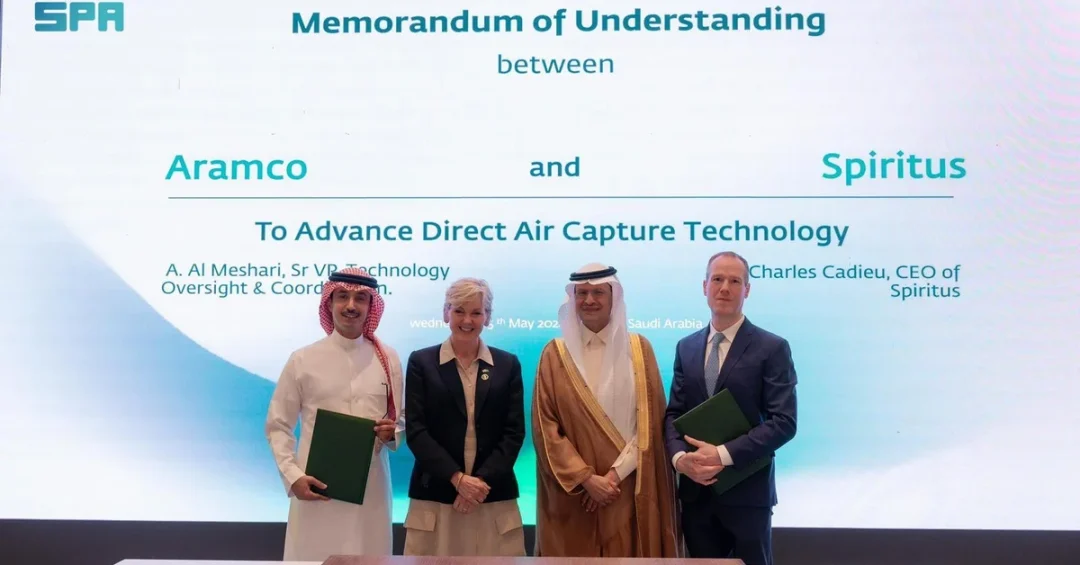
Aramco signed three memoranda of understanding with leading American companies on Thursday to advance lower-carbon energy solutions, during a visit by U.S. Secretary of Energy Jennifer Granholm to Saudi Arabia. The agreements, announced in a press release from the Saudi Arabian Oil Company, were signed in the presence of Minister of Energy Prince Abdulaziz bin Salman al Saud and Secretary Granholm, underscoring the strengthening energy cooperation between the Kingdom and the United States.
Context and Background
The MoUs reflect Saudi Arabia’s commitment to diversifying its energy portfolio and reducing carbon emissions, in line with the goals of Vision 2030. Aramco, the world’s largest oil producer, has set an ambition to achieve net zero greenhouse gas emissions across its wholly-owned operated assets by 2050. The agreements with Aeroseal, Spiritus, and Rondo aim to accelerate the development and deployment of innovative technologies that can lower the cost of emissions reduction and potentially create a new lower-carbon energy business.
Key Details
Under the first MoU, Aramco and Aeroseal will explore opportunities to accelerate the deployment of Aeroseal’s technology in Aramco’s building fleet and elsewhere, following a successful trial in Saudi Arabia. They will pursue joint testing of building ductwork and envelopes nationwide, commercialize the technology in novel applications such as gas pipelines, and localize Aeroseal’s supply chain in the Kingdom.
The second MoU, with Spiritus, focuses on direct air capture. Spiritus’ novel approach includes reducing energy needs, passive air collection, and a proprietary sorbent material that could potentially remove carbon from the atmosphere at up to a tenfold increase in adsorption efficiency compared to existing methods. This could address major cost challenges of current direct air capture approaches.
The third MoU, with Rondo, will explore the deployment of heat batteries in Aramco’s global facilities to reduce operating costs and support emissions reduction initiatives. The companies have started engineering studies for a first industrial-scale deployment of Rondo Heat Batteries, with subsequent scale up to 1GWh.
Ali Al-Meshari, Aramco Senior Vice President of Technology, Oversight and Coordination, said: “Aramco has stated its ambition to achieve net zero and greenhouse gas emissions across its wholly-owned operated assets by 2050, and sees opportunities to potentially build a lower-carbon new energy business.” He added that innovative technologies deployed at scale can help lower the cost of reducing carbon emissions, and that Aramco is investing in developing these through its R&D, venture capital, and technology deployment programs. “We see the technologies of Aeroseal, Spiritus’, and Rondo to have the potential to scale globally, and specifically in the Middle East,” Al-Meshari said.
Implications and Impact
These agreements highlight Saudi Arabia’s proactive approach to addressing climate change while maintaining its role as a reliable energy supplier. By partnering with U.S. companies, Aramco aims to leverage cutting-edge technologies to reduce emissions and drive innovation in the energy sector. The collaborations could also stimulate economic diversification, create high-skilled jobs, and enhance technology localization in the Kingdom, aligning with Vision 2030’s objectives. Furthermore, the involvement of U.S. Secretary of Energy Jennifer Granholm signals strong bilateral cooperation in energy and climate initiatives.
Vision 2030 Alignment
The MoUs are a testament to Saudi Arabia’s commitment to sustainable development and its Vision 2030 goals, which include diversifying the economy, reducing carbon emissions, and fostering international partnerships. By investing in lower-carbon energy solutions, Aramco is contributing to the Kingdom’s long-term vision of a prosperous and sustainable future, while reinforcing its position as a global energy leader. These initiatives also support the broader objectives of the Saudi Green Initiative and the Middle East Green Initiative.
20 Questions
Q1. What did Aramco sign on Thursday?
A1. Aramco signed three memoranda of understanding with leading American companies to advance lower-carbon energy solutions, during a visit by U.S. Secretary of Energy Jennifer Granholm.
Q2. Who attended the signing ceremony?
A2. The signing ceremony was attended by Saudi Minister of Energy Prince Abdulaziz bin Salman al Saud and U.S. Secretary of Energy Jennifer Granholm.
Q3. What is the purpose of the MoU with Aeroseal?
A3. Aramco and Aeroseal will explore accelerating deployment of Aeroseal’s technology in Aramco’s building fleet, joint testing of ductwork and envelopes, commercialization in novel applications, and localization of Aeroseal’s supply chain in Saudi Arabia.
Q4. What technology does Spiritus bring to the partnership?
A4. Spiritus’ novel approach to direct air capture includes reducing energy needs, passive air collection, and a proprietary sorbent material that could remove carbon from the atmosphere at up to a tenfold increase in adsorption efficiency compared to existing methods.
Q5. What is the focus of the MoU with Rondo?
A5. Aramco and Rondo will explore deployment of heat batteries in Aramco’s global facilities to reduce operating costs and support emissions reduction initiatives.
Q6. What did Ali Al-Meshari say about Aramco’s ambitions?
A6. Ali Al-Meshari stated that Aramco aims to achieve net zero greenhouse gas emissions across its wholly-owned operated assets by 2050 and sees opportunities to build a lower-carbon new energy business.
Q7. How can these technologies help Aramco?
A7. These technologies can help lower the cost of reducing carbon emissions, support emissions reduction initiatives, and potentially create new business opportunities in lower-carbon energy.
Q8. What is the significance of U.S. Secretary of Energy Jennifer Granholm’s visit?
A8. Her visit underscores the strengthening energy cooperation between Saudi Arabia and the United States and highlights bilateral efforts in advancing clean energy technologies.
Q9. What is direct air capture?
A9. Direct air capture is a technology that removes carbon dioxide directly from the atmosphere, helping to mitigate climate change. Spiritus’ approach aims to improve efficiency and reduce costs.
Q10. What are Rondo Heat Batteries?
A10. Rondo Heat Batteries store renewable energy as heat and can provide industrial process heat, reducing reliance on fossil fuels and lowering emissions.
Q11. How do these MoUs align with Vision 2030?
A11. They align with Vision 2030 by promoting economic diversification, technology localization, and environmental sustainability, contributing to Saudi Arabia’s long-term goals.
Q12. What is Aramco’s net zero target?
A12. Aramco aims to achieve net zero greenhouse gas emissions across its wholly-owned operated assets by 2050.
Q13. What did the successful trial of Aeroseal’s technology demonstrate?
A13. The trial demonstrated the potential of Aeroseal’s technology to seal building leaks, improve energy efficiency, and reduce emissions in Saudi Arabia’s climate.
Q14. What is the potential scale of Rondo Heat Battery deployment?
A14. The companies have started engineering studies for a first industrial-scale deployment, with subsequent scale up to 1GWh.
Q15. How might these partnerships benefit the Middle East?
A15. They could introduce advanced clean technologies to the region, reduce emissions, create jobs, and support economic diversification across the Middle East.
Q16. What role does Aramco’s R&D play in these agreements?
A16. Aramco’s R&D, venture capital, and technology deployment programs are investing in developing and scaling these innovative technologies.
Q17. Will these technologies be commercialized in Saudi Arabia?
A17. Yes, the MoUs include plans to commercialize and localize these technologies in Saudi Arabia, fostering domestic innovation and supply chains.
Q18. What is the expected impact on Aramco’s operations?
A18. The technologies are expected to reduce operating costs, lower emissions, and support Aramco’s ambition to build a lower-carbon energy business.
Q19. How does this collaboration reflect Saudi-U.S. relations?
A19. It reflects strong bilateral ties and a shared commitment to advancing clean energy and addressing climate change through joint efforts.
Q20. What are the next steps for these MoUs?
A20. The companies will conduct joint studies, testing, and engineering work to explore deployment opportunities, with the aim of scaling up technologies in the future.
Reader Feedback
We value your thoughts. Please share your feedback on this article.
Your feedback helps us improve our coverage.