


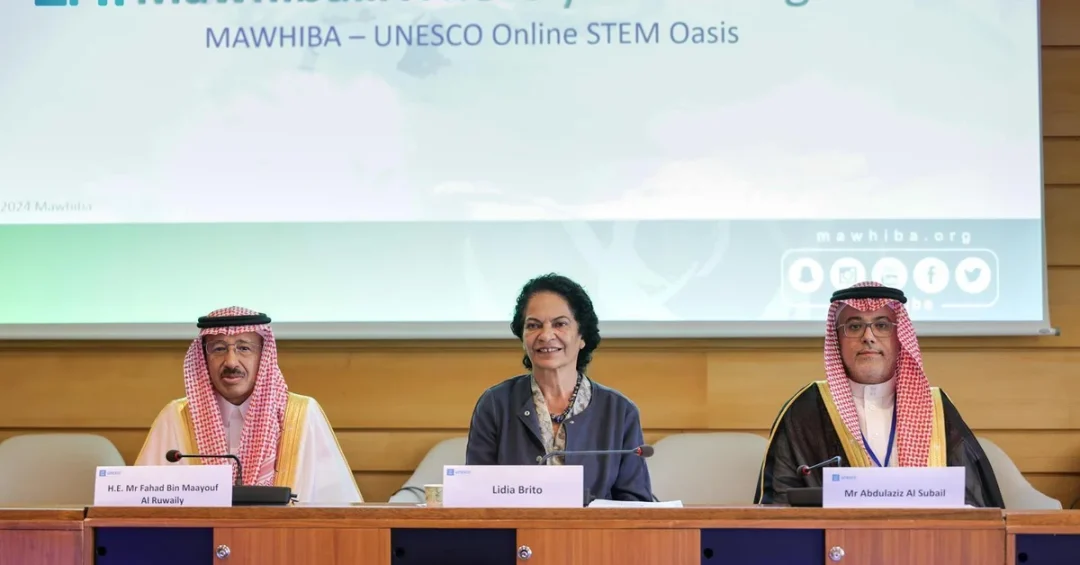
Paris — The King Abdulaziz and his Companions Foundation for Giftedness and Creativity (Mawhiba) signed a strategic partnership agreement with the United Nations Educational, Scientific and Cultural Organization (UNESCO) in Paris on July 20, 2024, to advance science, technology, engineering and mathematics (STEM) education across Arab states. The agreement, announced in an official Mawhiba news release, aims to expand educational opportunities for students from grades 6 through 12, with a particular focus on empowering Arab girls and young women.
Context and Background
The partnership was formalized at UNESCO headquarters in Paris, with UNESCO Assistant Director-General for Natural Sciences Dr. Lidia Arthur Brito and Saudi Ambassador to France and Monaco Fahd bin Mayouf Al-Ruwaili attending the ceremony. The agreement was signed by Mawhiba Deputy Secretary-General for Business Development and Communication Abdulaziz bin Saleh Al-Subail and Dr. Brito.
Mawhiba, a Saudi foundation dedicated to identifying and nurturing gifted students, has a strong track record in STEM education. Over the past three years, it has supported 839 students from Arab states through its enrichment programs, laying the groundwork for broader regional cooperation. This new partnership builds on that experience to scale impact across the Arab world and beyond.
Key Details
At the heart of the initiative is the MAWHIBA-UNESCO Online STEM Oasis, a global platform designed to host local, national and regional science and engineering fairs. This virtual hub will give Arab students the chance to showcase their talents and gain international recognition.
The partnership also includes real-time assessments of middle and high schools in Arab states to elevate educational standards and infrastructure. Recognizing the crucial role of educators, the program will train Arab science teachers to lead research and guide students in scientific projects. Public understanding of STEM will be strengthened through targeted training programs, particularly for preschoolers and young women, ensuring inclusivity and accessibility across the region.
Mawhiba Secretary-General Dr. Amal bint Abdullah Al-Hazzaa expressed the foundation’s honor to partner with UNESCO, emphasizing a shared commitment to empowering young Arab minds and advancing sustainable development through education and innovation. She highlighted Saudi Arabia’s progress in STEM under the leadership of the Custodian of the Two Holy Mosques, King Salman bin Abdulaziz, and His Royal Highness Crown Prince Mohammed bin Salman, noting the collaboration’s importance within the framework of Saudi Vision 2030.
Dr. Brito welcomed the agreement, stating that it addresses a vital area of UNESCO’s scientific work. She noted that the partnership aims to equip young people with the knowledge and capabilities to use STEM to meet global challenges. She also pointed to the potential for expanding these efforts to Africa and other parts of the world in support of sustainable development goals.
Implications and Impact
This partnership carries significant implications for STEM education across the Arab region. By combining Mawhiba’s expertise in talent development with UNESCO’s global reach, the initiative is poised to inspire a new generation of innovators. The focus on girls and young women addresses a critical gap in STEM fields, promoting gender equality and inclusive growth.
Moreover, the collaboration aims to amplify the region’s ability to tackle global challenges such as climate change, health crises and technological disruptions. Through access to cutting-edge research and resources like the UNESCO Open Science Portal and the UNESCO Science-2-Innovation Network, young Arab scientists will be better positioned to contribute to sustainable development. The initiative also sets a precedent for regional cooperation, demonstrating how partnerships can elevate educational standards and foster a culture of scientific inquiry.
Vision 2030 Alignment
This partnership aligns seamlessly with Saudi Vision 2030, which seeks to diversify the economy and empower youth through education and innovation. By investing in STEM education and fostering international collaboration, Mawhiba and UNESCO are helping to build a knowledge-based society that will drive the Kingdom’s future prosperity. The initiative not only enhances Saudi Arabia’s global leadership in education but also creates opportunities for all Arab states to thrive in STEM fields, contributing to a brighter, more sustainable future for the entire region.
20 Questions
Q1. What is Mawhiba?
A1. Mawhiba is the King Abdulaziz and his Companions Foundation for Giftedness and Creativity, a Saudi foundation dedicated to identifying and nurturing gifted students in STEM fields.
Q2. What does the new partnership between Mawhiba and UNESCO aim to achieve?
A2. It aims to foster STEM education across Arab countries, enhancing students’ scientific knowledge, creativity, and critical thinking from grades 6 through 12.
Q3. When and where was the agreement signed?
A3. The agreement was signed on July 20, 2024, at UNESCO headquarters in Paris, France.
Q4. Who signed the agreement on behalf of Mawhiba?
A4. Abdulaziz bin Saleh Al-Subail, Mawhiba Deputy Secretary-General for Business Development and Communication, signed for Mawhiba.
Q5. Who represented UNESCO at the signing?
A5. Dr. Lidia Arthur Brito, UNESCO Assistant Director-General for Natural Sciences, signed the agreement and represented UNESCO.
Q6. Which Saudi official attended the ceremony?
A6. Saudi Ambassador to France and Monaco Fahd bin Mayouf Al-Ruwaili attended the signing ceremony.
Q7. What is the MAWHIBA-UNESCO Online STEM Oasis?
A7. It is a global platform for hosting local, national, and regional science and engineering fairs, giving Arab students opportunities to showcase their talents.
Q8. How many Arab students has Mawhiba supported in the past three years?
A8. Mawhiba has supported 839 students from Arab states through its enriching STEM programs over the past three years.
Q9. What specific group will receive special attention in this initiative?
A9. Arab girls and young women will receive special attention to ensure they have equal opportunities to excel in STEM fields.
Q10. What did Dr. Amal Al-Hazzaa say about the partnership?
A10. She expressed honor in partnering with UNESCO and emphasized the shared commitment to empowering young Arab minds and advancing sustainable development through education and innovation.
Q11. How does this partnership align with Saudi Vision 2030?
A11. It supports Vision 2030’s goals of diversifying the economy and empowering youth through education and innovation, building a knowledge-based society.
Q12. What role will teachers play in this initiative?
A12. The partnership will train Arab science teachers to lead research and guide students in scientific projects, enhancing the overall quality of STEM education.
Q13. Will the initiative include assessments of schools?
A13. Yes, it will implement real-time assessments of middle and high schools in Arab states to elevate educational standards and infrastructure.
Q14. What global challenges does the partnership aim to address?
A14. It aims to address challenges such as climate change, health crises, and technological disruptions by equipping young people with STEM skills.
Q15. What did Dr. Lidia Brito say about the potential expansion of the partnership?
A15. She noted potential for expanding efforts to Africa and other parts of the world to promote sustainable development goals.
Q16. How will public understanding of STEM be bolstered?
A16. Through targeted training programs, particularly for preschoolers and young women, ensuring inclusivity and accessibility of STEM education across Arab States.
Q17. What UNESCO resources will be utilized in this partnership?
A17. The UNESCO Open Science Portal and the UNESCO Science-2-Innovation Network will be used to build capacity of young scientists and women in STEM.
Q18. What is the significance of this partnership for the Arab region?
A18. It represents a shared vision for creating opportunities for all Arab states to thrive in STEM fields, fostering a culture of scientific inquiry and technological advancement.
Q19. How does Mawhiba benefit from partnering with UNESCO?
A19. It amplifies Mawhiba’s ability to address global challenges and provides access to UNESCO’s global platforms, enhancing its international reach and impact.
Q20. What is the ultimate goal of this collaboration?
A20. To create an environment where every young Arab mind can thrive, innovate, and contribute to the global community through STEM education and sustainable development.
Reader Feedback
We value your thoughts. Please share your feedback on this article.
Your feedback helps us improve our coverage.