


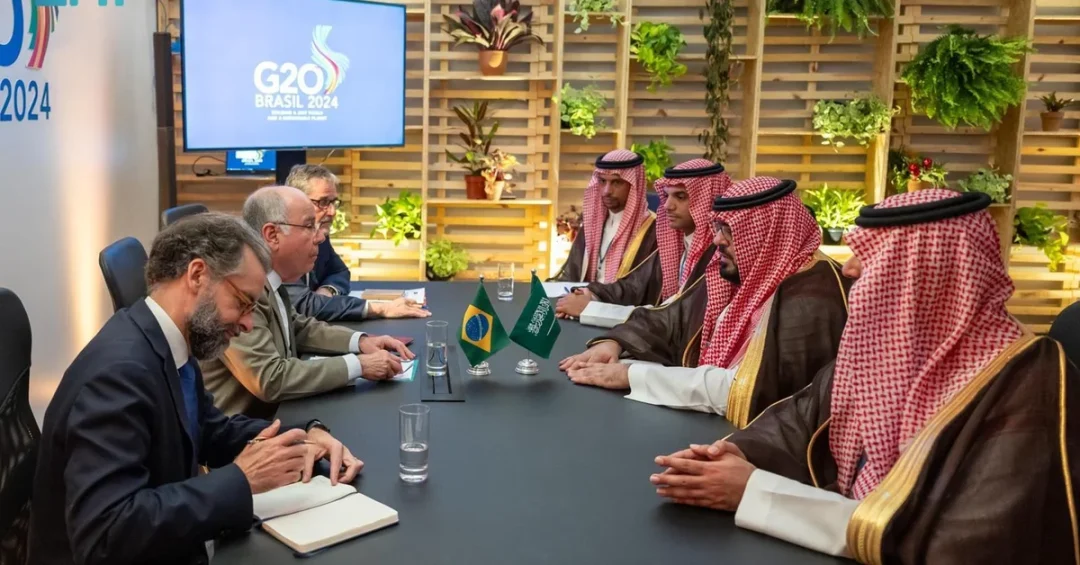
Saudi Minister of Economy and Planning Faisal bin Fadel Alibrahim met with Brazilian Foreign Minister Mauro Vieira on July 23, 2024, in Brasilia on the sidelines of the G20 Development Ministerial Meeting. The two officials discussed Brazil’s G20 presidency agenda and explored avenues to strengthen bilateral cooperation in infrastructure, agribusiness, and renewable energy, according to the Saudi Press Agency. The meeting underscores Saudi Arabia’s active engagement in global economic governance and its commitment to building strategic partnerships that support Vision 2030.
Context and Background
The G20 Development Ministerial Meeting, held in Brasilia, brought together representatives from the world’s major economies to address pressing development challenges and promote sustainable growth. Brazil assumed the G20 presidency in December 2023, prioritizing social inclusion, energy transition, and global governance reform. Saudi Arabia’s participation reflects its growing role as a bridge between developed and developing nations and its commitment to multilateral solutions.
Saudi-Brazilian relations have deepened in recent years, with both countries seeking to diversify their economies and expand trade and investment ties. Brazil is a key partner for Saudi Arabia in agribusiness, supplying significant quantities of food products, while Saudi Arabia is a major exporter of energy and petrochemicals. The meeting between Minister Alibrahim and Minister Vieira builds on this foundation and signals mutual interest in exploring new areas of cooperation.
Key Details
During the meeting, Minister Alibrahim and Minister Vieira reviewed the priorities of Brazil’s G20 presidency, which include combating hunger and poverty, sustainable development, and reforming global institutions. They also discussed ways to enhance bilateral relations across various sectors. Infrastructure emerged as a key area, with potential collaboration in transportation, logistics, and urban development. Agribusiness was another focus, as both nations seek to ensure food security and sustainable agricultural practices. Renewable energy was highlighted, aligning with Saudi Arabia’s Vision 2030 goals and Brazil’s own energy transition efforts.
The ministers emphasized the importance of continued dialogue and joint efforts to address global challenges. The meeting reflects Saudi Arabia’s proactive approach to international diplomacy and its commitment to fostering partnerships that drive economic diversification and innovation.
Implications and Impact
The meeting carries significant implications for Saudi-Brazilian relations and for broader global cooperation. By engaging with Brazil, Saudi Arabia reinforces its position as a reliable partner in the G20 and a leader in sustainable development. Enhanced cooperation in infrastructure could open new opportunities for Saudi companies in Latin America, while agribusiness collaboration can help secure food supplies for the Kingdom. Renewable energy partnerships are particularly promising, as Saudi Arabia advances its National Renewable Energy Program and Brazil continues to expand its bioenergy and solar sectors.
On a regional level, stronger ties with Brazil can facilitate Saudi Arabia’s access to Latin American markets and bolster its role as a hub connecting Asia, Africa, and the Americas. Globally, the meeting contributes to the G20’s mission of promoting inclusive and sustainable growth, demonstrating Saudi Arabia’s commitment to multilateralism and its readiness to share expertise in areas such as desalination, petrochemicals, and smart cities.
Vision 2030 Alignment
This meeting directly supports Saudi Arabia’s Vision 2030, which aims to diversify the economy, strengthen international partnerships, and position the Kingdom as a global investment and logistics hub. By collaborating with Brazil in infrastructure, agribusiness, and renewable energy, Saudi Arabia advances its goals of economic diversification, food security, and clean energy leadership. As the Kingdom continues to expand its global footprint, engagements like this underscore its dedication to building a prosperous and sustainable future in partnership with nations around the world.
20 Questions
Q1. Who met with Brazilian Foreign Minister Mauro Vieira on July 23, 2024?
A1. Saudi Minister of Economy and Planning Faisal bin Fadel Alibrahim met with Brazilian Foreign Minister Mauro Vieira on July 23, 2024, in Brasilia.
Q2. Where did the meeting take place?
A2. The meeting took place in Brasilia, the capital of Brazil, on the sidelines of the G20 Development Ministerial Meeting.
Q3. What event was being held in Brasilia at the time?
A3. The G20 Development Ministerial Meeting was being held in Brasilia, bringing together representatives from major economies.
Q4. What topics did the ministers discuss?
A4. They discussed Brazil’s G20 presidency agenda and explored ways to strengthen bilateral relations in infrastructure, agribusiness, and renewable energy.
Q5. What is Brazil’s role in the G20?
A5. Brazil holds the G20 presidency, with priorities including social inclusion, energy transition, and global governance reform.
Q6. How does this meeting reflect Saudi Arabia’s global engagement?
A6. It demonstrates Saudi Arabia’s active participation in multilateral forums and its commitment to building strategic international partnerships.
Q7. What sectors were highlighted for potential cooperation?
A7. Infrastructure, agribusiness, and renewable energy were highlighted as key areas for enhanced bilateral cooperation.
Q8. Why is renewable energy important for Saudi-Brazil cooperation?
A8. It aligns with Saudi Arabia’s Vision 2030 goals and Brazil’s energy transition efforts, promoting sustainable development.
Q9. What is the significance of agribusiness in Saudi-Brazil relations?
A9. Brazil is a major supplier of food products to Saudi Arabia, and collaboration can enhance food security and sustainable practices.
Q10. How does this meeting support Saudi Vision 2030?
A10. It advances economic diversification, international partnerships, and goals in food security and clean energy.
Q11. What are the implications for Saudi-Brazilian trade?
A11. The meeting could lead to increased trade and investment, particularly in infrastructure, agriculture, and energy sectors.
Q12. What is the G20 Development Ministerial Meeting?
A12. It is a gathering of G20 representatives to address development challenges and promote sustainable growth.
Q13. Who is Faisal bin Fadel Alibrahim?
A13. He is the Saudi Minister of Economy and Planning, responsible for driving economic diversification and international cooperation.
Q14. Who is Mauro Vieira?
A14. Mauro Vieira is the Minister of Foreign Affairs of the Federative Republic of Brazil.
Q15. What is the Kingdom’s stance on multilateral cooperation?
A15. Saudi Arabia actively supports multilateralism and engages in global forums to promote sustainable development and economic growth.
Q16. How can infrastructure cooperation benefit both countries?
A16. It can open new opportunities for Saudi companies in Latin America and support Brazil’s development goals.
Q17. What is Saudi Arabia’s National Renewable Energy Program?
A17. It is a key initiative under Vision 2030 to diversify energy sources and increase renewable energy production.
Q18. How does this meeting impact Saudi Arabia’s global role?
A18. It reinforces Saudi Arabia’s position as a reliable partner and a bridge between developed and developing nations.
Q19. What are Brazil’s G20 presidency priorities?
A19. Brazil’s priorities include combating hunger and poverty, sustainable development, and reforming global institutions.
Q20. What does this meeting signify for future Saudi-Brazil relations?
A20. It signals a deepening partnership and mutual commitment to explore new areas of cooperation for shared prosperity.
Reader Feedback
We value your thoughts. Please share your feedback on this article.
Your feedback helps us improve our coverage.