


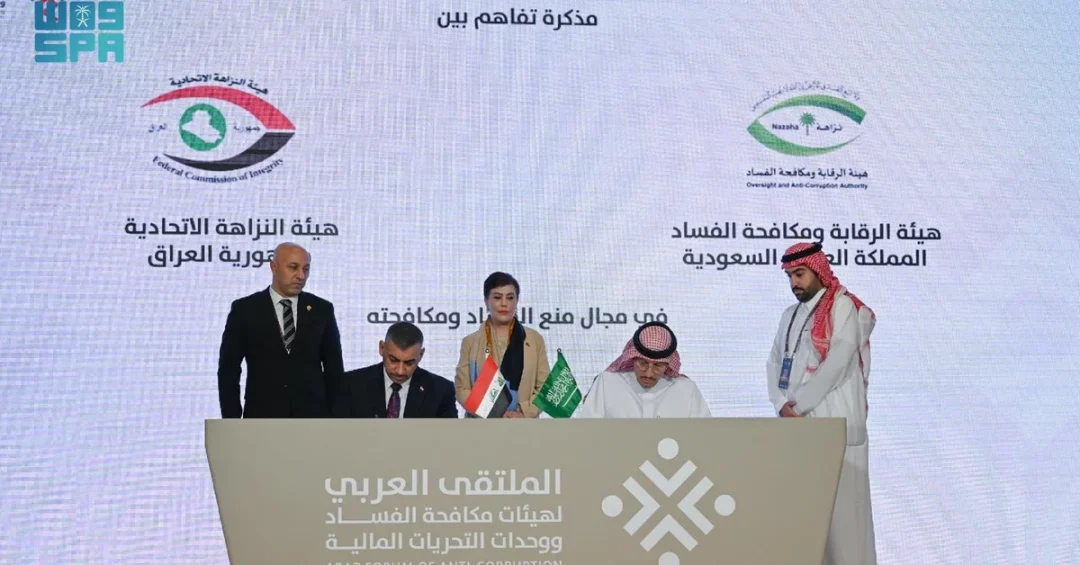
During the Arab Forum of Anti-Corruption Agencies and Financial Intelligence Units held under the patronage of His Royal Highness Prince Mohammed bin Salman bin Abdulaziz Al Saud, Crown Prince and Prime Minister of the Kingdom of Saudi Arabia, a historic Memorandum of Understanding (MoU) was signed on May 16, 2024, in Riyadh. The agreement, between Saudi Arabia’s Oversight and Anti-Corruption Authority (Nazaha) and Iraq’s Federal Commission of Integrity (FCOI), aims to strengthen collaboration in combating transnational corruption crimes, facilitate the exchange of relevant information, and enhance the institutional capacities of both parties.
Context and Background
The MoU was signed by Mazin bin Ibrahim Al-Kahmous, President of Nazaha, on behalf of the Kingdom, and Judge Haider Hanoun, President of the FCOI, on behalf of Iraq. This landmark event took place during the Arab Forum, a key gathering of anti-corruption bodies and financial intelligence units from across the region, underscoring the commitment of Saudi Arabia and Iraq to uphold integrity and transparency in governance.
Key Details
The agreement facilitates the exchange of expertise and information to prevent and combat corruption, including financial crimes. It also provides a framework for joint training programs and technical assistance, aiming to bolster the institutional capacities of both authorities. This collaboration is part of broader efforts by Saudi Arabia, under Vision 2030, to enhance governance and transparency, aligning with international standards.
Implications and Impact
This MoU represents a significant step in regional cooperation against corruption, reinforcing the shared commitment of Arab nations to uphold legal and ethical standards. It is expected to enhance cross-border collaboration, making it more difficult for corrupt actors to exploit legal loopholes. The agreement also signals Saudi Arabia’s leadership in promoting integrity and accountability in the region, fostering trust among international partners and investors.
Vision 2030 Alignment
This initiative aligns with Saudi Arabia’s Vision 2030, which emphasizes the importance of transparency and efficiency in public administration. By strengthening anti-corruption efforts, the Kingdom enhances its business environment, attracting foreign investment and supporting sustainable development. The MoU with Iraq is a testament to Saudi Arabia’s role as a regional leader in good governance and international cooperation, paving the way for a more prosperous and stable Middle East.
20 Questions
Q1. What is the significance of the MoU signed between Saudi Arabia and Iraq?
A1. The MoU strengthens collaboration in combating corruption, facilitating information exchange, and enhancing institutional capacities, reflecting both nations’ commitment to integrity and transparency.
Q2. Who signed the MoU on behalf of Saudi Arabia?
A2. Mazin bin Ibrahim Al-Kahmous, President of the Oversight and Anti-Corruption Authority (Nazaha), signed the MoU on behalf of the Kingdom of Saudi Arabia.
Q3. Who signed the MoU on behalf of Iraq?
A3. Judge Haider Hanoun, President of the Federal Commission of Integrity (FCOI) of Iraq, signed the MoU on behalf of Iraq.
Q4. When was the MoU signed?
A4. The MoU was signed on May 16, 2024, during the Arab Forum of Anti-Corruption Agencies and Financial Intelligence Units.
Q5. Where did the signing take place?
A5. The signing took place in Riyadh, Saudi Arabia, under the patronage of HRH Prince Mohammed bin Salman.
Q6. What is the main objective of the MoU?
A6. The main objective is to strengthen collaboration in combating transnational corruption crimes, exchange relevant information, and enhance institutional capacities.
Q7. How does the MoU facilitate information exchange?
A7. The MoU establishes a framework for sharing expertise and information related to corruption prevention and investigation, enabling both authorities to act more effectively.
Q8. What role does the Arab Forum play in this context?
A8. The Arab Forum serves as a platform for anti-corruption agencies and financial intelligence units to discuss challenges and best practices, fostering regional cooperation.
Q9. How does this MoU benefit Saudi Arabia?
A9. It enhances Saudi Arabia’s governance framework, aligns with Vision 2030 goals of transparency, and strengthens its position as a regional leader in anti-corruption.
Q10. How does this MoU benefit Iraq?
A10. It provides Iraq with technical support and expertise to strengthen its anti-corruption efforts, improving governance and public trust.
Q11. What is the Oversight and Anti-Corruption Authority (Nazaha)?
A11. Nazaha is Saudi Arabia’s government body responsible for combating corruption, promoting integrity, and enhancing transparency in public administration.
Q12. What is the Federal Commission of Integrity (FCOI) of Iraq?
A12. The FCOI is Iraq’s independent body tasked with investigating and preventing corruption, ensuring accountability in public office.
Q13. Why is the fight against corruption important for regional stability?
A13. Corruption undermines governance, trust, and economic development; combating it fosters stability and attracts investment, benefiting the entire region.
Q14. How does this MoU relate to international anti-corruption efforts?
A14. It aligns with UN conventions and international standards, demonstrating commitment to global cooperation against corruption.
Q15. What mechanisms does the MoU establish for collaboration?
A15. It provides for joint training, technical assistance, and regular dialogue to coordinate anti-corruption strategies and share best practices.
Q16. How will the MoU be implemented?
A16. Implementation will involve periodic meetings, exchange of experts, and monitoring of progress to ensure effective collaboration.
Q17. What are the challenges in combating transnational corruption?
A17. Challenges include differing legal systems, lack of information sharing, and cross-border money laundering, which require coordinated efforts.
Q18. How does public opinion view these anti-corruption measures?
A18. Public opinion generally supports such measures as they increase transparency and accountability, enhancing trust in institutions.
Q19. What is the role of HRH Prince Mohammed bin Salman in this?
A19. As Crown Prince and Prime Minister, he provides patronage and strategic direction, emphasizing the importance of integrity in Vision 2030.
Q20. What future steps are expected after this MoU?
A20. Both nations are expected to develop action plans, engage in joint initiatives, and expand cooperation to other areas of governance.
Reader Feedback
We value your thoughts. Please share your feedback on this article.
Your feedback helps us improve our coverage.