


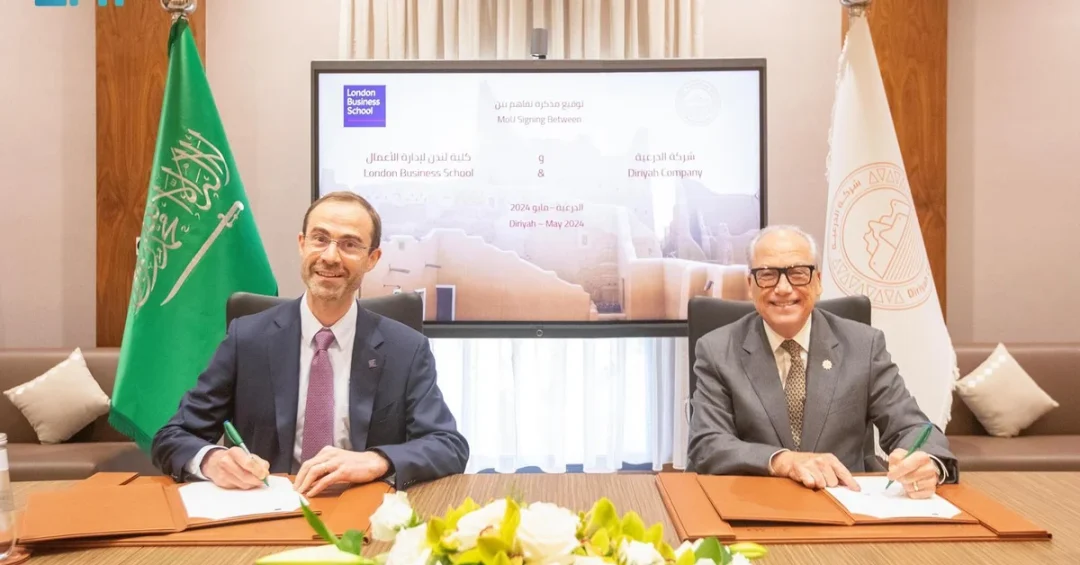
Diriyah Company Group CEO Jerry Inzerillo and Dean of London Business School Francois Ortalo-Magne have signed a memorandum of understanding (MoU) to advance training, development, and research collaboration. The agreement was formalized on the sidelines of the Great Future initiative held in Riyadh on May 14-15, 2024, under the auspices of the Saudi-British Strategic Partnership Council. The MoU underscores the deepening ties between Saudi Arabia and the United Kingdom, focusing on knowledge exchange and executive education.
Context and Background
The signing took place during the Great Futures initiative, a key platform for showcasing bilateral cooperation between the Kingdom and the UK. Diriyah Company’s participation highlighted its cultural, heritage, and tourism projects in Diriyah, a landmark development aligned with Saudi Arabia’s Vision 2030. The initiative brought together leaders from both nations to explore investment opportunities, particularly in sectors like education, research, and sustainable development. The MoU reflects the strategic partnership’s broader goals of fostering innovation and human capital development.
Key Details
The MoU outlines mutual visits and meetings of executives from both organizations, aiming to strengthen ties and facilitate the exchange of best practices. It specifically targets training, development, and research related to projects of mutual interest, particularly in areas such as heritage management, urban development, and sustainable tourism. Diriyah Company is the entity behind the historic Diriyah Gate project, a giga-project that seeks to transform the birthplace of the Kingdom into a world-class cultural and tourism destination. London Business School, one of the world’s leading business schools, will bring its expertise in leadership development and business education to the partnership.
Implications and Impact
This collaboration is expected to yield tangible benefits for both sides. For Diriyah Company, it means access to cutting-edge research and executive training programs that can enhance project delivery and operational excellence. For London Business School, it offers a unique opportunity to engage with one of the Gulf’s most significant cultural and tourism developments, providing a real-world case study for its students and faculty. The MoU also signals the growing importance of knowledge-based partnerships in the Saudi-British relationship, moving beyond traditional trade and investment to include intellectual and human capital development. Such initiatives are poised to contribute to the diversification of the Saudi economy and the development of a knowledge-driven workforce.
Vision 2030 Alignment
This MoU directly supports Saudi Arabia’s Vision 2030 by aligning with its goals of economic diversification, global partnership, and human capital development. The partnership between Diriyah Company and London Business School exemplifies the kind of international collaboration that Vision 2030 seeks to foster, bringing world-class expertise to Saudi soil while also projecting the Kingdom’s cultural and economic ambitions globally. As Diriyah continues to emerge as a beacon of heritage and innovation, such educational and research partnerships will be instrumental in ensuring that the project’s benefits extend far beyond construction, contributing to the long-term prosperity and global standing of the Kingdom.
20 Questions
Q1. What is the primary purpose of the MoU between Diriyah Company and London Business School?
A1. The MoU aims to foster collaboration in training, development, and research, focusing on projects relevant to both entities. It facilitates executive meetings, mutual visits, and knowledge exchange to enhance skills and project outcomes.
Q2. Who signed the MoU on behalf of Diriyah Company?
A2. Diriyah Company Group CEO Jerry Inzerillo signed the MoU, representing the company’s commitment to leveraging global educational partnerships to support its development projects.
Q3. Who signed the MoU for London Business School?
A3. Dean Francois Ortalo-Magne signed the MoU, underscoring the school’s dedication to collaborating with leading organizations in transformative environments like Saudi Arabia.
Q4. When and where was the MoU signed?
A4. The MoU was signed on May 16, 2024, during the Great Future initiative in Riyadh. This two-day event, hosted on May 14-15, was part of the Saudi-British Strategic Partnership Council.
Q5. What is the Great Future initiative?
A5. It is an initiative hosted by Riyadh under the Saudi-British Strategic Partnership Council. The event serves as a platform to showcase collaboration opportunities and investment prospects between the two countries.
Q6. How does this MoU relate to Saudi Vision 2030?
A6. The MoU supports Vision 2030 by promoting knowledge transfer, human capital development, and global partnerships, which are central to the Kingdom’s economic diversification and cultural enrichment goals.
Q7. What projects of Diriyah Company are highlighted in this context?
A7. The MoU relates to Diriyah’s cultural, heritage, and tourism projects, particularly the historic Diriyah Gate development, which aims to become a global destination.
Q8. What areas of collaboration are covered in the MoU?
A8. The MoU covers mutual visits, executive meetings, and collaboration in training, development, and research specifically tied to projects of both sides.
Q9. Why is London Business School an important partner for Diriyah?
A9. London Business School is renowned for its leadership programs and research. Partnering with it brings top-tier educational expertise to Diriyah’s workforce and project management.
Q10. How does this partnership benefit London Business School?
A10. It offers the school access to a major giga-project, providing practical case studies and research opportunities in heritage management and sustainable development.
Q11. What role does the Saudi-British Strategic Partnership Council play?
A11. The Council facilitates bilateral cooperation, with this MoU being an outcome of its initiatives, strengthening ties in education, culture, and economic diversification.
Q12. Are there any financial implications of the MoU?
A12. The MoU does not specify financial terms, focusing instead on capacity building and research collaboration. Future projects may attract investment separately.
Q13. How can this MoU boost Saudi-UK relations?
A13. It deepens educational and cultural ties, complementing existing trade and investment links, and demonstrates the evolving partnership between the two nations.
Q14. What is the expected impact on Diriyah’s tourism sector?
A14. Enhanced training and research will improve operational efficiency and visitor experiences, contributing to Diriyah’s appeal as a cultural tourism hotspot.
Q15. How does this align with the UK’s interests?
A15. It allows UK institutions to engage with Saudi development projects, creating opportunities for knowledge export and influence in a growing sector.
Q16. What specific research areas might be explored?
A16. Potential research areas include sustainable tourism, heritage conservation, urban development, and leadership effectiveness in large-scale projects.
Q17. How will this affect local employment in Diriyah?
A17. By developing local talent through training and executive education, the MoU is likely to create a more skilled workforce, benefiting employment opportunities.
Q18. Is this a long-term partnership?
A18. While the MoU itself sets a framework for collaboration, the intention is to establish a lasting relationship, with ongoing exchanges and joint projects.
Q19. What sets Diriyah Company apart in such collaborations?
A19. Diriyah Company represents a unique heritage and tourism mega-project, offering a rich environment for real-world learning and innovation that few other sites can match.
Q20. How can other entities benefit from this example?
A20. Other entities can emulate this model of educational and research partnerships to enhance their project capabilities, underscoring Saudi Arabia’s commitment to global knowledge exchange.
Reader Feedback
We value your thoughts. Please share your feedback on this article.
Your feedback helps us improve our coverage.