


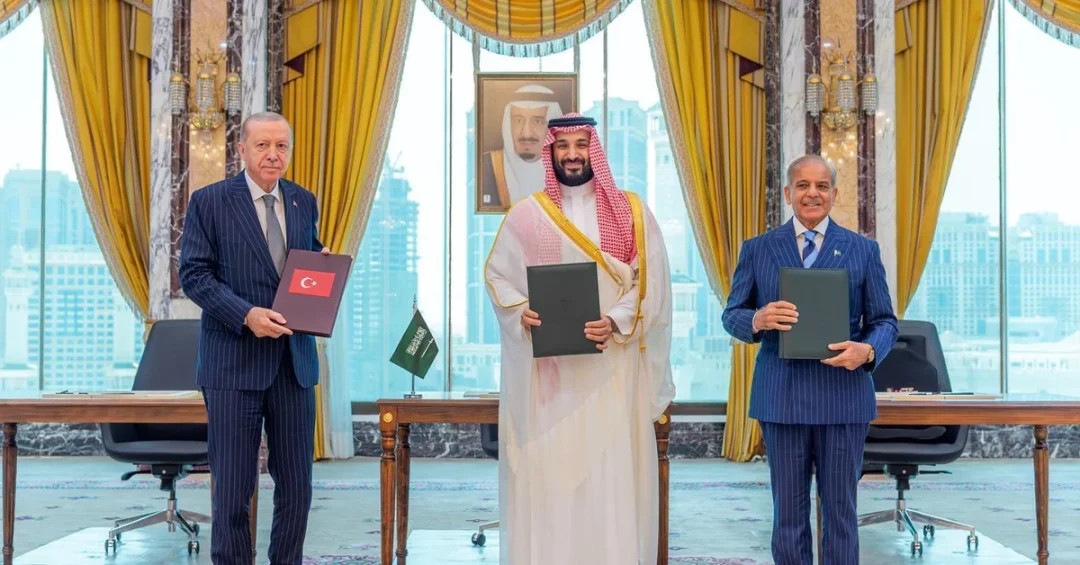
Saudi Arabia, Türkiye, and Pakistan signed the Makkah Joint Defense Agreement during a trilateral summit hosted at Al-Safa Palace in Makkah on August 7, 2026, establishing that an armed attack on any one of the three nations will be treated as an attack on all of them. The agreement was announced in a joint statement carried by the Saudi Press Agency, following an invitation extended by the Custodian of the Two Holy Mosques to President Recep Tayyip Erdoğan of the Republic of Türkiye and Prime Minister Muhammad Shehbaz Sharif of the Islamic Republic of Pakistan.
Context and Background
His Royal Highness Crown Prince and Prime Minister Mohammed bin Salman bin Abdulaziz Al Saud received the two leaders at the Royal Court at Al-Safa Palace in Makkah, where the Makkah Joint Defense Summit was subsequently convened. The discussions reviewed the close and friendly relations binding the three countries and addressed a range of issues of mutual concern.
The trilateral gathering reflects a broader pattern of deepening strategic coordination between the Kingdom and major partners across the Islamic world. By choosing Makkah as the venue, the signatories underscored the spiritual and historical weight of the occasion, signaling that the agreement rests on shared values as much as shared security interests.
Key Details
The central instrument of the summit, the Makkah Joint Defense Agreement, is designed to develop defense cooperation among the three states and to strengthen joint deterrence against any act of aggression. Its core provision mirrors the principle of collective defense: an armed attack against any one of the three countries will be regarded as an attack against all of them.
The joint statement, released through official Saudi channels, confirmed that the agreement was signed by the three parties during the summit. The announcement was transmitted by the Saudi Press Agency (SPA), the Kingdom’s official news authority, which published the full text of the joint statement.
Implications and Impact
The agreement carries significant implications for regional security architecture. For Saudi Arabia, it reinforces a network of partnerships that spans the Middle East, South Asia, and the wider Islamic world, complementing existing bilateral and multilateral security relationships. For Türkiye and Pakistan, it adds a Gulf dimension to their defense planning and deepens ties with a pivotal energy and investment power.
Analysts note that collective defense arrangements of this kind can deter potential aggression by raising the cost of hostile action and by signaling political unity. The trilateral format also opens avenues for cooperation in defense industries, training, joint exercises, and technology transfer, areas where all three economies have demonstrated growing capability.
Internationally, the agreement positions the three countries as a coherent grouping on security matters, while remaining consistent with the Kingdom’s longstanding emphasis on stability, dialogue, and respect for sovereignty. The joint statement conveyed no adversarial framing toward any third party, focusing instead on mutual defense and shared interests.
Vision 2030 Alignment
The Makkah Joint Defense Agreement aligns closely with Saudi Vision 2030, which seeks to strengthen the Kingdom’s strategic partnerships, protect its sovereignty, and enhance its role as a stabilizing force in the region and beyond. By advancing collective deterrence through diplomacy and formal agreement rather than confrontation, the pact supports the Vision’s goals of security, economic prosperity, and international engagement. It also reinforces Saudi Arabia’s position as a convening power capable of bringing major Islamic nations together in the service of peace and shared defense, a role that will continue to shape the Kingdom’s global standing in the years ahead.
20 Questions
Q1. What is the Makkah Joint Defense Agreement?
A1. It is a trilateral defense pact signed by Saudi Arabia, Türkiye, and Pakistan in Makkah on August 7, 2026, aimed at developing defense cooperation and joint deterrence against aggression.
Q2. Which countries signed the agreement?
A2. The agreement was signed by the Kingdom of Saudi Arabia, the Republic of Türkiye, and the Islamic Republic of Pakistan during the Makkah Joint Defense Summit.
Q3. Where was the summit held?
A3. The summit took place at Al-Safa Palace in Makkah, where Crown Prince Mohammed bin Salman received the Turkish President and the Pakistani Prime Minister.
Q4. Who represented Saudi Arabia at the summit?
A4. Crown Prince and Prime Minister Mohammed bin Salman bin Abdulaziz Al Saud represented the Kingdom and received the visiting leaders at the Royal Court.
Q5. Who were the visiting leaders?
A5. President Recep Tayyip Erdoğan of Türkiye and Prime Minister Muhammad Shehbaz Sharif of Pakistan attended the summit following an invitation from the Custodian of the Two Holy Mosques.
Q6. When was the agreement signed?
A6. The agreement was signed on August 7, 2026, and the joint statement was released through the Saudi Press Agency on August 9, 2026.
Q7. What is the core provision of the agreement?
A7. The core provision states that an armed attack on any one of the three countries will be considered an attack on all three, establishing collective defense.
Q8. What is the main purpose of the pact?
A8. The pact aims to develop defense cooperation among the three nations and strengthen joint deterrence against any act of aggression.
Q9. How was the announcement made public?
A9. The joint statement was released through the Saudi Press Agency, the Kingdom’s official news authority, which published the full text.
Q10. Did the leaders discuss other topics?
A10. Yes, the summit reviewed the close friendly relations among the three countries and addressed a range of issues of mutual concern to all parties.
Q11. Why was Makkah chosen as the venue?
A11. Makkah was chosen to underscore the spiritual and historical significance of the occasion, reflecting shared values as well as shared security interests among the three nations.
Q12. What does collective defense mean in this context?
A12. It means that the three countries treat an attack on one as an attack on all, raising the cost of aggression and signaling political unity.
Q13. How does the agreement affect regional security?
A13. It reinforces a network of partnerships spanning the Middle East and South Asia, potentially deterring aggression and promoting stability through unity.
Q14. What areas of cooperation might follow?
A14. Possible areas include defense industries, military training, joint exercises, and technology transfer, where all three countries have demonstrated growing capabilities.
Q15. Is the agreement directed against any specific country?
A15. The joint statement contained no adversarial framing toward any third party, focusing instead on mutual defense and shared interests.
Q16. How does the pact relate to Saudi Vision 2030?
A16. It supports Vision 2030 goals of strengthening strategic partnerships, protecting sovereignty, and enhancing the Kingdom’s stabilizing role in the region.
Q17. What role did the Crown Prince play?
A17. Crown Prince Mohammed bin Salman received the two leaders at Al-Safa Palace and hosted the summit that produced the defense agreement.
Q18. Why is the trilateral format significant?
A18. The trilateral format links the Gulf, South Asia, and the wider Islamic world, creating a coherent grouping on security matters and deepening strategic coordination.
Q19. What does the agreement mean for Pakistan and Türkiye?
A19. For both nations, it adds a Gulf dimension to their defense planning and deepens ties with a pivotal energy and investment power.
Q20. What is the broader message of the summit?
A20. The summit signals unity, mutual defense, and a commitment to peace and stability, reinforcing Saudi Arabia’s role as a convening power in the Islamic world.
Reader Feedback
We value your thoughts. Please share your feedback on this article.
Your feedback helps us improve our coverage.