


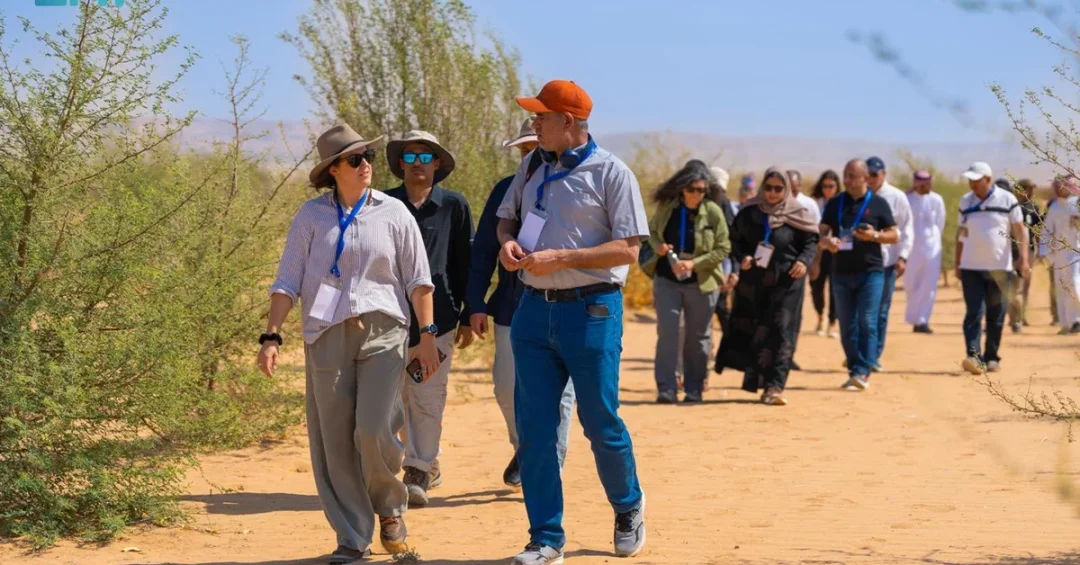
The King Abdulaziz Royal Reserve Development Authority recently hosted a field tour for international experts and representatives from national entities, showcasing its ecosystem restoration efforts as part of a workshop organized by the International Union for Conservation of Nature (IUCN). The tour highlighted the reserve’s successful initiatives to rehabilitate degraded lands, aligning with Saudi Vision 2030 environmental goals and the Saudi Green and Middle East Green Initiatives. Experts from the National Center for Wildlife Development and NEOM joined the visit, which included a stop at Rawdat Al-Khafs, where one million seedlings have been planted in collaboration with the National Center for Vegetation Cover and Combating Desertification.
Context and Background
The King Abdulaziz Royal Reserve, established by royal decree, is one of seven royal reserves in Saudi Arabia dedicated to environmental conservation. Covering approximately 28,000 square kilometers in Riyadh, it encompasses areas such as Rawdat Al-Tanhat, Rawdat Al-Khafs, Rawdat Noura, Al-Dahna, Al-Suman, and surrounding territories. The reserve is governed by an independent authority led by a board of directors chaired by Prince Abdulaziz bin Saud bin Naif. As a member of the IUCN, the reserve plays a pivotal role in Saudi Arabia’s broader environmental strategy.
The workshop, organized by the IUCN, focused on initiatives to restore degraded ecosystems across the Kingdom. It brought together local and international experts to exchange knowledge and best practices, underscoring Saudi Arabia’s commitment to global environmental cooperation. The field tour allowed participants to witness firsthand the reserve’s efforts to improve ecosystem services and restore biodiversity.
Key Details
During the tour, attendees visited Rawdat Al-Khafs, a site where one million seedlings have been planted as part of a collaboration with the National Center for Vegetation Cover and Combating Desertification. This initiative serves as a model for ecosystem restoration within the reserve’s boundaries, demonstrating the application of global best practices. The planting effort has effectively enhanced ecosystem services and contributed to the recovery of local biodiversity.
The King Abdulaziz Royal Reserve Development Authority, in partnership with public, private, and non-profit sectors, showcased its endeavors to rehabilitate degraded lands. These efforts are aligned with the environmental objectives of Saudi Vision 2030, the strategic targets for the Royal Reserves by 2030, and the outcomes of the Saudi Green and Middle East Green Initiatives. The participation of entities such as the National Center for Wildlife Development and NEOM highlights the collaborative approach driving these restoration efforts.
Implications and Impact
The successful restoration of degraded ecosystems within the King Abdulaziz Royal Reserve has significant implications for Saudi Arabia and the broader region. By improving ecosystem services and restoring biodiversity, the reserve contributes to environmental sustainability and climate resilience. These efforts also support the Kingdom’s goals under the Saudi Green Initiative, which aims to plant 10 billion trees and protect 30% of land and sea areas by 2030.
International experts’ involvement in the tour underscores the global recognition of Saudi Arabia’s environmental stewardship. The exchange of knowledge and best practices with IUCN representatives and other national entities enhances the Kingdom’s role in global conservation efforts. Furthermore, the collaboration with NEOM, a flagship project of Vision 2030, demonstrates the integration of environmental sustainability into large-scale development initiatives.
Vision 2030 Alignment
The King Abdulaziz Royal Reserve’s ecosystem restoration efforts are a direct reflection of Saudi Vision 2030’s environmental objectives. By rehabilitating degraded lands and enhancing biodiversity, the reserve supports the Kingdom’s transition to a sustainable future. These initiatives also align with the strategic targets for the Royal Reserves by 2030, which aim to protect natural habitats and promote ecotourism.
As Saudi Arabia continues to advance its environmental agenda, the King Abdulaziz Royal Reserve stands as a testament to the Kingdom’s commitment to preserving its natural heritage for future generations. Through collaborative efforts and international partnerships, the reserve exemplifies how Vision 2030 is translating into tangible environmental action, reinforcing Saudi Arabia’s leadership in global sustainability.
20 Questions
Q1. What was the purpose of the field tour hosted by the King Abdulaziz Royal Reserve Development Authority?
A1. The field tour aimed to showcase the reserve’s ecosystem restoration efforts to international experts and representatives from national entities, as part of a workshop organized by the International Union for Conservation of Nature (IUCN).
Q2. Which organizations participated in the field tour?
A2. Participants included international experts and representatives from the National Center for Wildlife Development and NEOM, among other national entities.
Q3. What is the significance of Rawdat Al-Khafs in the restoration efforts?
A3. Rawdat Al-Khafs is a site where one million seedlings have been planted in collaboration with the National Center for Vegetation Cover and Combating Desertification, serving as a successful model for ecosystem restoration.
Q4. How does the King Abdulaziz Royal Reserve align with Saudi Vision 2030?
A4. The reserve’s restoration efforts align with the environmental objectives of Saudi Vision 2030, the strategic targets for the Royal Reserves by 2030, and the outcomes of the Saudi Green and Middle East Green Initiatives.
Q5. What is the size of the King Abdulaziz Royal Reserve?
A5. The reserve covers an area of approximately 28,000 square kilometers in Riyadh, including Rawdat Al-Tanhat, Rawdat Al-Khafs, Rawdat Noura, Al-Dahna, Al-Suman, and surrounding areas.
Q6. Who chairs the board of directors of the King Abdulaziz Royal Reserve Development Authority?
A6. The board of directors is chaired by Prince Abdulaziz bin Saud bin Naif.
Q7. What is the role of the IUCN in the workshop?
A7. The IUCN organized the workshop on initiatives and efforts to restore degraded ecosystems in the Kingdom, facilitating knowledge exchange among local and international experts.
Q8. How many royal reserves are there in Saudi Arabia?
A8. The King Abdulaziz Royal Reserve is one of seven reserves established by royal decree in Saudi Arabia.
Q9. What collaboration led to the planting of one million seedlings?
A9. The planting was a collaboration between the King Abdulaziz Royal Reserve Development Authority and the National Center for Vegetation Cover and Combating Desertification.
Q10. What are the expected outcomes of the ecosystem restoration efforts?
A10. The efforts are expected to improve ecosystem services, restore biodiversity, and contribute to environmental sustainability and climate resilience in the region.
Q11. How does the reserve contribute to the Saudi Green Initiative?
A11. The reserve’s restoration efforts support the Saudi Green Initiative’s goals of planting 10 billion trees and protecting 30% of land and sea areas by 2030.
Q12. What is the significance of the reserve’s membership in the IUCN?
A12. Membership in the IUCN signifies the reserve’s commitment to global conservation standards and facilitates international cooperation and recognition.
Q13. What role does NEOM play in the restoration efforts?
A13. NEOM’s participation highlights the integration of environmental sustainability into large-scale development initiatives under Vision 2030.
Q14. What are the strategic targets for the Royal Reserves by 2030?
A14. The strategic targets aim to protect natural habitats, promote ecotourism, and enhance biodiversity conservation across the Kingdom’s royal reserves.
Q15. How does the reserve’s work impact local communities?
A15. The reserve’s restoration efforts can enhance local ecosystems, provide opportunities for ecotourism, and contribute to the overall quality of life for nearby communities.
Q16. What international best practices are being applied in the restoration efforts?
A16. The reserve applies global best practices in ecosystem restoration, including large-scale planting, habitat protection, and collaboration with international bodies like the IUCN.
Q17. What is the Middle East Green Initiative?
A17. The Middle East Green Initiative is a regional effort led by Saudi Arabia to combat climate change, plant 50 billion trees, and enhance environmental cooperation across the Middle East.
Q18. How does the reserve’s work align with global environmental goals?
A18. The reserve’s efforts contribute to global goals such as the UN Decade on Ecosystem Restoration and the Convention on Biological Diversity, showcasing Saudi Arabia’s role in international conservation.
Q19. What future plans are there for the King Abdulaziz Royal Reserve?
A19. Future plans include expanding restoration activities, enhancing biodiversity, and continuing to serve as a model for sustainable ecosystem management in line with Vision 2030.
Q20. How can other countries learn from Saudi Arabia’s restoration efforts?
A20. Other countries can learn from Saudi Arabia’s collaborative approach, large-scale planting initiatives, and integration of restoration with national development strategies like Vision 2030.
Reader Feedback
We value your thoughts. Please share your feedback on this article.
Your feedback helps us improve our coverage.