


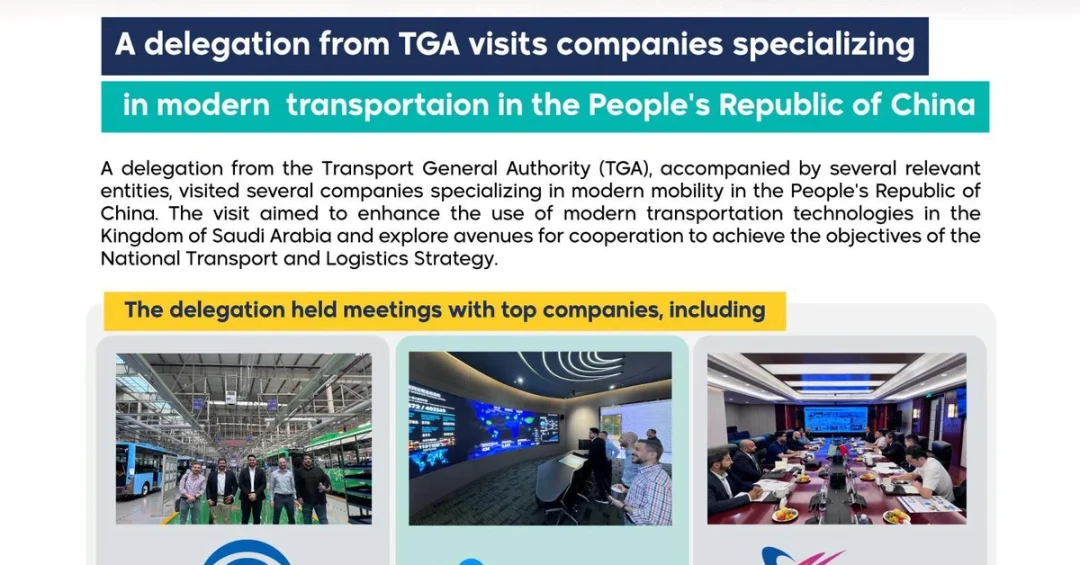
A delegation from the Transport General Authority (TGA) met with leading Chinese companies specializing in modern mobility technologies, self-driving vehicles, and the bus industry during an official visit to the People’s Republic of China, as reported by the Saudi Press Agency (SPA). The visit, aimed at exploring cooperation and exchanging expertise, supports the Kingdom’s efforts to advance environmentally sustainable transportation and increase the use of self-driving vehicles in line with the National Transport and Logistics Strategy (NTLS).
Context and Background
The TGA’s engagement with Chinese firms reflects Saudi Arabia’s proactive approach to international collaboration in advanced transport technologies. As part of the NTLS, a key initiative under Vision 2030, the Kingdom seeks to modernize its transport infrastructure, enhance efficiency, and reduce environmental impact. China’s expertise in electric buses, autonomous driving systems, and innovative transit solutions makes it a valuable partner in these efforts.
Key Details
During the visit, the delegation met with representatives from Yutong, a company specializing in the manufacture of buses and other vehicles. Yutong is known for its electric and hybrid buses, which could contribute to Saudi Arabia’s goal of sustainable public transport. The delegation also toured the headquarters of WeRide, a leading innovator in self-driving systems for passenger and goods transport. WeRide’s autonomous vehicle technology could play a role in the Kingdom’s plans to deploy self-driving vehicles.
Additionally, the delegation gained insights into the Autonomous Rail Rapid Transit (ART) system developed by Norinco. This semi-self-driving electric transport system combines the efficiency of a tram with the flexibility of a bus, with a capacity of over 300 passengers per vehicle. The ART system could offer a cost-effective and flexible solution for urban transit in Saudi cities. The visit also allowed the delegation to examine various transport systems, their operational locations, manufacturing processes, technical specifications, and operational mechanisms.
Implications and Impact
This visit underscores Saudi Arabia’s commitment to global partnerships that drive innovation and sustainability. By engaging with Chinese leaders in transport technology, the Kingdom can accelerate the adoption of smart mobility solutions, enhance the efficiency of its transport networks, and reduce carbon emissions. The collaboration could also open doors for knowledge transfer and investment opportunities, supporting the localization of advanced technologies in line with Vision 2030’s economic diversification goals. Furthermore, it strengthens bilateral ties between Saudi Arabia and China, fostering mutual growth and technological exchange.
Vision 2030 Alignment
The TGA’s visit aligns with Vision 2030’s objectives to build a robust, sustainable transport sector that supports economic growth and improves quality of life. The NTLS aims to position Saudi Arabia as a global logistics hub, and partnerships with innovative companies like Yutong, WeRide, and Norinco are pivotal in achieving this vision. By integrating self-driving vehicles and eco-friendly transit systems, the Kingdom is taking concrete steps toward a smarter, greener future, reinforcing its leadership in the region and beyond.
20 Questions
Q1. What was the purpose of the TGA delegation’s visit to China?
A1. The delegation aimed to explore cooperation in modern mobility technologies, self-driving vehicles, and the bus industry, and to exchange expertise to promote sustainable transport in Saudi Arabia.
Q2. Which Chinese companies did the TGA delegation meet?
A2. The delegation met with representatives from Yutong and toured the headquarters of WeRide, and also learned about the Autonomous Rail Rapid Transit system developed by Norinco.
Q3. What is Yutong known for?
A3. Yutong is a company specializing in the manufacture of buses and other vehicles, known for its electric and hybrid buses used in public transport systems worldwide.
Q4. What technology does WeRide specialize in?
A4. WeRide is a leading innovator in self-driving systems for passenger and goods transport, developing autonomous vehicle technology for various applications.
Q5. What is the Autonomous Rail Rapid Transit (ART) system?
A5. The ART system, developed by Norinco, is a semi-self-driving electric transport system that combines tram efficiency with bus flexibility, and can carry over 300 passengers per vehicle.
Q6. How does the visit align with Saudi Arabia’s National Transport and Logistics Strategy?
A6. The visit supports the NTLS objectives by exploring advanced technologies that can enhance sustainable transportation and increase the use of self-driving vehicles in the Kingdom.
Q7. What is the NTLS?
A7. The National Transport and Logistics Strategy is a key initiative under Saudi Vision 2030 aimed at modernizing transport infrastructure, improving efficiency, and positioning Saudi Arabia as a global logistics hub.
Q8. What benefits could Saudi Arabia gain from this collaboration?
A8. The collaboration could accelerate the adoption of smart mobility solutions, enhance transport network efficiency, reduce carbon emissions, and create investment and knowledge transfer opportunities.
Q9. Why is Saudi Arabia interested in self-driving vehicles?
A9. Self-driving vehicles can improve road safety, reduce traffic congestion, and support sustainable transportation, aligning with Vision 2030’s goals for a modern and efficient transport sector.
Q10. What is the capacity of the ART system?
A10. The ART system has a capacity of over 300 passengers per vehicle, making it suitable for high-demand urban transit routes.
Q11. What did the delegation examine during the visit?
A11. The delegation examined various transport systems, their operational locations, manufacturing processes, technical specifications, and operational mechanisms.
Q12. How does this visit strengthen Saudi-China relations?
A12. The visit fosters bilateral ties by promoting technological exchange, mutual growth, and cooperation in advanced transport sectors, benefiting both countries.
Q13. What role does the TGA play in Saudi Arabia’s transport sector?
A13. The Transport General Authority regulates and develops the Kingdom’s transport sector, ensuring it meets international standards and supports Vision 2030 objectives.
Q14. How does the ART system differ from traditional trams and buses?
A14. The ART system combines the efficiency of a tram with the flexibility of a bus, operating on virtual tracks and offering a cost-effective alternative for urban transit.
Q15. What is the significance of environmentally sustainable transportation for Saudi Arabia?
A15. Sustainable transportation reduces carbon emissions, aligns with global environmental goals, and supports Vision 2030’s aim for a greener, more sustainable future.
Q16. Could these technologies be localized in Saudi Arabia?
A16. Yes, part of the collaboration’s potential includes knowledge transfer and localization of advanced technologies, which would support economic diversification and job creation.
Q17. What are the next steps following this visit?
A17. The TGA will likely evaluate the insights gained and explore formal agreements or pilot projects to integrate these technologies into Saudi Arabia’s transport network.
Q18. How does this visit reflect Saudi Arabia’s global engagement?
A18. It demonstrates the Kingdom’s proactive approach to international partnerships, seeking best practices and innovations to enhance its domestic capabilities and global competitiveness.
Q19. What impact could self-driving vehicles have on Saudi cities?
A19. They could reduce traffic accidents, improve mobility for residents, and optimize public transport, contributing to smarter and safer urban environments.
Q20. How does this initiative support Vision 2030?
A20. It directly supports Vision 2030 by advancing transport modernization, sustainability, and economic diversification, key pillars of the Kingdom’s long-term development plan.
Reader Feedback
We value your thoughts. Please share your feedback on this article.
Your feedback helps us improve our coverage.