


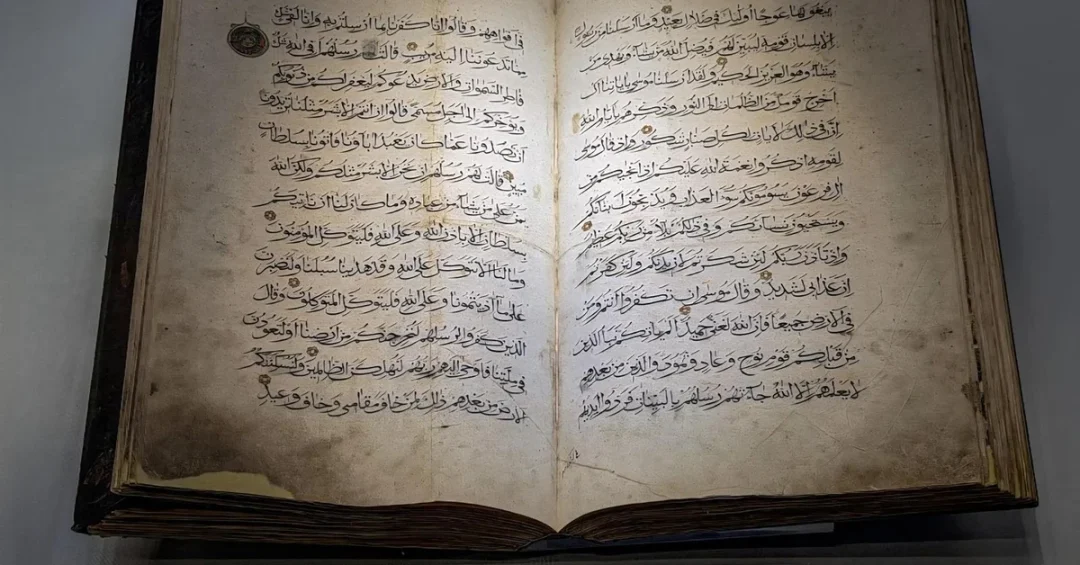
A complete Quran displayed at the Holy Quran Museum in the Hira Cultural District in Makkah showcases the remarkable artistry of Arabic calligraphy, bookbinding, and gilding, offering a window into the devotion and craftsmanship of earlier Islamic eras. According to the Saudi Press Agency (SPA), the manuscript is displayed open on facing pages beginning with Surat Al-Fatihah, revealing precise calligraphy in black ink and intricate decorative details that have preserved the sacred text with elegance and reverence for generations.
Context and Background
The Holy Quran Museum, located in the Hira Cultural District near the iconic Cave of Hira, serves as a cultural and educational landmark in Makkah. It houses a diverse collection of manuscripts, Qurans, and artifacts that document the history and arts of the Holy Quran. The museum’s exhibits trace the evolution of Quranic writing and recording, featuring various Arabic scripts, ornamentation techniques, and traditional tools used by scribes and artisans.
The displayed Quran exemplifies the meticulous care Muslims devoted to writing, decorating, and binding the Holy Quran in earlier eras. Its pages combine the beauty of Arabic calligraphy with precise composition, while the dark-brown binding features embossed decoration and an elegant medallion. Gilded separators and floral motifs complement the Quranic text without overpowering it, reflecting a harmonious balance between artistic expression and religious devotion.
Key Details
The Quran’s open pages reveal Surat Al-Fatihah, written in black ink with exacting calligraphic precision. Each page is adorned with gilded separators and floral motifs that enhance the sacred text. The binding, crafted from dark brown material, includes embossed decoration and a central medallion, demonstrating advanced bookbinding techniques of the era.
Among the museum’s most prominent holdings are rare historic Qurans, including examples written in Kufic script and others featuring ornamented and gilded pages. The collection also includes the renowned Blue Quran, whose verses were written in gold on dark-blue pages—a masterpiece of Islamic art that highlights the sophistication of early Quranic production.
Implications and Impact
The display of such artifacts underscores Saudi Arabia’s commitment to preserving Islamic heritage and sharing it with the world. The Holy Quran Museum in the Hira Cultural District serves as a hub for cultural tourism, attracting visitors and scholars interested in the history of Quranic calligraphy and bookbinding. By showcasing these masterpieces, the Kingdom reinforces its role as a guardian of Islamic traditions and a promoter of cultural dialogue.
This initiative aligns with Saudi Arabia’s broader efforts to enhance religious and cultural tourism under Vision 2030. The museum not only educates visitors about the arts of the Quran but also highlights the Kingdom’s dedication to maintaining the sanctity and beauty of Islamic heritage for future generations.
Vision 2030 Alignment
The Holy Quran Museum and its collection are integral to Saudi Arabia’s Vision 2030 goals, particularly in diversifying the economy through cultural and religious tourism. By preserving and displaying these historical treasures, the Kingdom showcases its rich Islamic heritage to the world, fostering cross-cultural understanding and attracting visitors to Makkah. This effort supports the Vision’s aim to increase religious tourism and promote the Kingdom as a global destination for cultural enrichment.
20 Questions
Q1. Where is the complete Quran displayed?
A1. It is displayed at the Holy Quran Museum in the Hira Cultural District in Makkah, Saudi Arabia.
Q2. What does the Quran’s open pages begin with?
A2. The open pages begin with Surat Al-Fatihah, the first chapter of the Quran.
Q3. What colors are used in the Quran’s calligraphy?
A3. The calligraphy is written in black ink, with gilded separators and floral motifs in gold.
Q4. What is special about the binding of the Quran?
A4. The binding is dark brown and features embossed decoration and an elegant medallion.
Q5. What scripts are featured in the museum’s collection?
A5. The collection includes examples in Kufic script and other ornamented and gilded scripts.
Q6. What is the Blue Quran?
A6. The Blue Quran is a rare manuscript with verses written in gold on dark-blue pages.
Q7. What other items are in the museum’s collection?
A7. The museum holds manuscripts, Qurans, artifacts, traditional writing and copying tools, and examples of ornamentation and gilding.
Q8. Why is the Hira Cultural District significant?
A8. It is located near the Cave of Hira, where Prophet Muhammad received the first revelation, making it a historically and spiritually significant site.
Q9. How does the museum contribute to cultural tourism?
A9. It attracts visitors and scholars, offering insights into Quranic arts and Islamic heritage, thus boosting cultural tourism in Makkah.
Q10. What does the Quran’s decoration include?
A10. It includes gilded separators and floral motifs that complement the Quranic text without overpowering it.
Q11. What is the significance of the Quran’s precise calligraphy?
A11. It demonstrates the high level of skill and devotion of early Muslim scribes in preserving the Quran.
Q12. How does the museum preserve Islamic heritage?
A12. By collecting, safeguarding, and displaying rare manuscripts and artifacts, the museum ensures their preservation for future generations.
Q13. What can visitors learn at the Holy Quran Museum?
A13. Visitors can learn about the history of Quranic writing, various Arabic scripts, ornamentation techniques, and traditional tools.
Q14. What is the role of the Saudi Press Agency in this context?
A14. SPA reported on the display, highlighting the museum’s collection and its cultural significance.
Q15. How does this align with Vision 2030?
A15. It supports Vision 2030 by promoting cultural and religious tourism and diversifying the economy.
Q16. What makes the Blue Quran unique?
A16. Its verses are written in gold on dark-blue pages, a rare and stunning example of Quranic art.
Q17. Are there other historic Qurans in the museum?
A17. Yes, the museum holds rare historic Qurans, including those in Kufic script and with gilded pages.
Q18. What tools are displayed in the museum?
A18. Traditional writing and copying tools used by scribes are part of the collection.
Q19. Why is the Quran’s composition important?
A19. The precise composition ensures the text is clear and readable, enhancing its sacred nature.
Q20. How does the museum foster cross-cultural understanding?
A20. By showcasing Islamic artistry, it educates international visitors and promotes appreciation for Islamic culture.
Reader Feedback
We value your thoughts. Please share your feedback on this article.
Your feedback helps us improve our coverage.