


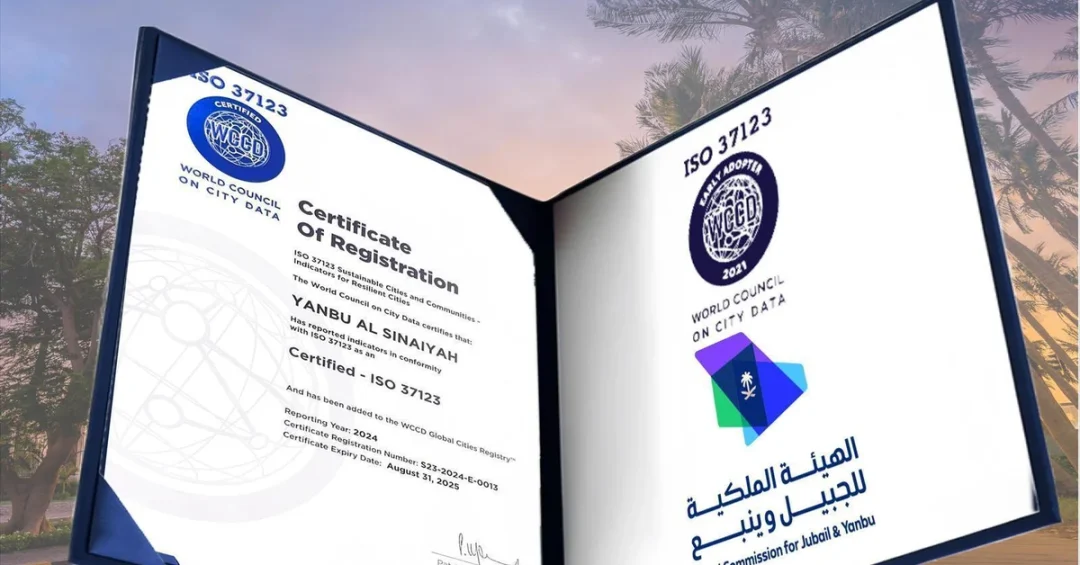
Yanbu Industrial City has become the first city in Saudi Arabia to receive the ISO 37123 certification for Sustainable Cities and Communities – Indicator for Resilient Cities, awarded by the World Council on City Data (WCCD). The Royal Commission for Jubail and Yanbu (RCJY) announced the achievement on August 21, 2024, marking a significant milestone in the Kingdom’s pursuit of sustainable urban development. The accreditation places Yanbu Industrial City in the WCCD Global Cities Registry, recognizing its commitment to resilience, sustainability, and quality of life.
Context and Background
The Royal Commission for Jubail and Yanbu (RCJY) has long been responsible for developing and managing Saudi Arabia’s industrial cities, ensuring they operate efficiently and sustainably. The ISO 37123 standard, developed by the International Organization for Standardization (ISO), provides a framework for cities to measure and improve their resilience to challenges such as natural disasters, economic shocks, and climate change. The WCCD, a global leader in standardized city data, awards this certification to cities that demonstrate exceptional performance in resilience indicators. Yanbu Industrial City’s inclusion in the WCCD Global Cities Registry underscores Saudi Arabia’s commitment to international best practices and its Vision 2030 goals.
Key Details
According to the Saudi Press Agency (SPA), the RCJY emphasized its dedication to enhancing the resilience and sustainability of its cities, enabling them to grow, prosper, adapt to changes, and conserve national resources. The commission’s approach integrates all works to ensure continuous service delivery to stakeholders in both routine and emergency circumstances. This certification reflects the city’s robust infrastructure, emergency preparedness, and sustainable resource management. The ISO 37123 certification is part of the broader ISO 37100 family of standards for sustainable cities and communities, focusing specifically on resilience indicators such as infrastructure, environmental management, and social cohesion. Yanbu Industrial City’s achievement aligns with the RCJY’s mission to raise the quality of life and status of its cities, in line with the Kingdom’s Vision 2030.
Implications and Impact
This accreditation has significant implications for Saudi Arabia’s urban development and its international standing. It positions Yanbu Industrial City as a model for other cities in the Kingdom and the region, demonstrating that Saudi cities can meet global standards for resilience and sustainability. The recognition also enhances the city’s attractiveness to international investors and partners, as it signals a stable and well-managed environment. Furthermore, it supports Saudi Arabia’s efforts to diversify its economy and promote sustainable industrialization, key pillars of Vision 2030. The WCCD certification provides a benchmark for continuous improvement, encouraging other Saudi cities to pursue similar accolades and contribute to the Kingdom’s sustainable urban future.
Vision 2030 Alignment
This achievement is directly aligned with Saudi Arabia’s Vision 2030, which aims to build a thriving economy and vibrant society. By fostering resilient and sustainable cities, the Kingdom is enhancing the quality of life for its citizens and residents, while also attracting global investment. The RCJY’s success in securing this accreditation for Yanbu Industrial City exemplifies the Vision’s emphasis on efficient public services, environmental stewardship, and international collaboration. As Saudi Arabia continues to transform its urban landscape, such milestones reinforce its position as a leader in sustainable development and a model for the region and the world.
20 Questions
Q1. What is the significance of Yanbu Industrial City receiving the ISO 37123 certification?
A1. It makes Yanbu the first Saudi city to receive this international accreditation for resilient cities, demonstrating the Kingdom’s commitment to sustainable urban development and global best practices.
Q2. What is the World Council on City Data (WCCD)?
A2. The WCCD is a global organization that promotes standardized city data to help cities improve services, resilience, and quality of life. It awards certifications like ISO 37123.
Q3. What does ISO 37123 specifically measure?
A3. ISO 37123 measures a city’s resilience to shocks and stresses, including natural disasters, economic disruptions, and climate impacts, through a set of standardized indicators.
Q4. How does this certification benefit Yanbu Industrial City?
A4. It enhances the city’s reputation, attracts investment, and provides a framework for continuous improvement in resilience and sustainability, benefiting residents and businesses.
Q5. What is the role of the Royal Commission for Jubail and Yanbu (RCJY)?
A5. RCJY develops and manages Saudi Arabia’s industrial cities, ensuring they are sustainable, resilient, and aligned with Vision 2030 goals.
Q6. How does this achievement align with Saudi Vision 2030?
A6. It supports Vision 2030’s objectives of economic diversification, improved quality of life, and sustainable development, showcasing Saudi leadership in urban innovation.
Q7. What are the key indicators of a resilient city?
A7. Key indicators include robust infrastructure, emergency preparedness, environmental management, social cohesion, and economic adaptability.
Q8. How does Yanbu Industrial City compare to other cities globally?
A8. Yanbu now joins a select group of cities in the WCCD Global Cities Registry, meeting international standards for resilience and sustainability.
Q9. What steps did RCJY take to achieve this certification?
A9. RCJY integrated resilience and sustainability into city planning, ensured service continuity, and complied with ISO 37123 indicators, as verified by WCCD.
Q10. What impact does this have on Saudi Arabia’s international standing?
A10. It reinforces the Kingdom’s reputation as a leader in sustainable development and urban innovation, attracting global partnerships and investment.
Q11. How will this certification affect residents of Yanbu?
A11. Residents will benefit from improved services, enhanced quality of life, and a more resilient city that can better handle emergencies and challenges.
Q12. What other Saudi cities might pursue similar certifications?
A12. Other industrial cities managed by RCJY, such as Jubail, and major urban centers like Riyadh and Jeddah, may seek similar accreditations to align with Vision 2030.
Q13. What is the WCCD Global Cities Registry?
A13. It is a registry of cities that have achieved ISO certifications for standardized data, showcasing their commitment to sustainability and resilience.
Q14. How does this certification contribute to environmental sustainability?
A14. It encourages practices like resource conservation, pollution reduction, and climate adaptation, which are integral to environmental sustainability.
Q15. What does ‘resilient cities’ mean in the context of ISO 37123?
A15. It refers to cities’ ability to withstand and recover from shocks and stresses, ensuring continuity of services and protecting citizens.
Q16. How does RCJY ensure integration of works across its cities?
A16. RCJY coordinates infrastructure, services, and emergency planning to ensure coherence and efficiency, as stated in their approach.
Q17. What are the economic benefits of this accreditation for Yanbu?
A17. It attracts investors seeking stable environments, boosts local businesses, and supports economic diversification, aligning with Vision 2030.
Q18. How does this certification reflect on Saudi Arabia’s Vision 2030?
A18. It exemplifies Vision 2030’s goals of sustainable development, global engagement, and improved quality of life, positioning Saudi Arabia as a model for others.
Q19. What role did SPA play in announcing this achievement?
A19. The Saudi Press Agency (SPA) officially reported the certification, highlighting RCJY’s success and its alignment with national objectives.
Q20. What future steps might RCJY take following this recognition?
A20. RCJY may use this as a benchmark to further enhance resilience, pursue additional certifications, and share best practices with other Saudi cities.
Reader Feedback
We value your thoughts. Please share your feedback on this article.
Your feedback helps us improve our coverage.