


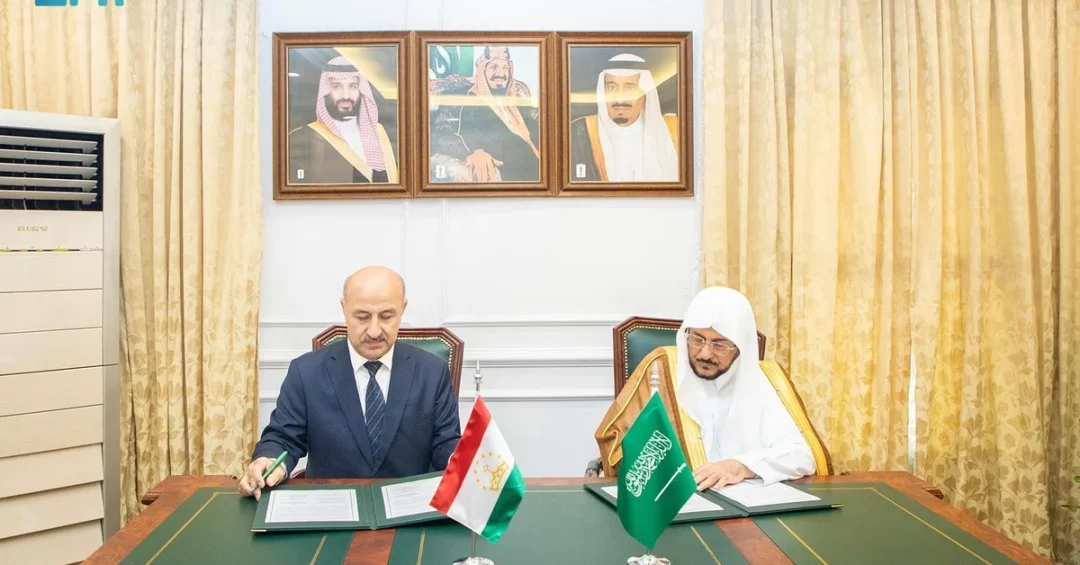
The Ministry of Islamic Affairs, Dawah, and Guidance signed a memorandum of understanding with the Committee on Religion, Regulation of Traditions and Ceremonies of the Republic of Tajikistan in Jeddah on August 22, 2024, aiming to enhance bilateral cooperation in Islamic affairs. The agreement was signed by Sheikh Dr. Abdullatif bin Abdulaziz Al Al-Sheikh, Minister of Islamic Affairs, Dawah, and Guidance, and Sulaymon Davlatzoda, Chairman of the Tajikistan Committee on Religion, Regulation of Traditions and Ceremonies. The memorandum outlines a comprehensive framework for collaboration in promoting moderate Islam, exchanging expertise, and supporting joint initiatives in religious education and cultural exchange.
Context and Background
The signing of this memorandum reflects the Kingdom of Saudi Arabia’s ongoing commitment to fostering international partnerships that promote the true teachings of Islam, characterized by tolerance, moderation, and peace. Tajikistan, a Central Asian nation with a predominantly Muslim population, shares historical and cultural ties with the Islamic world, and this agreement builds on the longstanding relations between the two countries. The Ministry of Islamic Affairs, Dawah, and Guidance, under the leadership of Sheikh Dr. Abdullatif bin Abdulaziz Al Al-Sheikh, has been at the forefront of Saudi Arabia’s efforts to spread the message of moderate Islam globally, in line with the directives of the Kingdom’s leadership.
This memorandum is part of a series of similar agreements signed with various countries, underscoring Saudi Arabia’s role as a global leader in Islamic affairs and its dedication to serving Islam and Muslims worldwide. It also aligns with the objectives of Saudi Vision 2030, which emphasizes international cooperation and cultural diplomacy as key pillars of the Kingdom’s foreign policy.
Key Details of the Memorandum
The memorandum encompasses a wide range of cooperative areas designed to strengthen the understanding of Islam and address contemporary issues. Key provisions include the exchange of research and scientific books in multiple languages, the organization of joint scientific seminars focused on training workers in Islamic affairs, and the facilitation of participation by scholars and specialists in conferences and seminars held in both countries.
Furthermore, the agreement stipulates cooperation in the construction and maintenance of mosques, as well as the training and qualification of their staff. A significant component is the collaboration in the service of the Holy Quran and the Sunnah of the Prophet, through the exchange of expertise in printing the Holy Quran and translating its meanings. The Ministry will provide the Tajik committee with copies of publications from the King Fahd Complex for the Printing of the Holy Quran, a leading institution in this field. Additionally, the memorandum includes exchanging invitations to participate in Quran memorization competitions and sharing regulations and guidelines related to such competitions and their criteria.
Both sides also agreed to exchange expertise and information pertaining to Quran manuscripts and Islamic heritage, highlighting the commitment to preserving Islamic cultural legacy.
Implications and Impact
This memorandum is expected to have a positive impact on the bilateral relations between Saudi Arabia and Tajikistan, enhancing mutual understanding and cooperation in religious and cultural spheres. It provides a structured framework for sharing knowledge and best practices, which can contribute to countering extremism and promoting moderate Islam in the region. The agreement also opens avenues for Tajik scholars and officials to benefit from Saudi Arabia’s expertise in Islamic affairs, including the training of religious personnel and the organization of exhibitions to introduce Islam.
On a broader scale, this collaboration reinforces Saudi Arabia’s position as a key partner in Central Asia, a region of growing strategic importance. It also demonstrates the Kingdom’s soft power and its ability to build bridges with diverse nations through shared religious and cultural values.
Vision 2030 Alignment
This memorandum of understanding is closely aligned with Saudi Vision 2030, particularly in its emphasis on international cooperation, cultural exchange, and the promotion of moderate Islam. By strengthening ties with Tajikistan, the Kingdom advances its goal of fostering global peace and understanding, while also showcasing its leadership in Islamic affairs. The agreement supports the Vision’s objectives of enhancing Saudi Arabia’s global role and building strategic partnerships that contribute to the prosperity and stability of the region and beyond.
20 Questions
Q1. What is the memorandum of understanding signed between Saudi Arabia and Tajikistan?
A1. The memorandum of understanding is an agreement signed between the Ministry of Islamic Affairs, Dawah, and Guidance of Saudi Arabia and the Committee on Religion, Regulation of Traditions and Ceremonies of Tajikistan to enhance cooperation in Islamic affairs, including the exchange of expertise and joint initiatives.
Q2. Who signed the memorandum on behalf of Saudi Arabia?
A2. The memorandum was signed by Sheikh Dr. Abdullatif bin Abdulaziz Al Al-Sheikh, the Minister of Islamic Affairs, Dawah, and Guidance of Saudi Arabia.
Q3. Who signed the memorandum on behalf of Tajikistan?
A3. Sulaymon Davlatzoda, Chairman of the Committee on Religion, Regulation of Traditions and Ceremonies of Tajikistan, signed the memorandum on behalf of his country.
Q4. Where and when was the memorandum signed?
A4. The memorandum was signed in Jeddah on August 22, 2024.
Q5. What are the main areas of cooperation outlined in the memorandum?
A5. The main areas include promoting understanding of Islam, exchanging research and scientific books, organizing joint scientific seminars, training workers in Islamic affairs, constructing and maintaining mosques, and cooperating in the service of the Holy Quran and the Sunnah.
Q6. How does the memorandum address contemporary issues?
A6. The memorandum addresses contemporary issues through the exchange of research and scientific books in various languages and by organizing joint scientific seminars to discuss and find solutions to modern challenges.
Q7. What role does the King Fahd Complex play in this agreement?
A7. The King Fahd Complex for the Printing of the Holy Quran will provide the Tajik committee with copies of its publications, and the two sides will exchange expertise in printing the Holy Quran and translating its meanings.
Q8. Will there be joint exhibitions to introduce Islam?
A8. Yes, the memorandum includes organizing joint exhibitions to introduce Islam and highlight its virtues and tolerance.
Q9. How will scholars and specialists participate in conferences?
A9. The memorandum facilitates the participation of scholars and specialists in Islamic affairs in conferences and seminars held in both countries through the exchange of invitations.
Q10. What is the significance of cooperation in Quran memorization competitions?
A10. Cooperation in Quran memorization competitions includes exchanging invitations to participate and sharing regulations and criteria, which helps in promoting the memorization and understanding of the Holy Quran among the youth.
Q11. How does the memorandum support the training of mosque staff?
A11. The memorandum includes provisions for the training and qualification of mosque staff, which will enhance their ability to serve their communities effectively and promote moderate Islam.
Q12. What is the expected impact of this memorandum on Saudi-Tajik relations?
A12. The memorandum is expected to strengthen bilateral relations by fostering mutual understanding and cooperation in religious and cultural fields, contributing to regional stability and peace.
Q13. How does this agreement align with Saudi Vision 2030?
A13. It aligns with Vision 2030 by promoting international cooperation, cultural exchange, and the Kingdom’s role as a global leader in Islamic affairs, which are key objectives of the Vision.
Q14. What is the role of the Ministry of Islamic Affairs in this agreement?
A14. The Ministry of Islamic Affairs, Dawah, and Guidance is responsible for implementing the memorandum’s provisions, including providing publications and facilitating exchanges with the Tajik committee.
Q15. Will there be exchange of expertise in Quran manuscripts and Islamic heritage?
A15. Yes, the memorandum includes the exchange of expertise and information pertaining to Quran manuscripts and Islamic heritage, aiming to preserve and promote these important aspects of Islamic culture.
Q16. How does the memorandum promote moderate Islam?
A16. The memorandum promotes moderate Islam by highlighting its virtues and tolerance, addressing contemporary issues through dialogue, and supporting educational and cultural exchanges that spread the true message of Islam.
Q17. What kind of seminars will be organized under this memorandum?
A17. Joint scientific seminars related to the training of workers in Islamic affairs will be organized, allowing for the exchange of knowledge and best practices.
Q18. How will the memorandum facilitate the construction and maintenance of mosques?
A18. The memorandum stipulates cooperation in the construction and maintenance of mosques, which may include sharing expertise, resources, and technical support.
Q19. What is the significance of exchanging invitations for conferences?
A19. Exchanging invitations allows scholars and specialists from both countries to participate in important conferences and seminars, fostering dialogue and cooperation in Islamic affairs.
Q20. How does this memorandum reflect Saudi Arabia’s commitment to global Islamic cooperation?
A20. It reflects Saudi Arabia’s commitment by demonstrating its ongoing efforts to build partnerships with countries worldwide, promote moderate Islam, and serve the interests of Muslims globally through collaborative initiatives.
Reader Feedback
We value your thoughts. Please share your feedback on this article.
Your feedback helps us improve our coverage.