


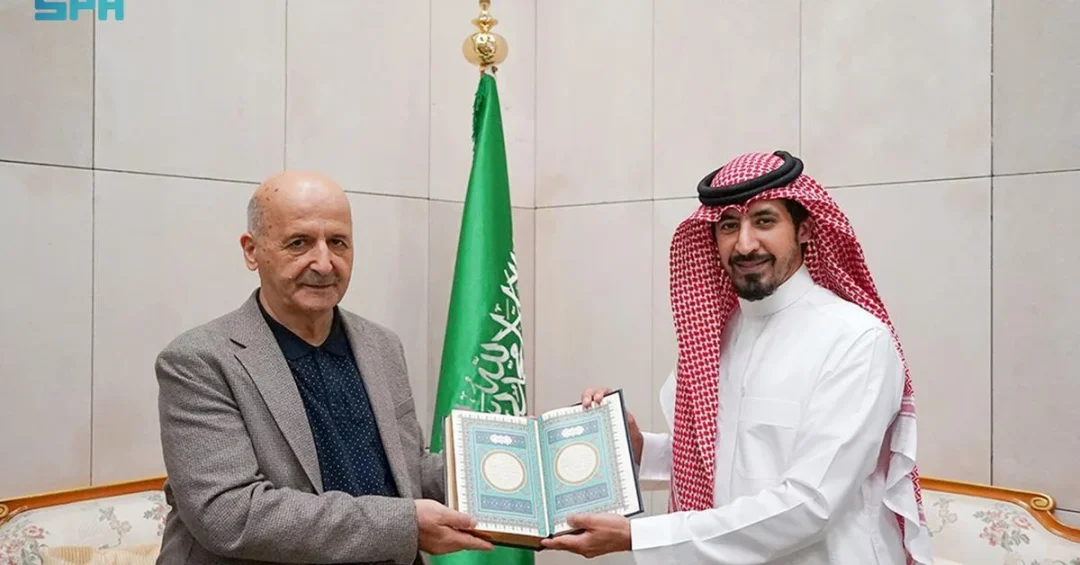
A delegation from Tajikistan’s Committee on Religion, Regulation of Traditions, Celebrations, and Ceremonies visited the King Fahd Complex for the Printing of the Holy Quran in Madinah on August 24, 2024, according to the Saudi Press Agency (SPA). The visit focused on enhancing cooperation in serving the Holy Quran and the Sunnah of the Prophet, with discussions centered on exchanging expertise and information related to printing the Holy Quran and translating its meanings. The meeting underscores the Kingdom’s pivotal role in preserving and disseminating Islamic heritage globally.
Context and Background
The King Fahd Complex for the Printing of the Holy Quran, located in Madinah, is a leading institution dedicated to the production and distribution of the Holy Quran and its translations. Established in 1985, the complex has printed millions of copies in numerous languages, serving Muslims worldwide. Its mission aligns with Saudi Arabia’s commitment to serving Islam and Muslims, a cornerstone of the Kingdom’s policy under the leadership of Custodian of the Two Holy Mosques King Salman bin Abdulaziz Al Saud and Crown Prince Mohammed bin Salman.
The Tajik delegation’s visit reflects the strong bilateral ties between Saudi Arabia and Tajikistan, which have deepened in recent years through mutual visits and agreements in various fields. Tajikistan, a Central Asian nation with a predominantly Muslim population, values the Kingdom’s expertise in religious affairs and its role in promoting moderate Islam.
Key Details
During the visit, the Tajik delegation, led by officials from the Committee on Religion, Regulation of Traditions, Celebrations, and Ceremonies, toured the complex’s facilities, including printing presses, binding units, and translation departments. They observed the meticulous process of producing the Holy Quran, from calligraphy to final packaging. Discussions also covered the complex’s advanced techniques in translating the Quran’s meanings into multiple languages, ensuring accuracy and respect for Islamic teachings.
The two sides explored avenues for future collaboration, such as training Tajik specialists in Quran printing and translation, and sharing digital resources. The King Fahd Complex has previously collaborated with various countries, distributing free copies of the Quran and its translations to Hajj pilgrims and Islamic centers globally. This visit is part of Saudi Arabia’s broader efforts to foster international partnerships in religious services, as highlighted by the Ministry of Islamic Affairs, Dawah and Guidance.
Implications and Impact
The delegation’s visit signifies Saudi Arabia’s expanding influence in Central Asia, where it promotes religious moderation and counteracts extremism. By sharing its expertise, the Kingdom supports Tajikistan in meeting the religious needs of its citizens while strengthening cultural and diplomatic ties. This collaboration also reinforces the role of the King Fahd Complex as a global hub for Quranic services, enhancing its reputation for excellence and innovation.
On a regional level, the visit aligns with Saudi Arabia’s Vision 2030, which emphasizes international cooperation and the promotion of moderate Islam. It also complements the goals of the Makkah-based Muslim World League and other Saudi-led initiatives that bridge cultures and foster peace. For Tajikistan, the partnership offers access to best practices in Quran printing, helping to preserve its Islamic heritage for future generations.
Vision 2030 Alignment
This visit exemplifies Saudi Arabia’s Vision 2030 objective of strengthening global partnerships and enhancing the Kingdom’s leadership in serving Islam and Muslims. By facilitating such exchanges, Saudi Arabia not only shares its rich experience but also builds bridges of understanding and cooperation that extend beyond religious matters. As the Kingdom continues to modernize and open up to the world, initiatives like this showcase its commitment to peace, moderation, and the preservation of Islamic values, further solidifying its role as a beacon of Islamic scholarship and diplomacy.
20 Questions
Q1. What was the purpose of the Tajik delegation’s visit to the King Fahd Complex?
A1. The delegation aimed to enhance cooperation in serving the Holy Quran and the Sunnah, exchanging expertise on Quran printing and translation, and exploring opportunities for future collaboration between Tajikistan and Saudi Arabia.
Q2. When did the Tajik delegation visit the King Fahd Complex?
A2. According to the Saudi Press Agency, the delegation visited on August 24, 2024. The visit was part of ongoing efforts to strengthen bilateral ties and religious cooperation between the two nations.
Q3. What is the King Fahd Complex known for?
A3. The King Fahd Complex in Madinah is renowned for printing the Holy Quran and translating its meanings into multiple languages. It distributes millions of copies worldwide, serving Muslims and promoting Islamic teachings.
Q4. Which Tajik body sent the delegation?
A4. The delegation was from Tajikistan’s Committee on Religion, Regulation of Traditions, Celebrations, and Ceremonies. This body oversees religious affairs and ensures the proper observance of Islamic practices in Tajikistan.
Q5. What topics were discussed during the visit?
A5. Discussions focused on cooperation in serving the Holy Quran and Sunnah, exchanging experience and information regarding printing the Holy Quran, and translating its meanings to support global Muslim communities.
Q6. How does this visit reflect Saudi Arabia’s role in the Islamic world?
A6. It highlights Saudi Arabia’s leadership in serving Islam and Muslims, showcasing its commitment to preserving Islamic heritage and promoting moderate teachings through institutions like the King Fahd Complex.
Q7. What is the significance of the King Fahd Complex in Madinah?
A7. The complex is a leading global institution for Quran printing and translation. It supports the dissemination of Islamic knowledge and ensures the accurate reproduction of the Holy Quran in various languages.
Q8. How does this visit align with Saudi Vision 2030?
A8. It aligns with Vision 2030 by fostering international partnerships, promoting moderate Islam, and enhancing Saudi Arabia’s global role in religious diplomacy and cultural exchange.
Q9. What benefits does Tajikistan gain from this collaboration?
A9. Tajikistan gains access to Saudi expertise in Quran printing and translation, helping preserve its Islamic heritage. It also strengthens religious and cultural ties with the Kingdom.
Q10. What is the historical background of Saudi-Tajik relations?
A10. Saudi Arabia and Tajikistan have maintained strong relations since Tajikistan’s independence. Ties have deepened through mutual visits and cooperation in religious, economic, and cultural fields.
Q11. How does the King Fahd Complex ensure the accuracy of Quran translations?
A11. The complex employs expert scholars and translators who rigorously review translations to ensure they accurately convey the meanings of the Holy Quran while respecting Islamic teachings and cultural sensitivities.
Q12. What other countries have collaborated with the King Fahd Complex?
A12. Many countries across Asia, Africa, and Europe have partnered with the complex. It regularly distributes free copies of the Quran and its translations to Hajj pilgrims and Islamic centers globally.
Q13. What role does the Saudi Ministry of Islamic Affairs play in such visits?
A13. The Ministry of Islamic Affairs, Dawah and Guidance oversees religious diplomacy, facilitates visits, and promotes Saudi Arabia’s message of moderate Islam and interfaith dialogue.
Q14. How does this visit contribute to combating extremism?
A14. By promoting moderate Islam and providing accurate religious resources, the collaboration helps counter extremist narratives and supports Tajikistan in fostering a tolerant and peaceful society.
Q15. What is the expected outcome of the Tajik delegation’s visit?
A15. The visit is expected to lead to enhanced cooperation, including potential training programs for Tajik specialists and sharing of digital resources for Quran printing and translation.
Q16. How does the King Fahd Complex distribute the Holy Quran globally?
A16. The complex distributes the Holy Quran through Saudi embassies, Islamic centers, and during Hajj and Umrah seasons. It also partners with international organizations to reach Muslims worldwide.
Q17. What languages are the Quran translations available in?
A17. The King Fahd Complex has translated the Quran into numerous languages, including English, French, Urdu, Indonesian, Russian, and many others, catering to diverse Muslim communities.
Q18. How does this visit strengthen Saudi-Tajik diplomatic ties?
A18. It builds trust and mutual respect, showcasing Saudi Arabia’s willingness to share expertise. Such exchanges deepen bilateral relations and open avenues for cooperation in other sectors.
Q19. What is the significance of Madinah as the location of the King Fahd Complex?
A19. Madinah is the second holiest city in Islam, making it a fitting location for the complex. It symbolizes the Kingdom’s dedication to serving the Holy Quran and facilitating access to Islamic knowledge.
Q20. How can other countries benefit from similar collaborations with Saudi Arabia?
A20. Other countries can benefit by requesting partnerships with the King Fahd Complex, participating in training programs, and accessing Saudi expertise in Quran printing, translation, and distribution to serve their Muslim populations.
Reader Feedback
We value your thoughts. Please share your feedback on this article.
Your feedback helps us improve our coverage.