


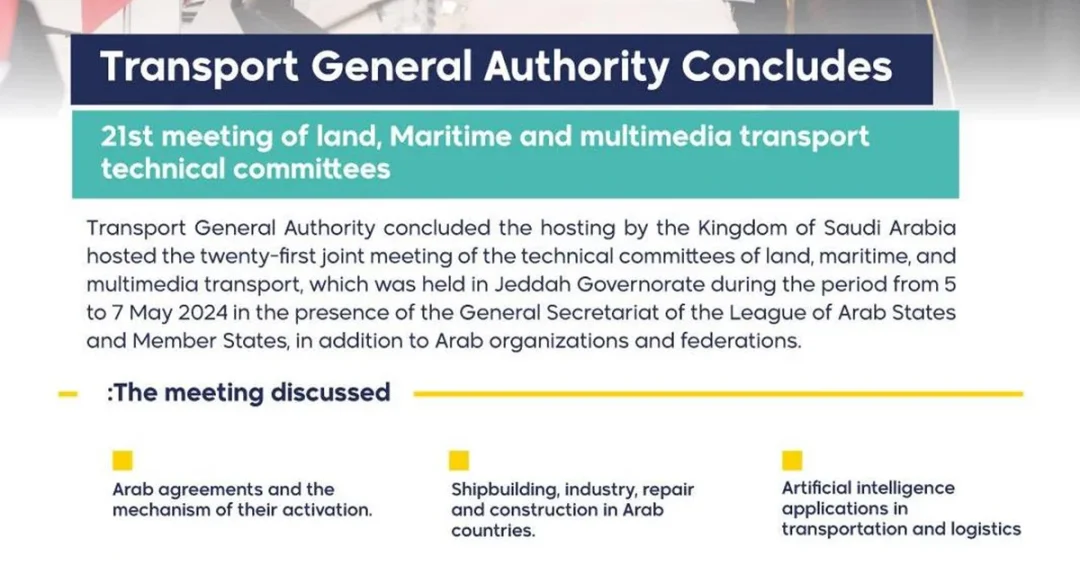
The Transport General Authority (TGA) of Saudi Arabia successfully hosted the 21st session of the joint meeting of technical committees for land, maritime, and multimedia transport in Jeddah from May 5 to 7, 2024. The meeting brought together representatives from Arab organizations, federations, and member states of the League of Arab States to discuss key issues and share expertise. The Kingdom showcased its advancements in logistics, railway transport, and the use of artificial intelligence (AI) in container handling, reinforcing its leadership in regional transport cooperation.
Context and Background
The joint meeting of technical committees is a regular forum under the League of Arab States aimed at enhancing collaboration among Arab nations in the transport sector. This 21st session, hosted by the Transport General Authority (TGA), focused on critical topics such as activating Arab agreements, ship manufacturing and repair, the application of AI in transport and logistics, the transportation of hazardous materials, and the development of electronic platforms and databases. The gathering underscores Saudi Arabia’s commitment to fostering regional integration and advancing the Arab world’s transport infrastructure.
Key Details
During the three-day event, participants engaged in discussions on various strategic areas. The Kingdom shared its experiences in the logistics and transport sector, particularly highlighting its expertise in railway transport. Attendees were taken on a visit to the Haramain Express train stations in Jeddah Governorate and King Abdullah Economic City in Rabigh, where they observed firsthand the Kingdom’s advanced rail infrastructure. Additionally, Saudi Arabia showcased its pioneering use of AI in container handling, with insights shared from a visit to King Abdullah Port in King Abdullah Economic City. These demonstrations reflect the Kingdom’s efforts to integrate cutting-edge technology into its transport and logistics operations.
Implications and Impact
The outcomes of this meeting are expected to have significant implications for regional transport cooperation. By aligning Arab agreements and standardizing practices, member states can enhance the efficiency and safety of cross-border transport. Saudi Arabia’s leadership in hosting and sharing its expertise not only strengthens its ties with other Arab nations but also positions the Kingdom as a model for innovation in the sector. The adoption of AI and electronic platforms discussed during the session could lead to streamlined logistics, reduced costs, and improved trade flows across the region, benefiting all participating countries.
Vision 2030 Alignment
This meeting aligns closely with Saudi Arabia’s Vision 2030, which aims to diversify the economy and establish the Kingdom as a global logistics hub. By investing in transport infrastructure, such as the Haramain Express and King Abdullah Port, and embracing AI technologies, Saudi Arabia is not only enhancing its own capabilities but also contributing to the broader Arab world’s development. The TGA’s successful hosting of this session demonstrates the Kingdom’s proactive role in driving regional integration and sustainable growth, key pillars of Vision 2030.
20 Questions
Q1. What was the main event hosted by the Transport General Authority in Jeddah?
A1. The Transport General Authority hosted the 21st session of the joint meeting of technical committees for land, maritime, and multimedia transport in Jeddah from May 5 to 7, 2024.
Q2. Which organizations participated in the meeting?
A2. Representatives from Arab organizations, federations, and member states of the League of Arab States participated in the meeting.
Q3. What were some of the key topics discussed at the meeting?
A3. Key topics included activating Arab agreements, ship manufacturing and repair, AI in transport and logistics, hazardous materials transport, and electronic platforms and databases.
Q4. How did Saudi Arabia share its expertise during the meeting?
A4. Saudi Arabia shared its experiences in logistics, railway transport, and the use of AI in container handling, and organized visits to Haramain Express stations and King Abdullah Port.
Q5. What sites did attendees visit as part of the meeting?
A5. Attendees visited the Haramain Express train stations in Jeddah Governorate and King Abdullah Economic City in Rabigh, as well as King Abdullah Port.
Q6. What is the significance of the Haramain Express train in Saudi Arabia?
A6. The Haramain Express is a high-speed rail line connecting major cities, enhancing transportation for pilgrims and citizens, and showcasing Saudi Arabia’s advanced infrastructure.
Q7. How is Saudi Arabia applying AI in its transport sector?
A7. Saudi Arabia is using AI in container handling at King Abdullah Port to improve efficiency and logistics operations, as demonstrated to meeting attendees.
Q8. What is the role of the Transport General Authority in Saudi Arabia?
A8. The Transport General Authority regulates and develops the transport sector in Saudi Arabia, aiming to enhance safety, efficiency, and innovation in line with Vision 2030.
Q9. What are the expected outcomes of the meeting?
A9. The meeting is expected to strengthen regional cooperation, align transport standards, and promote the adoption of advanced technologies across Arab nations.
Q10. How does this meeting align with Saudi Vision 2030?
A10. It supports Vision 2030 by advancing Saudi Arabia’s position as a global logistics hub, fostering economic diversification, and promoting regional integration through infrastructure and technology.
Q11. What is the League of Arab States’ role in transport cooperation?
A11. The League of Arab States facilitates joint meetings and agreements among member states to enhance collaboration and standardization in transport and logistics across the Arab world.
Q12. What are the benefits of activating Arab agreements in transport?
A12. Activating these agreements leads to smoother cross-border transport, reduced trade barriers, and improved efficiency, benefiting all member states economically.
Q13. How does the meeting address hazardous materials transport?
A13. Participants discussed best practices and regulations for safely transporting hazardous materials, aiming to harmonize standards and enhance regional safety.
Q14. What electronic platforms were discussed at the meeting?
A14. The meeting covered the development of electronic platforms for transport databases and coordination, aiming to streamline information sharing and logistics among Arab countries.
Q15. Why is ship manufacturing and repair important for Arab countries?
A15. Enhancing shipbuilding and repair capabilities supports maritime trade, reduces reliance on external services, and boosts economic growth in the region.
Q16. How does Saudi Arabia’s logistics sector benefit from these meetings?
A16. By sharing expertise and learning from others, Saudi Arabia can further develop its logistics sector, attract investment, and improve its global competitiveness.
Q17. What is King Abdullah Port’s significance in Saudi Arabia’s transport strategy?
A17. King Abdullah Port is a key hub for trade and logistics, demonstrating Saudi Arabia’s commitment to modern infrastructure and technological innovation in maritime transport.
Q18. What role does railway transport play in Saudi Arabia’s Vision 2030?
A18. Railway transport is vital for connecting cities, facilitating pilgrimages, and reducing road congestion, contributing to Vision 2030’s goals of sustainable development and economic diversification.
Q19. How might AI in transport improve logistics in the Arab world?
A19. AI can optimize routes, predict maintenance, and automate container handling, leading to faster, cost-effective, and more reliable logistics across the region.
Q20. What future collaborations can be expected following this meeting?
A20. Future collaborations may include joint projects on AI integration, infrastructure development, and harmonized regulations, further uniting Arab nations in transport and logistics.
Reader Feedback
We value your thoughts. Please share your feedback on this article.
Your feedback helps us improve our coverage.