


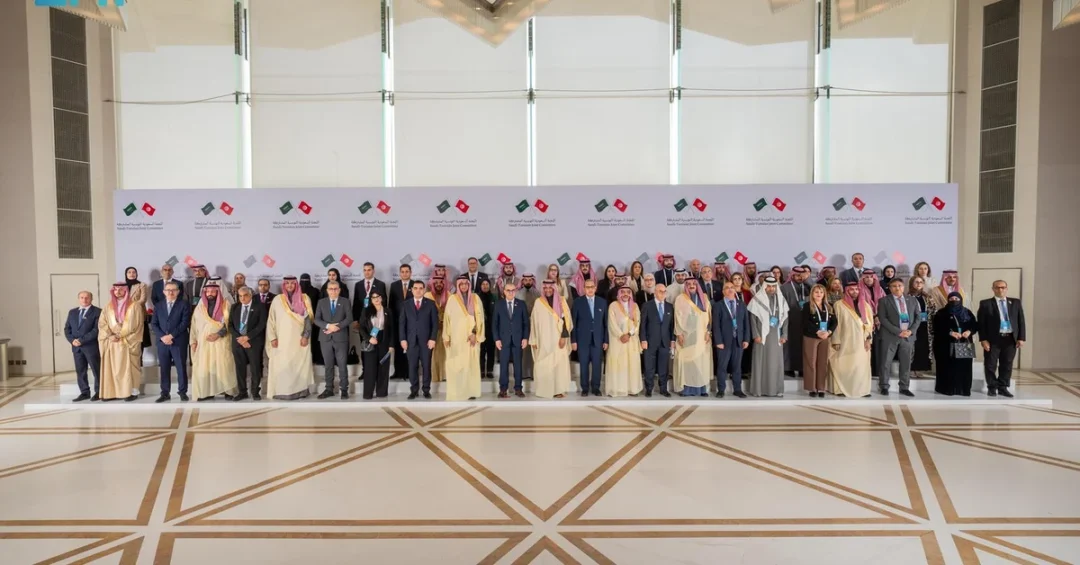
Riyadh, December 28, 2025 — The 12th session of the Saudi-Tunisian Joint Committee concluded in the Saudi capital with the signing of five agreements, memoranda of understanding and executive programs covering customs, mineral resources, postal services and media cooperation. The session, hosted by the Saudi Ministry of Industry and Mineral Resources, also approved the minutes of the 12th session, which included 100 cooperation items across 15 strategic areas. The outcome, announced by the Saudi Press Agency, marks a further step in the Kingdom’s expanding partnership with Tunisia and its wider Arab and African engagement.
Context and Background
The Saudi-Tunisian Joint Committee is the two countries’ principal bilateral platform for reviewing political, economic and sectoral cooperation and for converting shared priorities into concrete programs. The 12th session was co-chaired by Bandar Alkhorayef, Saudi Minister of Industry and Mineral Resources, and Samir Abdelhafidh, Tunisia’s Minister of Economy and Planning, with broad participation from government representatives on both sides.
Discussions reviewed bilateral cooperation tracks and partnership priorities in trade and investment, development, renewable energy, industry and mining, transport and logistics, digital transformation and postal services, tourism, culture and media. The agenda also covered consular, security and judicial affairs, together with Hajj and Umrah and Islamic affairs, reflecting the depth and breadth of the relationship between the two countries.
Key Details: Agreements and Cooperation Items
The closing session produced a package of strategic instruments. These included an agreement on cooperation and mutual assistance in customs matters, a memorandum of understanding on cooperation in the mineral resources sector, a memorandum on the postal sector, and a further memorandum on cooperation in radio and television broadcasting.
The two delegations also signed an executive program for cooperation and news exchange between the Saudi Press Agency (SPA) and Tunis Afrique Presse (TAP), formalizing a direct channel for official information between the two countries.
Trade and Economic Cooperation
On the economic and trade track, the committee called for completing the implementation of agreed initiatives to boost trade exchange and to activate the role of the Joint Business Council, while expanding mutual recognition of product conformity certificates. Delegates also commended the positive outcomes of the third meeting of the Joint Working Group for Trade Cooperation, held in Tunisia in July 2025, which contributed to a 38 percent increase in trade volume by September 2025 compared with the same period a year earlier.
Representatives of government sectors reviewed cooperation in priority economic sectors and existing and future joint development projects, noting their direct impact on supporting economic and social development in both countries. Both sides underscored the importance of maximizing mutual investment in vital and high-value sectors to support knowledge transfer, localization of expertise and the creation of quality opportunities for sustainable development.
International and Regional Impact
The 100 cooperation items approved by the committee span 15 areas, covering energy, industry, mining, justice, transport and logistics, aviation and human resource development, with the stated aim of consolidating economic integration and strengthening the comprehensive partnership between Saudi Arabia and Tunisia. The scope of the package signals a relationship that extends well beyond trade, reaching into institutional capacity, skills development and industrial capability.
Both sides agreed to continue holding the committee on a biennial basis, alternating between the two countries, with the two secretariats following up on implementation and addressing any challenges through two periodic meetings each year. They also expressed their aspiration to hold the 13th session in Tunisia at a date to be determined later through diplomatic channels.
Vision 2030 Alignment
The session’s emphasis on mining, industry, logistics, digital services and knowledge transfer aligns closely with Saudi Vision 2030, which seeks to diversify the national economy, expand non-oil exports and establish mining and manufacturing as key growth pillars. By pairing Saudi capital and industrial ambition with Tunisia’s position as a gateway to North African and Mediterranean markets, the committee’s outcomes support the Kingdom’s wider objective of building durable, mutually beneficial partnerships that create opportunities for investment, trade and talent. As preparations begin for the 13th session, the framework established in Riyadh provides a practical foundation for turning shared priorities into measurable economic results.
20 Questions
Q1. What was the outcome of the 12th session of the Saudi-Tunisian Joint Committee?
A1. The session concluded in Riyadh on December 28, 2025, with the signing of five agreements, memoranda of understanding and executive programs covering customs, mineral resources, postal services and media cooperation, alongside approval of 100 cooperation items across 15 strategic areas.
Q2. Where and when was the 12th session held?
A2. The 12th session was hosted in Riyadh, the capital of the Kingdom of Saudi Arabia, by the Saudi Ministry of Industry and Mineral Resources. The closing meetings and signing ceremony took place on December 28, 2025, according to the Saudi Press Agency.
Q3. Who co-chaired the committee meeting?
A3. The Saudi side was co-chaired by Bandar Alkhorayef, Minister of Industry and Mineral Resources, while the Tunisian side was co-chaired by Samir Abdelhafidh, Minister of Economy and Planning. Government representatives from both countries participated broadly in the deliberations.
Q4. Which five documents were signed at the session?
A4. The package included an agreement on cooperation and mutual assistance in customs matters, a memorandum of understanding on mineral resources cooperation, another on postal services, one on radio and television broadcasting, and an executive program for news exchange between SPA and TAP.
Q5. What does the customs cooperation agreement cover?
A5. It establishes a framework for cooperation and mutual assistance in customs matters between the two countries, supporting closer coordination between Saudi and Tunisian customs authorities as part of broader efforts to strengthen bilateral trade and economic integration.
Q6. Which areas of cooperation did the committee review?
A6. Discussions covered trade and investment, development, renewable energy, industry and mining, transport and logistics, digital transformation and postal services, tourism, culture and media, as well as consular, security and judicial affairs and Hajj, Umrah and Islamic affairs.
Q7. How many cooperation items did the committee approve?
A7. The committee approved the minutes of its 12th session, which contained 100 cooperation items spanning 15 areas. These items address strategic sectors including energy, industry, mining, justice, transport and logistics, aviation, and human resource development.
Q8. What trade growth was reported during the session?
A8. The meetings commended the outcomes of the third meeting of the Joint Working Group for Trade Cooperation, held in Tunisia in July 2025, which contributed to a notable 38 percent increase in trade volume by September 2025 compared with the same period a year earlier.
Q9. What role did the committee assign to the Joint Business Council?
A9. The committee called for activating the Joint Business Council to boost trade exchange and encourage private-sector engagement between the two countries, complementing government-level efforts to expand commercial ties, investment flows and industrial cooperation.
Q10. What did the committee say about product conformity certificates?
A10. Both sides endorsed expanding mutual recognition of product conformity certificates, a measure aimed at reducing procedural obstacles for exporters and importers and supporting smoother, more predictable access to each other’s markets within the agreed cooperation framework.
Q11. What was stated about mutual investments?
A11. Both sides underscored the importance of maximizing the benefits of mutual investments in vital and high-value sectors, supporting knowledge transfer, localization of expertise, and the creation of quality opportunities that contribute to sustainable development in both countries.
Q12. How often will the joint committee meet going forward?
A12. The two sides agreed to continue holding the joint committee on a biennial basis, alternating between Saudi Arabia and Tunisia. Their two secretariats will follow up on the implementation of recommendations and address related challenges through two periodic meetings each year.
Q13. Where will the 13th session be held?
A13. Both parties expressed their aspiration to hold the 13th session of the joint committee in Tunisia, at a date to be determined later through diplomatic channels, continuing the established practice of alternating hosts between the two countries.
Q14. Which Saudi ministry hosted the meetings?
A14. The Saudi Ministry of Industry and Mineral Resources hosted the meetings, reflecting the Kingdom’s focus on industry and mining as key pillars of economic diversification under Vision 2030 and of its wider partnership with Tunisia.
Q15. Which sectors are covered by the 100 cooperation items?
A15. The items cover 15 areas across strategic sectors, notably energy, industry, mining, justice, transport and logistics, aviation and human resource development, all aimed at consolidating economic integration and strengthening the comprehensive partnership between the two countries.
Q16. Which news agencies signed a cooperation program?
A16. The Saudi Press Agency (SPA) and Tunis Afrique Presse (TAP) signed an executive program for cooperation and news exchange, supporting the flow of accurate official information between the two countries and strengthening institutional media collaboration.
Q17. What media-related cooperation was agreed during the session?
A17. A memorandum of understanding was signed on cooperation in radio and television broadcasting, alongside the SPA and TAP news exchange program, expanding joint work in broadcast content and the exchange of official information between the two countries.
Q18. Why does this committee matter for regional cooperation?
A18. The committee provides a structured, recurring platform for Arab and African partnership, linking Saudi Arabia’s economic weight with Tunisia’s strategic location in North Africa and supporting trade, investment and stability across the wider region.
Q19. How do these outcomes align with Saudi Vision 2030?
A19. The agreements support Vision 2030 goals of diversifying the economy beyond oil, expanding non-oil exports, developing mining and industry, and deepening international partnerships that create sustainable opportunities for the Kingdom’s private sector and workforce.
Q20. What happens next after the 12th session?
A20. Technical teams and the two secretariats will implement the approved cooperation items and monitor progress through periodic meetings. Officials will also coordinate through diplomatic channels to set the date for the 13th session in Tunisia.
Reader Feedback
We value your thoughts. Please share your feedback on this article.
Your feedback helps us improve our coverage.