


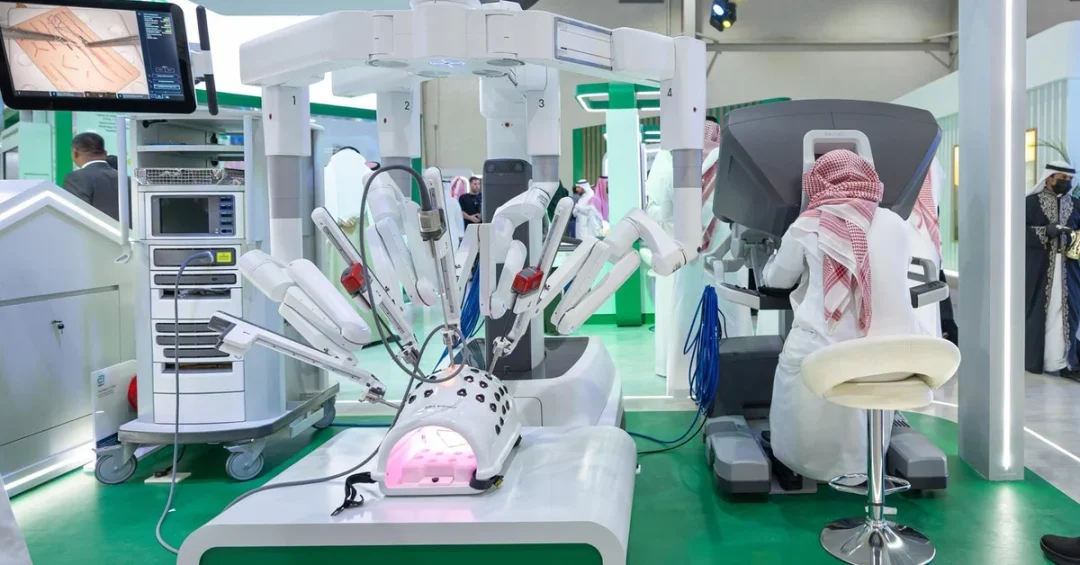
King Faisal Specialist Hospital and Research Centre (KFSHRC) showcased its advanced robotic surgery system at the Global Health Exhibition 2025, held at the Riyadh Exhibition and Convention Center, according to a press release issued by the hospital and carried by the Saudi Press Agency on October 27, 2025. The display placed one of the Kingdom’s most advanced clinical technology programmes before an international audience of healthcare leaders, policymakers and medical experts, and reinforced Saudi Arabia’s position as a regional leader in healthcare innovation.
The announcement detailed both the scale of the hospital’s robotic surgery activity and a series of technical milestones that have drawn global attention. Together, they illustrate how a Saudi academic medical centre has moved from adopting established technology to extending its boundaries.
Context and Background
King Faisal Specialist Hospital and Research Centre is one of the Kingdom’s foremost academic medical centres, combining tertiary patient care with research and professional training. Its standing in the international health community provides the backdrop to the Riyadh showcase. For 2025, KFSHRC was ranked first in the Middle East and North Africa and fifteenth globally among the world’s top 250 academic medical centres, and Brand Finance recognised it as the region’s most valuable healthcare brand. Newsweek has listed the hospital among the World’s Best Hospitals 2025, Best Smart Hospitals 2026 and Best Specialized Hospitals 2026.
The Global Health Exhibition, staged at the Riyadh Exhibition and Convention Center, has become a regular fixture on the international healthcare calendar. It brings together manufacturers, clinicians, investors and government representatives, making it a natural venue for KFSHRC to present clinical results alongside its training and infrastructure ambitions.
Record Growth in Robotic Procedures
Central to the hospital’s presentation was its performance data. In 2024, KFSHRC performed 1,370 robotic surgeries, a 28 percent increase on the previous year. The hospital attributed the growth to sustained investment in advanced surgical technologies and to the integration of technical precision with clinical expertise when performing complex procedures.
That volume matters because robotic surgery is not a single specialty but a platform. The same systems support urology, cardiac, hepatic, colorectal, thoracic and neurosurgical work, so higher case numbers translate directly into broader access to minimally invasive care for patients who might otherwise face longer, more invasive operations. KFSHRC said it is investing in advanced surgical infrastructure and developing Saudi talent through comprehensive training on the latest robotic systems, with the objective of establishing robotic surgery as the preferred approach for high-precision operations.
World Firsts in Precision Surgery
According to the release, KFSHRC has moved beyond basic adoption of robotic platforms to pioneering advanced applications. The hospital has recorded several world firsts: the first complete robotic liver transplant, the first complete robotic heart transplant and the first robotic resection of an intracranial brain tumour.
Robotic surgery offers precision beyond traditional manual techniques. Advanced three-dimensional visualisation and articulated robotic arms allow surgeons to operate with exceptional control and accuracy. By minimising incision size and surgical trauma, the approach reduces recovery time, decreases complications and improves patient outcomes, making it well suited to complex and minimally invasive procedures. The hospital noted that its milestones have elevated surgical precision standards worldwide and opened new possibilities for precision surgical medicine.
International Impact
The implications extend beyond a single institution. Demonstrating that complete robotic transplants and intricate neurosurgical resections can be performed successfully in Riyadh gives other hospitals in the region a clinical reference point and encourages further investment in surgical technology across the Middle East and North Africa. For international partners, it identifies KFSHRC as a credible collaborator for research, device evaluation and surgeon training.
For patients, the practical effect is measured in shorter hospital stays, fewer complications and access to advanced procedures closer to home. For Saudi Arabia, it strengthens the case for the Kingdom as a destination for specialised medical care and as a contributor to global clinical knowledge rather than only a consumer of imported technology.
Vision 2030 Alignment
The initiative aligns with Saudi Arabia’s Vision 2030 and its Health Sector Transformation Program, which aim to build a more resilient, innovative and patient-centred health system. By pairing advanced surgical infrastructure with structured training for Saudi clinicians, KFSHRC is helping to develop national expertise that can be retained and shared across the Kingdom. The hospital’s stated goal of making robotic surgery the preferred approach for high-precision operations positions Saudi Arabia as a long-term leader in precision medicine, supporting the broader national ambition of diversification, excellence and global engagement in healthcare.
20 Questions
Q1. What is King Faisal Specialist Hospital and Research Centre?
A1. King Faisal Specialist Hospital and Research Centre, known as KFSHRC, is a leading Saudi academic medical centre based in Riyadh. It delivers specialised tertiary care, conducts medical research and trains healthcare professionals, and is consistently recognised among the world’s top academic medical centres for innovation-driven patient care.
Q2. What did KFSHRC showcase at the Global Health Exhibition 2025?
A2. KFSHRC showcased its advanced robotic surgery system at the Global Health Exhibition 2025, held at the Riyadh Exhibition and Convention Center. The presentation highlighted the hospital’s clinical results, its surgical technology and its commitment to adopting cutting-edge medical innovation.
Q3. When and where was the exhibition held?
A3. The Global Health Exhibition 2025 took place at the Riyadh Exhibition and Convention Center in Riyadh, Saudi Arabia. KFSHRC announced its participation through a press release issued on October 27, 2025 and carried by the Saudi Press Agency.
Q4. How many robotic surgeries did KFSHRC perform in 2024?
A4. KFSHRC performed 1,370 robotic surgeries in 2024, according to the hospital’s press release. The figure reflects sustained investment in advanced surgical technology and the routine integration of robotic platforms into complex, high-precision clinical procedures.
Q5. What was the growth rate in robotic procedures?
A5. The hospital reported a 28 percent increase in robotic surgeries in 2024 compared with the previous year. The growth illustrates the seamless integration of technical precision with clinical expertise and confirms that robotic surgery has become a routine part of its surgical practice.
Q6. What world firsts has KFSHRC achieved?
A6. KFSHRC has recorded several world firsts, including the first complete robotic liver transplant, the first complete robotic heart transplant and the first robotic resection of an intracranial brain tumour. These milestones have raised surgical precision standards internationally.
Q7. How does robotic surgery improve patient outcomes?
A7. Robotic surgery allows procedures to be performed with exceptional control and accuracy. Minimising incision size and trauma reduces recovery time, decreases complications and significantly improves patient outcomes, making the technique particularly valuable for complex and minimally invasive operations.
Q8. Why is three-dimensional visualisation important?
A8. Three-dimensional visualisation provides surgeons with depth perception and magnified detail during delicate operations. Combined with articulated robotic arms, it supports precise instrument movement, helping to protect surrounding tissue and improve accuracy within confined anatomical spaces.
Q9. What is KFSHRC’s strategic vision for robotic surgery?
A9. KFSHRC aims to establish robotic surgery as the preferred approach for high-precision operations and to strengthen its position as a global leader in the field, supported by investment in advanced surgical infrastructure and structured training for Saudi clinicians.
Q10. How does KFSHRC develop Saudi talent?
A10. The hospital develops national capability through comprehensive training programmes on the latest robotic surgery systems. These initiatives build clinical expertise within the Kingdom, support knowledge transfer between senior and junior surgeons, and help retain specialised skills locally.
Q11. How was KFSHRC ranked among global academic medical centres?
A11. For 2025, KFSHRC was ranked first in the Middle East and North Africa and fifteenth globally among the world’s top 250 academic medical centres. The ranking reflects strengths in research, education and innovation-driven patient care.
Q12. What brand recognition has the hospital received?
A12. Brand Finance recognised KFSHRC as the region’s most valuable healthcare brand. The recognition reflects the hospital’s reputation for quality, its research output and its contribution to the modernisation of healthcare delivery in Saudi Arabia.
Q13. Which international publications have recognised KFSHRC?
A13. Newsweek has listed KFSHRC among the World’s Best Hospitals 2025, Best Smart Hospitals 2026 and Best Specialized Hospitals 2026. These listings reaffirm its leadership in innovation-driven care and specialised medicine.
Q14. What does the Global Health Exhibition contribute to Saudi Arabia?
A14. The exhibition gathers healthcare leaders, policymakers and experts from around the world in Riyadh. It creates a platform for knowledge exchange, showcases medical innovation and reinforces Saudi Arabia’s position as a regional leader in healthcare development and investment.
Q15. Why is robotic surgery suited to complex procedures?
A15. Robotic systems combine exceptional precision with smaller incisions, which reduces surgical trauma, lowers complication rates and shortens recovery periods. This makes the approach especially valuable for delicate operations involving vital organs and intricate anatomy.
Q16. What was significant about the first complete robotic heart transplant?
A16. The first complete robotic heart transplant demonstrated that highly complex cardiac procedures can be performed using robotic assistance. It expanded the recognised boundaries of precision surgical medicine and encouraged further innovation in minimally invasive techniques worldwide.
Q17. What did the first complete robotic liver transplant demonstrate?
A17. The first complete robotic liver transplant showed that robotic systems can support intricate transplant procedures requiring extreme precision. The achievement strengthened KFSHRC’s reputation as a pioneer and opened new possibilities for patients requiring complex organ replacement.
Q18. How does robotic surgery support Saudi healthcare goals?
A18. Robotic surgery raises standards of care, improves patient outcomes and builds national clinical capability. These advances contribute to the objectives of the Health Sector Transformation Program under Vision 2030, which seeks a more resilient and innovative health system.
Q19. What do these achievements mean for the region?
A19. KFSHRC’s achievements reinforce Saudi Arabia’s position as a regional leader in healthcare innovation. They show that advanced medical technology can be delivered within the Middle East and North Africa, encouraging further investment in research, training and specialised care.
Q20. How does robotic surgery align with Vision 2030?
A20. Robotic surgery aligns with Vision 2030 by advancing healthcare quality, promoting innovation and developing Saudi talent. KFSHRC’s investments in surgical infrastructure and training support the Health Sector Transformation Program and the Kingdom’s goal of global leadership in modern care.
Reader Feedback
We value your thoughts. Please share your feedback on this article.
Your feedback helps us improve our coverage.