


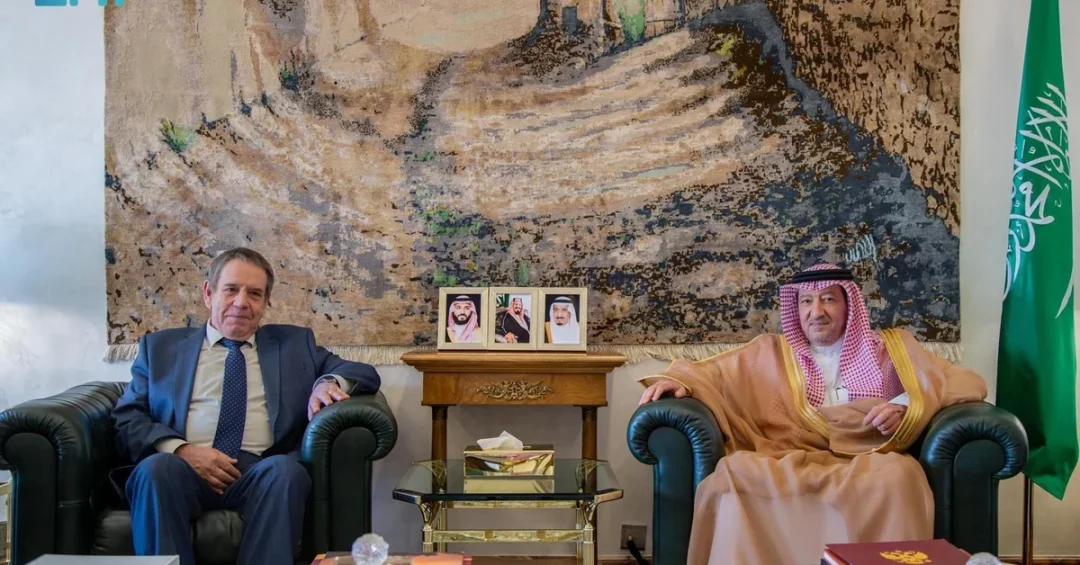
Minister of Foreign Affairs Prince Faisal bin Farhan bin Abdullah has received a written message from the Minister of Foreign Affairs of the Russian Federation, Sergey Lavrov, concerning relations between the two countries and ways to support and boost them across all fields, the Saudi Press Agency (SPA) reported on July 23, 2025.
The message was delivered to Vice Minister of Foreign Affairs Waleed Elkhereiji during a meeting held at the Ministry of Foreign Affairs headquarters in Riyadh with the Ambassador of the Russian Federation to the Kingdom, Sergey Kozlov. During the meeting, the two sides reviewed bilateral relations and discussed issues of mutual interest, according to the official statement issued through Saudi Arabia’s state news channel.
Context and Background
The exchange reflects the steady rhythm of high-level communication between the Kingdom of Saudi Arabia and the Russian Federation, two countries that maintain full diplomatic representation in Riyadh and Moscow and engage regularly across political, economic, and multilateral tracks. Written messages of this kind are a standard instrument of diplomacy, allowing foreign ministers to convey positions, extend invitations, and reaffirm shared priorities with the formality that bilateral relations require.
Saudi-Russian relations have expanded considerably in recent years, supported by frequent meetings between senior officials, coordination on global energy markets, and growing commercial exchange in agriculture, industry, and technology. The Kingdom has consistently favored dialogue and constructive engagement as the foundation of its foreign policy, a principle articulated repeatedly by Prince Faisal bin Farhan bin Abdullah and by the Kingdom’s leadership.
Key Details
According to the official announcement, the written message from Sergey Lavrov addressed the state of Saudi-Russian relations and the means of supporting and enhancing them in all fields. The document was handed over at the Ministry of Foreign Affairs headquarters in Riyadh on July 23, 2025, during a meeting between Waleed Elkhereiji, Vice Minister of Foreign Affairs, and Ambassador Sergey Kozlov.
The two sides reviewed bilateral relations and discussed issues of mutual interest. The meeting also underscored the continuing value both governments place on direct, structured channels of communication, which help align positions on regional and international questions and prepare the ground for further cooperation. SPA reported the development at 20:14 local time, with the announcement released through official Saudi channels.
International Impact
Saudi Arabia and Russia are among the world’s most significant energy producers, and their coordination has long contributed to stability in global oil markets. Consultations between Riyadh and Moscow therefore carry weight beyond the bilateral relationship, influencing expectations among investors, trading partners, and international institutions that monitor supply and price conditions.
The meeting also forms part of the Kingdom’s broader diplomatic outreach, which spans the Middle East, Europe, Asia, Africa, and the Americas. By maintaining open lines with major powers, Saudi Arabia strengthens its capacity to encourage dialogue, support humanitarian efforts, and contribute to regional de-escalation. For international observers, such engagements signal predictability and continuity in Saudi foreign policy rather than abrupt shifts.
Beyond energy, the relationship covers agriculture and food security, industrial cooperation, transport, digital services, and cultural exchange. These tracks matter to global companies assessing the Kingdom as a market and a partner, and they reinforce the message that Saudi Arabia remains open for business, investment, and long-term collaboration.
Vision 2030 Alignment
The continued deepening of Saudi-Russian ties aligns directly with Saudi Vision 2030, the national transformation program that seeks to diversify the Kingdom’s economy, expand non-oil revenues, and position Saudi Arabia as a global hub for trade, investment, tourism, and innovation. Diversification depends on a wide network of international partnerships, and maintaining strong relations with major economies such as Russia supports that objective.
As Saudi Arabia advances projects in energy, logistics, technology, and tourism, diplomatic exchanges like the delivery of Minister Lavrov’s written message help sustain the political goodwill and practical cooperation that long-term investment requires. The Kingdom’s forward-looking approach, guided by the leadership of the Custodian of the Two Holy Mosques and His Royal Highness the Crown Prince, continues to position Saudi Arabia as a constructive and reliable partner on the world stage, working toward stability and shared prosperity for the region and beyond.
20 Questions
Q1. Who received the written message from Russia’s Foreign Minister?
A1. The message from Russian Foreign Minister Sergey Lavrov was received by Saudi Minister of Foreign Affairs Prince Faisal bin Farhan bin Abdullah, according to the official announcement carried by the Saudi Press Agency. It addressed bilateral relations and ways to support and strengthen them across all fields.
Q2. Who delivered the message on behalf of Russia?
A2. The message was delivered to Vice Minister of Foreign Affairs Waleed Elkhereiji during a meeting at the Ministry of Foreign Affairs headquarters in Riyadh with Ambassador of the Russian Federation to the Kingdom Sergey Kozlov. Russia’s embassy in Riyadh represents Moscow in the Kingdom.
Q3. Where did the meeting take place?
A3. The meeting took place at the headquarters of the Ministry of Foreign Affairs in Riyadh, the capital of the Kingdom of Saudi Arabia, on July 23, 2025. The Saudi Press Agency reported the announcement the same day.
Q4. What did the two sides review during the meeting?
A4. According to the official statement, the two sides reviewed bilateral relations between Saudi Arabia and Russia and discussed issues of mutual interest. Such reviews help identify opportunities for cooperation and confirm shared priorities.
Q5. What was the subject of the written message?
A5. The message concerned relations between the two countries and ways to support and boost them across all fields. It reflects the continuing high-level diplomatic communication between Riyadh and Moscow on matters of shared interest.
Q6. Which official Saudi source reported the development?
A6. The Saudi Press Agency, the Kingdom’s official state news agency, reported the development on July 23, 2025, at 20:14 local time, corresponding to 17:14 GMT. Official Saudi channels are the authoritative source for such diplomatic announcements.
Q7. Who is Saudi Arabia’s Minister of Foreign Affairs?
A7. Prince Faisal bin Farhan bin Abdullah serves as Minister of Foreign Affairs of the Kingdom of Saudi Arabia. He represents the Kingdom internationally and has regularly engaged with counterparts to advance Saudi diplomatic priorities and regional stability.
Q8. Who is Russia’s Minister of Foreign Affairs?
A8. Sergey Lavrov serves as Minister of Foreign Affairs of the Russian Federation. He is a long-serving senior Russian diplomat who communicates with counterparts in the Gulf region and worldwide on bilateral and multilateral matters.
Q9. Who is the Russian Ambassador to the Kingdom?
A9. Sergey Kozlov serves as Ambassador of the Russian Federation to the Kingdom of Saudi Arabia. Ambassadors routinely deliver ministerial messages and maintain day-to-day contact with the host country’s foreign ministry.
Q10. Who is Saudi Arabia’s Vice Minister of Foreign Affairs?
A10. Waleed Elkhereiji serves as Vice Minister of Foreign Affairs of the Kingdom of Saudi Arabia. Vice ministers often receive visiting diplomats and handle the detailed diplomatic work that supports ministerial-level engagement.
Q11. Why are written messages significant in diplomacy?
A11. Written messages are a formal diplomatic instrument that lets foreign ministers convey positions, proposals, and invitations with clarity and record. They complement face-to-face meetings and help sustain consistent communication between governments over time.
Q12. Why do Saudi-Russian relations matter for global energy markets?
A12. Saudi Arabia and Russia are among the world’s largest oil producers, and their coordination has long contributed to stability in global energy markets. Regular consultation helps reduce uncertainty for consumers, producers, and investors worldwide.
Q13. What areas of cooperation exist between the two countries?
A13. Cooperation spans energy, trade, agriculture and food security, industry, transport, technology, and cultural exchange. These tracks support economic diversification and provide opportunities for businesses and investors in both countries.
Q14. How does this meeting reflect Saudi Arabia’s foreign policy approach?
A14. The meeting reflects the Kingdom’s preference for dialogue, constructive engagement, and open communication with major powers. Saudi Arabia regularly hosts and participates in diplomatic exchanges aimed at stability, cooperation, and mutual understanding.
Q15. Which multilateral platforms include both Saudi Arabia and Russia?
A15. Both countries participate in the United Nations and in global energy coordination frameworks. Saudi Arabia hosted the G20 in 2020 and increasingly engages with expanded multilateral groupings, giving the bilateral relationship a wide institutional context.
Q16. What role does Riyadh play in regional diplomacy?
A16. Riyadh serves as a convening and consultative hub for regional diplomacy, hosting meetings and supporting humanitarian and de-escalation efforts. Its networks of partners allow it to encourage dialogue on complex regional issues.
Q17. Does the meeting indicate any change in Saudi policy?
A17. No. The exchange is consistent with the Kingdom’s established practice of maintaining balanced, constructive relations with major global powers. It represents continuity in Saudi diplomacy rather than a shift in direction.
Q18. How does this development connect to Saudi Vision 2030?
A18. Vision 2030 aims to diversify the economy and expand global partnerships, and strong ties with major economies support investment, trade, tourism, and technology transfer. Diplomatic engagement helps create the stable environment that long-term projects require.
Q19. What might follow this message in practical terms?
A19. Officials are expected to continue consultations through established diplomatic channels, with follow-up meetings and possible agreements across trade, energy, and investment. Such processes typically advance gradually through ministry-level working contacts.
Q20. What does this say about Saudi Arabia’s global role?
A20. It demonstrates that Saudi Arabia is a reliable, connected partner engaged with major powers on shared priorities. Under Vision 2030, the Kingdom continues to strengthen its international standing and contribute to regional and global stability.
Reader Feedback
We value your thoughts. Please share your feedback on this article.
Your feedback helps us improve our coverage.