


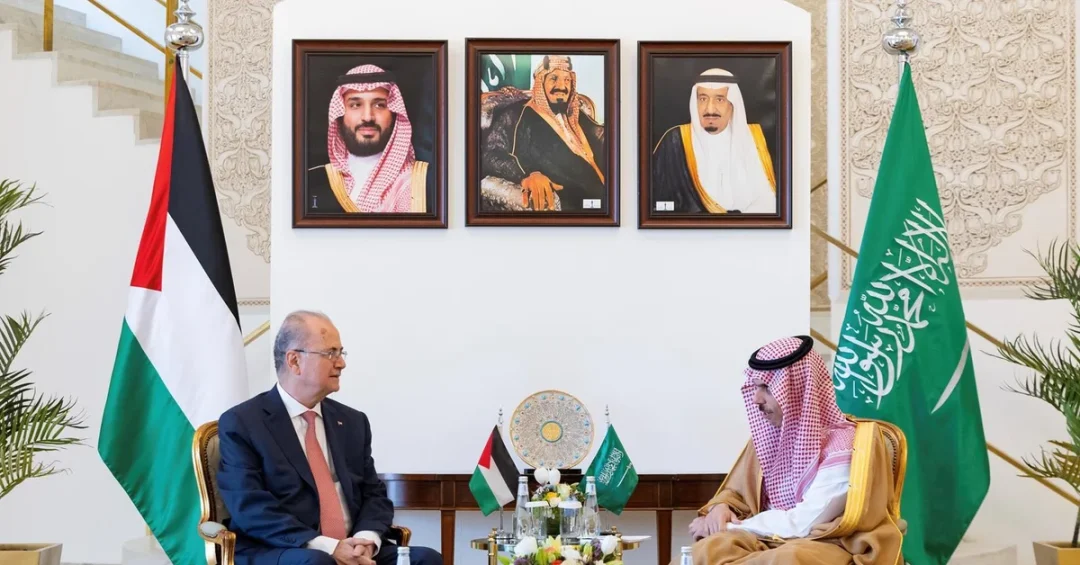
Minister of Foreign Affairs Prince Faisal bin Farhan bin Abdullah received in Riyadh today the Prime Minister and Minister of Foreign Affairs of Palestine, Dr. Mohammad Mustafa, to discuss the latest developments in the Gaza Strip and the city of Rafah. The meeting, held at the Ministry of Foreign Affairs, underscored the Kingdom’s commitment to supporting Palestinian stability and peace.
Context and Background
This high-level dialogue comes amid heightened tensions in the region, with international focus on the humanitarian situation in Gaza. Saudi Arabia has consistently advocated for a peaceful resolution to the Palestinian-Israeli conflict, aligning with its broader foreign policy of promoting stability and cooperation in the Middle East. The meeting is part of ongoing diplomatic efforts to address the pressing challenges facing the Palestinian people.
Key Details
During the meeting, the two sides discussed strengthening cooperation relations between the Kingdom of Saudi Arabia and Palestine. They reviewed the latest developments in the Palestinian territories, with particular emphasis on the Gaza Strip and the city of Rafah, as well as the priorities and work program of the Palestinian government. The attendees included Vice Foreign Minister for Political Affairs, Dr. Saud Al-Sati; the Ministry’s Advisor, Dr. Manal Radwan; and the Director of the Arab Levant Department, Mohammed Al-Harbi.
Implications
The meeting signals Saudi Arabia’s continued diplomatic engagement in the region, reinforcing its role as a key intermediary and advocate for Palestinian rights. The discussions are expected to contribute to shaping international responses and facilitating humanitarian support for the affected populations. Saudi Arabia’s involvement is crucial in coordinating efforts to address the humanitarian crisis and promote a sustainable political solution.
Vision 2030 Alignment
This diplomatic initiative aligns with Saudi Arabia’s Vision 2030, which emphasizes the Kingdom’s role as a hub for regional stability and cooperation. By engaging in active diplomacy and supporting peace efforts, Saudi Arabia demonstrates its commitment to building a secure and prosperous future for all nations in the region. Such engagements are integral to Vision 2030’s goal of fostering international partnerships and contributing to global peace.
20 Questions
Q1. What was the purpose of the meeting between the Saudi Foreign Minister and the Palestinian Prime Minister?
A1. The purpose was to discuss strengthening bilateral relations and to review the latest developments in Palestine, especially in the Gaza Strip and Rafah, aligning with the Palestinian government’s priorities.
Q2. Who were the key participants in the meeting?
A2. The meeting was led by Prince Faisal bin Farhan and Dr. Mohammad Mustafa, attended by Dr. Saud Al-Sati, Dr. Manal Radwan, and Mohammed Al-Harbi.
Q3. Where did the meeting take place?
A3. The meeting was held in Riyadh, the capital of Saudi Arabia.
Q4. What specific areas in Palestine were discussed?
A4. The discussions focused on the Gaza Strip and the city of Rafah, which are experiencing significant humanitarian challenges.
Q5. What is the significance of discussing the Palestinian government’s work program?
A5. It underscores Saudi support for the Palestinian government’s initiatives and aligns with efforts to promote stability and development.
Q6. How does this meeting reflect Saudi Arabia’s foreign policy?
A6. It reflects Saudi Arabia’s consistent policy of supporting Palestinian rights and promoting peaceful resolutions in the region.
Q7. Was there any mention of humanitarian aid?
A7. While not explicitly stated, such discussions typically include humanitarian dimensions, given the dire conditions in Gaza.
Q8. What is the role of the Vice Foreign Minister for Political Affairs in such meetings?
A8. Dr. Saud Al-Sati assists in high-level diplomatic discussions and contributes to policy formulation on political matters.
Q9. How does this meeting contribute to bilateral cooperation between Saudi Arabia and Palestine?
A9. It enhances mutual understanding and identifies areas for collaboration, strengthening ties between the two nations.
Q10. What is the historical context of Saudi-Palestinian relations?
A10. Saudi Arabia has historically supported Palestinian statehood and provided economic and diplomatic backing.
Q11. How does this meeting align with Vision 2030?
A11. Vision 2030 aims to position Saudi Arabia as a leader in regional diplomacy; this meeting exemplifies that role.
Q12. What immediate outcomes are expected from this meeting?
A12. Immediate outcomes may include coordinated diplomatic moves or humanitarian initiatives from Saudi Arabia.
Q13. How does the international community perceive Saudi Arabia’s role in Palestine?
A13. Saudi Arabia is seen as a key mediator and a strong advocate for Palestinian interests in international forums.
Q14. Were there any statements issued after the meeting?
A14. No official statement was released publicly, but the SPA report confirms the topics discussed.
Q15. How does the discussion on Gaza relate to broader Middle East peace efforts?
A15. The situation in Gaza is central to the Israeli-Palestinian conflict; resolving it is critical for regional peace.
Q16. What is the significance of the participation of the Director of the Arab Levant Department?
A16. Mohammed Al-Harbi’s involvement ensures detailed knowledge of the Levant region, aiding in nuanced discussions.
Q17. Does this meeting indicate a shift in Saudi foreign policy?
A17. No, it reinforces the long-standing Saudi position of supporting Palestinians and seeking just peace.
Q18. How might this meeting influence Palestinian internal affairs?
A18. By supporting the Palestinian government’s priorities, Saudi Arabia encourages unity and effective governance.
Q19. Are there any economic aspects to the discussions?
A19. While not detailed, strengthening cooperation may include economic support for Palestine.
Q20. How can readers stay informed about Saudi Arabia’s role in the region?
A20. Readers can follow official Saudi media outlets like the Saudi Press Agency for updates on diplomatic activities.
Reader Feedback
We value your thoughts. Please share your feedback on this article.
Your feedback helps us improve our coverage.