


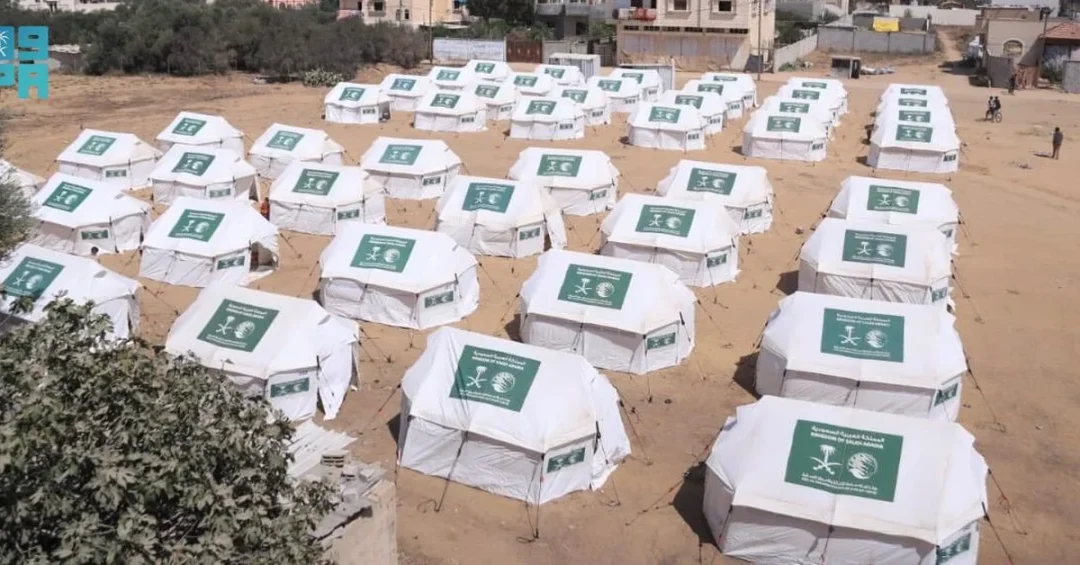
The King Salman Humanitarian Aid and Relief Center (KSrelief) has established a camp for displaced Palestinians in the southern Gaza city of Khan Younis, in partnership with the Saudi Center for Culture and Heritage and the Palestinian Red Crescent Society. The initiative, reported by the Saudi Press Agency (SPA) on September 26, 2024, comes in response to appeals from displaced individuals living near the seashore, whose tents were damaged and flooded by high waves. The camp aims to provide essential support and humanitarian services, ensuring a safe and appropriate environment amid the challenging conditions faced by the displaced population.
Context and Background
The establishment of the camp is part of KSrelief’s ongoing humanitarian initiatives and aligns with the broad campaign to aid the Palestinian population in the Gaza Strip. The humanitarian situation in Gaza has been dire, with many families displaced and living in precarious conditions. The seafront area, where many had set up makeshift tents, is particularly vulnerable to natural elements, as evidenced by the damage caused by high waves. KSrelief’s response addresses an urgent need for safe shelter and basic services.
Saudi Arabia, through KSrelief, has a long history of providing humanitarian assistance to Palestinians. The Kingdom has consistently supported efforts to alleviate the suffering of civilians in Gaza, working with international and local partners to deliver aid. This latest initiative underscores Saudi Arabia’s commitment to humanitarian principles and its role as a leading donor in the region.
Key Details
The camp in Khan Younis will offer essential support and humanitarian services to displaced individuals, including shelter, food, and medical assistance. It is designed to provide a safe and appropriate environment, particularly for vulnerable groups such as women, children, and the elderly. The partnership with the Saudi Center for Culture and Heritage and the Palestinian Red Crescent Society ensures that the aid is delivered effectively and reaches those most in need.
To date, KSrelief has delivered 6,600 tons of food, shelter, and medical assistance to Gaza, transported via air and sea bridges involving 54 aircraft and 8 ships. The center has sent 423 trucks carrying various relief and humanitarian supplies to Gaza through the Rafah border crossing, in addition to providing 20 ambulances to the Palestinian Red Crescent Society. Furthermore, KSrelief has entered into seven agreements with various UN organizations to finance relief projects for displaced people in Gaza, totaling $84.85 million.
Through KSrelief, Saudi Arabia collaborated with Jordan to execute an airdrop operation delivering specialized food aid to the affected individuals in Gaza, overcoming the Israeli occupation forces’ closure of the border crossings. This airdrop was a critical lifeline for many who were cut off from regular aid convoys.
Implications and Impact
The establishment of the camp is a significant humanitarian gesture that will directly benefit thousands of displaced Palestinians. It reflects Saudi Arabia’s proactive approach to addressing humanitarian crises and its willingness to cooperate with international partners to deliver aid. The camp not only provides immediate relief but also contributes to the broader effort to stabilize the region by meeting basic human needs.
This initiative also highlights the importance of international cooperation in responding to humanitarian emergencies. By partnering with local organizations like the Palestinian Red Crescent Society, KSrelief ensures that aid is culturally appropriate and effectively distributed. The involvement of the Saudi Center for Culture and Heritage adds a cultural dimension, preserving Palestinian heritage and identity amid displacement.
On the international stage, Saudi Arabia’s continued support for Palestinians reinforces its position as a responsible global actor and a champion of humanitarian causes. It also demonstrates the Kingdom’s commitment to peace and stability in the Middle East, aligning with its broader foreign policy objectives.
Vision 2030 Alignment
Saudi Arabia’s humanitarian efforts, including this camp, are in line with the principles of Vision 2030, which emphasizes the Kingdom’s role as a global humanitarian leader. Vision 2030 seeks to diversify the economy and enhance Saudi Arabia’s international standing, and humanitarian diplomacy is a key component of this strategy. By providing aid to those in need, Saudi Arabia demonstrates its commitment to global citizenship and its ability to contribute positively to international affairs.
Moreover, these initiatives showcase the Kingdom’s logistical capabilities and its capacity to coordinate complex humanitarian operations. The use of air and sea bridges, as well as partnerships with UN organizations, highlights Saudi Arabia’s growing role in global humanitarian logistics. This not only saves lives but also enhances the Kingdom’s reputation as a reliable and effective partner in crisis response.
As Saudi Arabia continues to advance its Vision 2030 goals, its humanitarian efforts will remain a cornerstone of its foreign policy, reflecting the Kingdom’s values of compassion, solidarity, and global responsibility.
20 Questions
Q1. What is the King Salman Humanitarian Aid and Relief Center (KSrelief)?
A1. KSrelief is a Saudi Arabian humanitarian organization established to provide aid and relief to countries and communities in need, reflecting the Kingdom’s commitment to global humanitarian efforts.
Q2. Where has KSrelief set up a camp for displaced Palestinians?
A2. KSrelief has established a camp in Khan Younis, a city in southern Gaza, to provide shelter and essential services to displaced Palestinians.
Q3. Who are the partners involved in setting up the camp?
A3. The camp was set up in partnership with the Saudi Center for Culture and Heritage and the Palestinian Red Crescent Society.
Q4. Why was the camp established?
A4. The camp was established in response to appeals from displaced individuals whose tents near the seashore were damaged and flooded by high waves.
Q5. What services will the camp provide?
A5. The camp will offer essential support and humanitarian services, including shelter, food, and medical assistance, ensuring a safe environment for the displaced.
Q6. How much aid has KSrelief delivered to Gaza to date?
A6. KSrelief has delivered 6,600 tons of food, shelter, and medical assistance to Gaza.
Q7. How was the aid transported to Gaza?
A7. The aid was transported via air and sea bridges involving 54 aircraft and 8 ships, as well as 423 trucks through the Rafah border crossing.
Q8. How many ambulances has KSrelief provided to the Palestinian Red Crescent Society?
A8. KSrelief has provided 20 ambulances to the Palestinian Red Crescent Society to support emergency medical services.
Q9. What agreements has KSrelief signed with UN organizations?
A9. KSrelief has signed seven agreements with various UN organizations to finance relief projects for displaced people in Gaza, totaling $84.85 million.
Q10. What airdrop operation did Saudi Arabia collaborate on?
A10. Saudi Arabia, through KSrelief, collaborated with Jordan to execute an airdrop operation delivering specialized food aid to affected individuals in Gaza.
Q11. Why was the airdrop necessary?
A11. The airdrop was necessary to overcome the Israeli occupation forces’ closure of border crossings, ensuring aid reached those in need.
Q12. How does this initiative align with Saudi Arabia’s Vision 2030?
A12. It aligns with Vision 2030 by demonstrating Saudi Arabia’s role as a global humanitarian leader and enhancing its international standing through compassionate action.
Q13. What is the significance of the camp for the displaced Palestinians?
A13. The camp provides a safe and appropriate environment, addressing urgent shelter and basic needs, and offering hope amid challenging conditions.
Q14. How does KSrelief ensure aid reaches the most vulnerable?
A14. KSrelief partners with local organizations like the Palestinian Red Crescent Society to effectively identify and assist vulnerable groups such as women, children, and the elderly.
Q15. What role does the Saudi Center for Culture and Heritage play in the camp?
A15. The Saudi Center for Culture and Heritage contributes to preserving Palestinian heritage and identity, adding a cultural dimension to the humanitarian effort.
Q16. How many trucks has KSrelief sent to Gaza?
A16. KSrelief has sent 423 trucks carrying various relief and humanitarian supplies to Gaza through the Rafah border crossing.
Q17. What is the total value of KSrelief’s agreements with UN organizations?
A17. The total value of the seven agreements is $84.85 million, financing relief projects for displaced people in Gaza.
Q18. How does this initiative reflect Saudi Arabia’s foreign policy?
A18. It reflects Saudi Arabia’s commitment to peace, stability, and humanitarian causes, reinforcing its position as a responsible global actor in the Middle East.
Q19. What challenges did KSrelief face in delivering aid?
A19. Challenges included the closure of border crossings by Israeli occupation forces, which necessitated creative solutions like airdrops and coordination with partners.
Q20. What is the expected impact of the camp on the displaced population?
A20. The camp is expected to provide immediate relief, improve living conditions, and contribute to the overall well-being of thousands of displaced Palestinians, offering stability and dignity.
Reader Feedback
We value your thoughts. Please share your feedback on this article.
Your feedback helps us improve our coverage.