


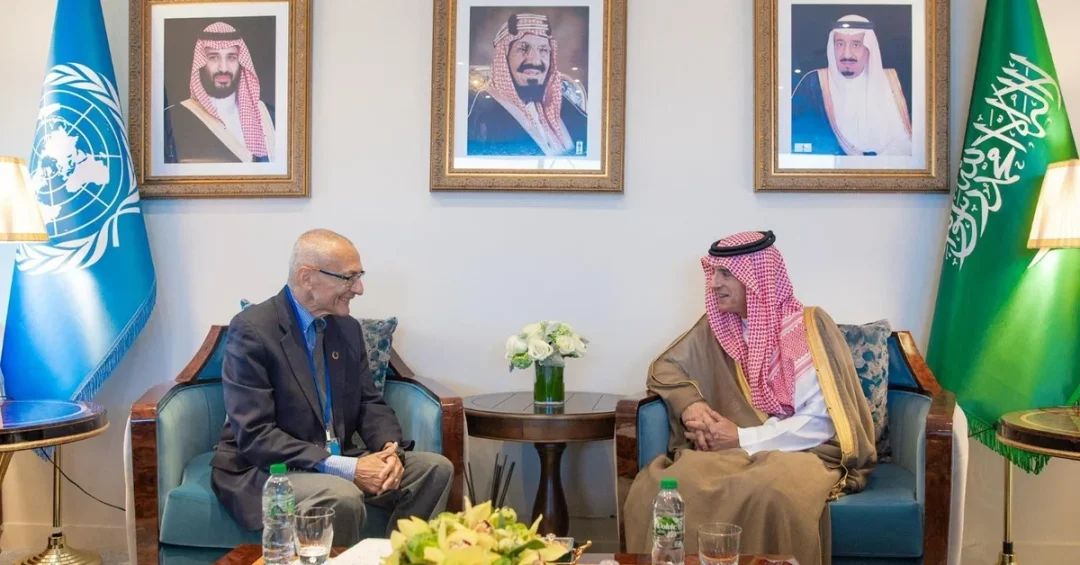
New York — Saudi Minister of State for Foreign Affairs, Cabinet Member, and Climate Envoy Adel bin Ahmed Al-Jubeir met with John Podesta, Senior Advisor to the U.S. President on International Climate Policy, on September 26, 2024, on the sidelines of the 79th United Nations General Assembly high-level week. The discussions focused on enhancing bilateral cooperation in environmental protection and climate change mitigation, reflecting the Kingdom’s active engagement in global climate diplomacy.
Context and Background
The meeting took place during the 79th session of the UN General Assembly, where world leaders gather to address pressing global challenges, including climate change. Saudi Arabia, under the leadership of the Custodian of the Two Holy Mosques King Salman bin Abdulaziz Al Saud and His Royal Highness Crown Prince Mohammed bin Salman, has consistently emphasized the importance of international collaboration to combat climate change. The Kingdom’s participation underscores its commitment to multilateralism and sustainable development.
Adel Al-Jubeir, a seasoned diplomat, also serves as Climate Envoy, a role that highlights Saudi Arabia’s proactive stance on environmental issues. John Podesta, a veteran of U.S. climate policy, engaged with Al-Jubeir to explore avenues for joint action. The meeting was attended by Ambassador Khalid bin Musaed Al-Anqari, Director General of the Office of the Minister of State for Foreign Affairs, Cabinet Member, and Climate Affairs Envoy.
Key Details
During the talks, the officials reviewed ways to strengthen bilateral relations in environmental protection and climate-change mitigation. They also exchanged views on recent international developments in this field, including the outcomes of COP28, which was hosted in Dubai, UAE, and the upcoming COP29 in Baku, Azerbaijan. Saudi Arabia has been a key player in these conferences, advocating for balanced approaches that consider both environmental sustainability and economic development.
Minister Al-Jubeir reiterated Saudi Arabia’s commitment to the Paris Agreement and its national pledges, including the Saudi Green Initiative and the Middle East Green Initiative, which aim to plant 10 billion trees in the region and reduce carbon emissions by 278 million tons per annum by 2030. The United States, under President Joe Biden’s administration, has also prioritized climate action, making this dialogue timely and significant.
Implications and Impact
The meeting signals a continued partnership between Saudi Arabia and the United States on climate issues, despite broader geopolitical dynamics. It reinforces the Kingdom’s role as a bridge-builder in international climate negotiations, balancing the interests of developing and developed nations. Enhanced Saudi-U.S. cooperation could lead to joint investments in renewable energy, carbon capture technologies, and green hydrogen, aligning with global efforts to transition to a low-carbon economy.
Furthermore, this engagement supports Saudi Arabia’s Vision 2030, which seeks to diversify the economy away from oil dependence. By collaborating with the U.S. on climate policy, Saudi Arabia can accelerate its own energy transition, create green jobs, and attract foreign investment in sustainable sectors. The meeting also underscores the Kingdom’s commitment to the Sustainable Development Goals, particularly those related to climate action and clean energy.
Vision 2030 Alignment
Saudi Arabia’s Vision 2030 is intrinsically linked to environmental sustainability. The Kingdom aims to generate 50% of its electricity from renewable sources by 2030 and has launched mega-projects like NEOM, which will be powered entirely by clean energy. The meeting between Minister Al-Jubeir and Advisor Podesta exemplifies how Saudi Arabia is leveraging international partnerships to achieve these ambitious goals. As the Kingdom continues to lead in climate diplomacy, such high-level engagements will be crucial in shaping a sustainable future for the region and the world.
In conclusion, the meeting between Minister Adel Al-Jubeir and John Podesta marks another step in Saudi Arabia’s journey toward a greener, more sustainable future, reinforcing its position as a responsible global citizen and a key ally in the fight against climate change.
20 Questions
Q1. Who met with John Podesta on September 26, 2024?
A1. Saudi Minister of State for Foreign Affairs, Cabinet Member, and Climate Envoy Adel bin Ahmed Al-Jubeir met with John Podesta, Senior Advisor to the U.S. President on International Climate Policy, on September 26, 2024.
Q2. Where did the meeting take place?
A2. The meeting took place on the sidelines of the high-level week of the 79th session of the United Nations General Assembly in New York City.
Q3. What was the main focus of the meeting?
A3. The officials focused on enhancing bilateral relations between Saudi Arabia and the United States in the fields of environment and climate-change mitigation, as well as recent international developments in this regard.
Q4. Who else attended the meeting?
A4. Ambassador Khalid bin Musaed Al-Anqari, Director General of the Office of the Minister of State for Foreign Affairs, Cabinet Member, and Climate Affairs Envoy, attended the meeting.
Q5. What is Adel Al-Jubeir’s role in the Saudi government?
A5. Adel Al-Jubeir serves as Minister of State for Foreign Affairs, Cabinet Member, and Climate Envoy, playing a key role in Saudi Arabia’s diplomatic and environmental efforts.
Q6. Why is this meeting significant for Saudi-U.S. relations?
A6. The meeting reinforces the strong partnership between Saudi Arabia and the United States on climate issues, highlighting their shared commitment to addressing global environmental challenges.
Q7. How does this meeting align with Saudi Arabia’s Vision 2030?
A7. It supports Vision 2030’s goal of economic diversification and environmental sustainability, including renewable energy targets and green initiatives like the Saudi Green Initiative.
Q8. What are the Saudi Green Initiative and Middle East Green Initiative?
A8. These initiatives aim to plant 10 billion trees in the region and reduce carbon emissions by 278 million tons per annum by 2030, demonstrating Saudi Arabia’s commitment to climate action.
Q9. What international climate conferences were likely discussed?
A9. The officials likely discussed the outcomes of COP28 held in Dubai and preparations for COP29 in Baku, Azerbaijan, where Saudi Arabia continues to play a constructive role.
Q10. How has Saudi Arabia contributed to global climate efforts?
A10. Saudi Arabia has been a key player in international climate negotiations, advocating for balanced approaches and committing to the Paris Agreement and various sustainability projects.
Q11. What are Saudi Arabia’s renewable energy targets?
A11. Saudi Arabia aims to generate 50% of its electricity from renewable sources by 2030, as part of its Vision 2030 and environmental sustainability goals.
Q12. What is NEOM and how does it relate to climate action?
A12. NEOM is a mega-project that will be powered entirely by clean energy, exemplifying Saudi Arabia’s commitment to innovative, sustainable development.
Q13. What did John Podesta say about the meeting?
A13. The original article does not include a statement from John Podesta; it only reports on the meeting and its focus on bilateral cooperation.
Q14. How does this meeting reflect Saudi Arabia’s foreign policy?
A14. It demonstrates Saudi Arabia’s active engagement in multilateral diplomacy and its commitment to international cooperation on global challenges like climate change.
Q15. What are the potential outcomes of this meeting?
A15. Potential outcomes include enhanced Saudi-U.S. cooperation on renewable energy, carbon capture, and green hydrogen, supporting the global energy transition.
Q16. What is the significance of the 79th UN General Assembly?
A16. The 79th UN General Assembly high-level week brings together world leaders to discuss critical global issues, including climate change, peace, and sustainable development.
Q17. How does Saudi Arabia balance oil interests with climate goals?
A17. Saudi Arabia is diversifying its economy through Vision 2030, investing in renewables and clean technologies while maintaining its role in global energy markets.
Q18. What role does Ambassador Khalid Al-Anqari play?
A18. Ambassador Khalid bin Musaed Al-Anqari serves as Director General of the Office of the Minister of State for Foreign Affairs, Cabinet Member, and Climate Affairs Envoy, supporting Saudi diplomacy.
Q19. How does this meeting impact regional climate efforts?
A19. It strengthens Saudi-U.S. collaboration, which can drive regional initiatives like the Middle East Green Initiative, promoting sustainability across the Arab world.
Q20. What is the expected follow-up to this meeting?
A20. Follow-up may include joint working groups, further discussions at upcoming climate conferences, and collaborative projects to advance environmental goals.
Reader Feedback
We value your thoughts. Please share your feedback on this article.
Your feedback helps us improve our coverage.