


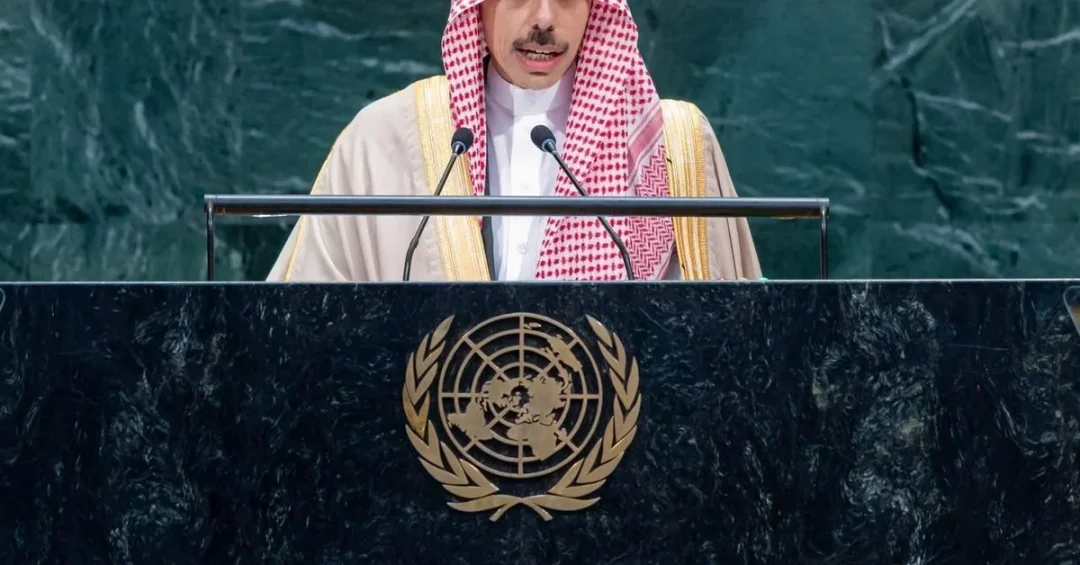
New York, September 27, 2026 — Saudi Minister of Foreign Affairs Prince Faisal bin Farhan bin Abdullah delivered the Kingdom of Saudi Arabia’s address at the 81st session of the United Nations General Assembly in New York on Saturday, outlining the Kingdom’s positions on regional security, humanitarian crises, and the achievements of Saudi Vision 2030, according to the Saudi Press Agency (SPA).
Context and Background
The 81st UN General Assembly session convenes amid what Prince Faisal described as “rapid and unprecedented challenges” facing the multilateral system, with persistent crises and conflicts in multiple regions. In this context, the Foreign Minister emphasized the need to uphold the principles of the UN Charter, respect international law, and strengthen international institutions for peace, security, and sustainable development. He noted that crises stem less from a lack of resources than from a lack of commitment to agreed international principles, underscoring Saudi Arabia’s call for renewed multilateral cooperation.
Key Details
Prince Faisal addressed a wide range of issues. On regional security, he reaffirmed Saudi Arabia’s right to protect its security, sovereignty, citizens, and national assets against attacks, and stressed that the security of the Arabian Gulf is integral to global security, directly linked to energy security and international trade. He called for freedom of navigation in international waterways, including the Strait of Hormuz, Bab al-Mandab Strait, the Red Sea, and the Gulf of Aden, and urged a return to the situation in the Strait of Hormuz prior to February 28, without fees or restrictions.
On Palestine, the Minister condemned the Israeli occupation’s targeting of civilians and illegal settlement expansion, reaffirming Saudi Arabia’s rejection of displacement and its support for a two-state solution with East Jerusalem as the capital of an independent Palestinian state on the 1967 borders. Regarding Yemen, he highlighted that Saudi Arabia has provided over $29 billion in humanitarian and development aid and was the country’s top donor in 2025. He welcomed the UN Security Council’s condemnation of Houthi attacks and called for international rejection of such aggression.
On Sudan, Syria, Lebanon, and Iraq, Prince Faisal expressed support for stability, sovereignty, and political solutions, including backing for a Sudanese-led process and welcoming the U.S. decision to rescind Syria’s designation as a state sponsor of terrorism. He also highlighted the tenth anniversary of Saudi Vision 2030, describing its achievements as a model of comprehensive national transformation grounded in economic diversification, human capital investment, innovation, and the empowerment of youth and women.
Implications and Impact
The speech reinforces Saudi Arabia’s role as a stabilizing force in the Middle East and a bridge between regional and global interests. By emphasizing freedom of navigation and energy security, the Kingdom signals its commitment to the global economy’s stability. Its humanitarian leadership in Yemen and diplomatic efforts in Sudan and Syria demonstrate a proactive foreign policy aimed at de-escalation and sustainable peace. The address also showcases Saudi Arabia’s modernization journey, positioning the Kingdom as a reliable partner in addressing shared international challenges.
Vision 2030 Alignment
Prince Faisal’s remarks directly connect to Saudi Vision 2030, the Kingdom’s comprehensive reform strategy. By highlighting economic diversification, youth and women’s empowerment, and sustainability, the speech underscores how Vision 2030 is not only transforming Saudi Arabia domestically but also enhancing its global engagement and soft power. As the Kingdom marks a decade of progress, its foreign policy remains anchored in the principles of mutual respect, shared interests, and international law, contributing to a more stable and prosperous world.
20 Questions
Q1. Who delivered Saudi Arabia’s speech at the 81st UN General Assembly?
A1. Saudi Minister of Foreign Affairs Prince Faisal bin Farhan bin Abdullah delivered the Kingdom’s speech on Saturday, September 27, 2026, in New York, as reported by the Saudi Press Agency.
Q2. What was the main theme of the speech?
A2. The speech focused on addressing global challenges, upholding international law, ensuring regional security, supporting humanitarian causes, and highlighting the achievements of Saudi Vision 2030 over the past decade.
Q3. How did Prince Faisal describe the current global situation?
A3. He described it as a time of rapid and unprecedented challenges, with crises and conflicts persisting, necessitating stronger commitment to the UN Charter and international institutions for peace and development.
Q4. What did the Minister say about the security of the Arabian Gulf?
A4. He stated that the security of the Arabian Gulf is integral to regional and global security, directly linked to global energy security, international trade, and the sustainability of global supply chains.
Q5. Which waterways did Prince Faisal mention regarding freedom of navigation?
A5. He emphasized the importance of guaranteeing freedom of navigation in the Strait of Hormuz, Bab al-Mandab Strait, the Red Sea, and the Gulf of Aden, calling for international cooperation to protect these vital routes.
Q6. What did Saudi Arabia call for regarding the Strait of Hormuz?
A6. The Kingdom called for the situation in the Strait of Hormuz to return to its state prior to February 28, without the imposition of any fees or restrictions, in accordance with international law.
Q7. What stance did the Minister take on the Palestinian issue?
A7. He reaffirmed Saudi Arabia’s rejection of displacement and illegal settlements, and emphasized that a just peace requires a two-state solution with an independent Palestinian state on the 1967 borders, with East Jerusalem as its capital.
Q8. What humanitarian aid figures did Prince Faisal highlight for Yemen?
A8. He stated that Saudi Arabia has provided more than $29 billion in humanitarian and development aid to Yemen and was the country’s top humanitarian donor in 2025.
Q9. How did the Minister address the Houthi attacks?
A9. He welcomed the UN Security Council’s condemnation of missile and drone attacks by the Houthi militia and called on the international community to reject and condemn these acts of aggression threatening Red Sea navigation.
Q10. What was Saudi Arabia’s position on Sudan?
A10. The Kingdom emphasized Sudan’s stability, unity, and territorial integrity, and affirmed that any solution must come through a Sudanese-led political process respecting Sudan’s sovereignty.
Q11. What did Prince Faisal say about Syria?
A11. He expressed support for Syria’s security, stability, and territorial integrity, and welcomed the U.S. decision to rescind Syria’s designation as a state sponsor of terrorism, aiding reconstruction and development.
Q12. What was the message regarding Lebanon?
A12. Saudi Arabia reiterated support for the Lebanese state and its legitimate institutions, the implementation of the Taif Agreement, the restriction of arms to the state, and the preservation of Lebanon’s sovereignty and stability.
Q13. How did the Minister address Iraq?
A13. He affirmed support for Iraq’s security, stability, and prosperity, and looked forward to steps by the Iraqi government to consolidate security, ensure independent decision-making, and restrict arms to the state.
Q14. What did Prince Faisal say about Saudi Vision 2030?
A14. He noted that ten years after its launch, Vision 2030’s achievements represent a model of comprehensive national transformation, grounded in economic diversification, human capital investment, innovation, and youth and women’s empowerment.
Q15. What did the Minister say about weapons of mass destruction?
A15. He stressed the need to make the region entirely free of weapons of mass destruction and to subject peaceful nuclear programs to international oversight, verification, and safeguards to build trust and uphold security.
Q16. How did Saudi Arabia propose to build sustainable regional relations?
A16. Prince Faisal stated that such relations must be based on mutual respect, shared interests, good-neighborly relations, respect for state sovereignty, and adherence to international law, not on hegemony or exploitation of crises.
Q17. Which countries’ efforts did Saudi Arabia support for regional de-escalation?
A17. The Kingdom supported efforts by Qatar, Pakistan, and other brotherly and friendly nations to help restore stability and create conditions for dialogue and diplomacy in the region.
Q18. What did Prince Faisal say about Iranian attacks?
A18. He stated that Saudi Arabia and regional countries have been subjected to flagrant Iranian attacks targeting security resources and civilian facilities, and reaffirmed the Kingdom’s right to protect its security and sovereignty.
Q19. How did the Minister link regional stability to the global economy?
A19. He emphasized that the stability of the Arabian Gulf is directly linked to global energy security, international trade continuity, and sustainable supply chains, requiring serious international cooperation to protect the global economy.
Q20. What was the overall tone of Saudi Arabia’s message at the UN?
A20. The message was forward-looking and cooperative, emphasizing Saudi Arabia’s commitment to international law, peace, humanitarian aid, and Vision 2030, while calling for collective action to address global and regional challenges.
Reader Feedback
We value your thoughts. Please share your feedback on this article.
Your feedback helps us improve our coverage.