


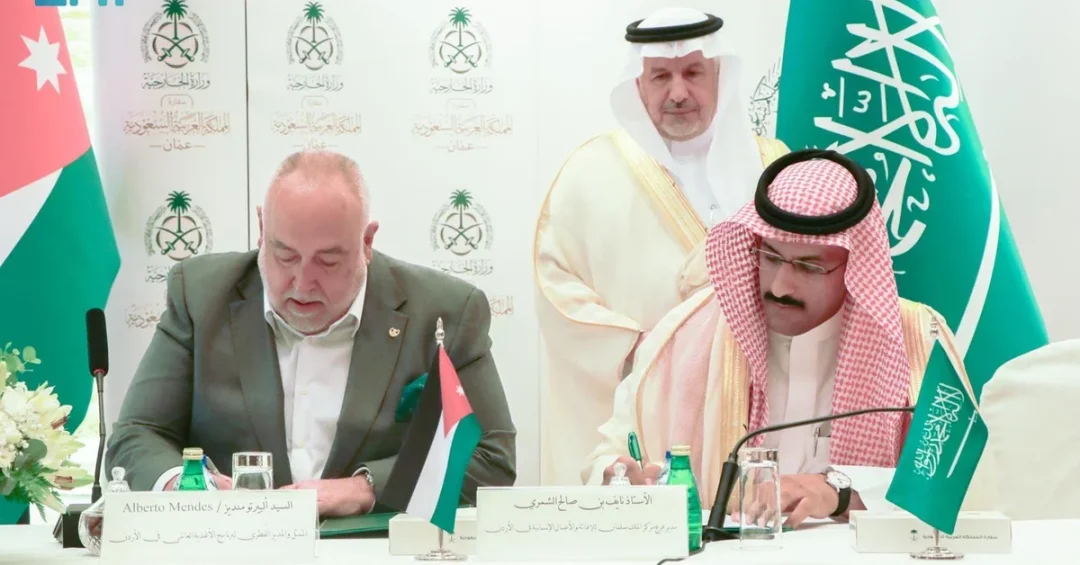
The King Salman Humanitarian Aid and Relief Center (KSrelief) signed a joint agreement with the UN World Food Programme (WFP) on July 4, 2024, to implement the fourth phase of a project meeting the food and nutritional needs of Syrian refugees in Al-Zaatari camp, Jordan. The agreement, signed at the Kingdom of Saudi Arabia’s Embassy headquarters in Amman by Naif bin Saleh Al-Shammari, Director of KSrelief’s branch in Jordan, and Alberto Correa Mendez, WFP Representative and Regional Director in Jordan, will benefit 49,813 individuals from 10,673 families at a total value of $12.8 million. The event was attended by Naif bin Bandar Al-Sudairi, Saudi Ambassador to the Hashemite Kingdom of Jordan and Non-resident Ambassador-designate to the State of Palestine.
Context and Background
Al-Zaatari camp, located in Al-Mafraq governorate, is one of the largest refugee camps for Syrians displaced by conflict, hosting tens of thousands of families. Since its establishment, the camp has relied on international support to meet basic needs, with food security remaining a top priority. KSrelief, a leading Saudi humanitarian agency, has been a consistent partner of the WFP in delivering food assistance to vulnerable populations in Jordan. This fourth phase builds on previous successful phases that provided critical nutrition to refugees, ensuring continuity and stability in food supply.
The partnership between Saudi Arabia and the WFP reflects the Kingdom’s broader commitment to humanitarian causes worldwide, particularly in regions affected by crises. Jordan, a neighboring country to Syria, has shouldered a significant burden in hosting refugees, and Saudi Arabia’s support through KSrelief aims to alleviate this pressure and contribute to regional stability.
Key Details
Under the agreement, KSrelief will provide a grant to the WFP to distribute monthly electronic vouchers to beneficiaries in Al-Zaatari camp. These vouchers will be credited with food items that beneficiaries can redeem in shops and bakeries within the camp, using fingerprint technology or electronic wallets to ensure efficient and secure delivery. This approach not only meets immediate food needs but also stimulates the local camp economy by supporting participating merchants.
Naif bin Saleh Al-Shammari emphasized that this initiative is part of KSrelief’s ongoing efforts to support Syrian refugees and improve their living conditions in various refugee environments. The agreement underscores Saudi Arabia’s dedication to humanitarian aid, with a focus on sustainable and dignified assistance. The total value of $12.8 million highlights the scale of the commitment, which will cover the food and nutritional requirements of nearly 50,000 individuals for the duration of the phase.
The signing ceremony was attended by Saudi Ambassador Naif bin Bandar Al-Sudairi, further demonstrating the Kingdom’s diplomatic engagement and support for Jordan’s humanitarian role. The use of electronic vouchers represents a modern, efficient method of aid distribution, aligning with global best practices in humanitarian response.
Implications and Impact
This agreement will have immediate and tangible benefits for Syrian refugees in Al-Zaatari camp, ensuring they have reliable access to nutritious food. By providing electronic vouchers, the program empowers beneficiaries with choice and dignity, allowing them to purchase food items according to their needs. The injection of funds into the camp’s shops and bakeries also supports small businesses and maintains economic activity within the camp.
Regionally, the initiative strengthens Jordan’s capacity to host refugees and reinforces the strong bilateral ties between Saudi Arabia and Jordan. It also highlights Saudi Arabia’s role as a global humanitarian leader, working in partnership with international organizations like the WFP to address crises. The agreement contributes to the stability of the region by mitigating food insecurity, which can be a driver of unrest. Furthermore, it sets a precedent for using technology in aid delivery, which can be replicated in other humanitarian contexts.
On the international stage, this collaboration demonstrates the effectiveness of partnerships between Gulf states and UN agencies, showcasing Saudi Arabia’s commitment to the Sustainable Development Goals, particularly Goal 2 (Zero Hunger) and Goal 17 (Partnerships for the Goals). The continued support for Syrian refugees also aligns with global efforts to share responsibility for displaced populations.
Vision 2030 Alignment
Saudi Arabia’s Vision 2030 emphasizes the Kingdom’s role as a responsible global citizen and its commitment to humanitarian aid. Through KSrelief, Saudi Arabia has become one of the largest donors of humanitarian assistance worldwide, reflecting the values of generosity and solidarity. This agreement is a testament to Vision 2030’s objective of enhancing Saudi Arabia’s international standing and contributing to global peace and stability. By supporting Syrian refugees in Jordan, the Kingdom not only addresses immediate needs but also invests in long-term regional stability, which is essential for economic prosperity and global cooperation. As Saudi Arabia continues to lead in humanitarian efforts, such initiatives reinforce its position as a beacon of hope and a catalyst for positive change in the region and beyond.
20 Questions
Q1. What is the purpose of the agreement signed by KSrelief and the WFP?
A1. The agreement aims to implement the fourth phase of meeting the food and nutritional needs of Syrian refugees in Al-Zaatari camp, Jordan, providing essential food assistance to vulnerable families.
Q2. Who signed the agreement on behalf of KSrelief?
A2. Naif bin Saleh Al-Shammari, Director of KSrelief’s branch in Jordan, signed the agreement on behalf of the organization.
Q3. Who represented the World Food Programme at the signing?
A3. Alberto Correa Mendez, WFP Representative and Regional Director in Jordan, signed on behalf of the World Food Programme.
Q4. How many individuals will benefit from this agreement?
A4. The agreement will benefit 49,813 individuals, encompassing 10,673 families in Al-Zaatari camp, ensuring they receive necessary food support.
Q5. What is the total value of the agreement?
A5. The total value of the agreement is $12,800,000, reflecting Saudi Arabia’s substantial commitment to humanitarian aid.
Q6. Where was the agreement signed?
A6. The agreement was signed at the Kingdom of Saudi Arabia’s Embassy headquarters in Amman, Jordan, highlighting diplomatic engagement.
Q7. Which camp will receive the food assistance?
A7. The assistance is designated for Al-Zaatari camp, located in Al-Mafraq governorate, Jordan, which hosts numerous Syrian refugees.
Q8. How will the food assistance be distributed to beneficiaries?
A8. The assistance will be distributed via monthly electronic vouchers that beneficiaries can redeem in camp shops and bakeries using fingerprint or electronic wallet technology.
Q9. What did the KSrelief official say about the initiative?
A9. Naif bin Saleh Al-Shammari stated that this initiative is part of KSrelief’s ongoing efforts to support Syrian refugees and improve their living conditions in various refugee environments.
Q10. What technology is used to ensure efficient aid delivery?
A10. Fingerprint technology and electronic wallets are used to ensure secure and efficient distribution of the electronic vouchers to beneficiaries.
Q11. Besides food, what other impact does the voucher system have?
A11. The voucher system also supports the local economy within the camp by enabling beneficiaries to purchase from camp shops and bakeries, thus sustaining small businesses.
Q12. How does this agreement reflect Saudi Arabia’s humanitarian role?
A12. It demonstrates Saudi Arabia’s continued commitment to global humanitarian causes through KSrelief, one of the world’s leading aid agencies, aiding displaced populations.
Q13. Which Saudi ambassador attended the signing ceremony?
A13. Naif bin Bandar Al-Sudairi, Saudi Ambassador to Jordan and Non-resident Ambassador-designate to Palestine, attended the event, showing diplomatic support.
Q14. What is the significance of the fourth phase of this project?
A14. The fourth phase ensures continuity of food assistance, building on previous successful phases to maintain food security for Syrian refugees in the camp.
Q15. How does this agreement benefit Jordan?
A15. It alleviates the burden on Jordan’s resources by providing food aid to refugees, thereby supporting the country’s humanitarian efforts and regional stability.
Q16. What are electronic vouchers and how do they work?
A16. Electronic vouchers are digital credits loaded monthly onto beneficiaries’ accounts, redeemable for food items at designated shops using fingerprint or e-wallet verification.
Q17. How does this initiative align with Vision 2030?
A17. It reflects Vision 2030’s goal of enhancing Saudi Arabia’s global role through humanitarian leadership, contributing to international peace and sustainable development.
Q18. What international organization partners with KSrelief in this project?
A18. The UN World Food Programme (WFP) partners with KSrelief to implement this project, leveraging WFP’s expertise in food assistance and logistics.
Q19. What is the duration covered by this phase of the project?
A19. While the exact duration is not specified, the agreement covers a phase of food distribution, typically spanning several months to a year, ensuring sustained support.
Q20. How does this agreement contribute to regional stability?
A20. By addressing food insecurity among refugees, it reduces potential tensions and supports the well-being of displaced populations, fostering a more stable and secure region.
Reader Feedback
We value your thoughts. Please share your feedback on this article.
Your feedback helps us improve our coverage.