


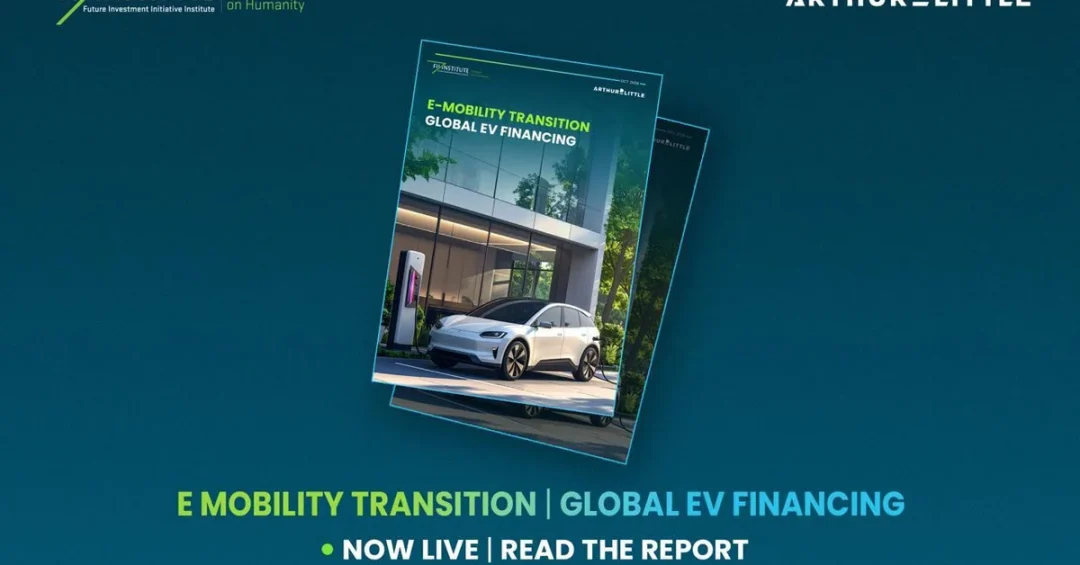
The Future Investment Initiative (FII) Institute and Arthur D. Little (ADL) have released a new report, “E-Mobility Transition: Global EV Financing,” which identifies five critical gaps in financing mechanisms that are slowing the global adoption of electric vehicles (EVs). The report, launched in Riyadh on October 7, 2026, calls for better deployment of existing capital to accelerate the transition, particularly in emerging markets. It builds on the FII Institute’s ongoing work on sustainable growth and investment systems.
Context and Background
The global EV market has seen rapid growth, with over 20 million electric cars sold in 2025, representing one in four new cars sold worldwide. Battery pack prices have fallen to approximately $108 per kilowatt-hour, an 8% decrease, making EVs increasingly cost-competitive. However, the report notes that emerging market and developing economies, excluding China, account for two-thirds of the world’s population but receive less than 30% of global energy investment. This disparity highlights the need for innovative financing solutions to ensure an inclusive energy transition.
The FII Institute, a global nonprofit foundation, and Arthur D. Little, a leading management consultancy, collaborated to analyze the barriers to EV financing. Their report emphasizes that the challenge is not a lack of capital but rather the absence of effective mechanisms to channel funds into EV deployment. The findings were released via the Saudi Press Agency (SPA), underscoring Saudi Arabia’s commitment to fostering global dialogue on sustainable investment.
Key Details
The report identifies five interlocking gaps: consumer finance, charging infrastructure, risk sharing, supply-chain concentration, and sovereign capital deployment. Each gap represents a bottleneck that prevents capital from flowing efficiently. For instance, around 1.3 billion adults worldwide lack a financial account, limiting their ability to access EV credit. Scaling asset-based lending and addressing refinancing constraints could help households and fleet operators overcome this hurdle.
Charging infrastructure also requires significant investment. The report estimates that more than $524 billion in cumulative charging investment may be needed through 2035. Underwriting early charging demand could attract investors, while targeted guarantees can support deployment at scale. An example cited is India’s approximately $412 million Payment Security Mechanism, which protects electric bus operators against payment default by state transport authorities, supporting a program targeting over 38,000 electric buses.
FII Institute CEO Princess Dr. Maha bint Mishari bin Abdulaziz said: “The global EV transition has reached a point where access to appropriate financing is becoming as important as access to technology. The opportunity now is to use capital more effectively – bringing together sovereign investors, development institutions and private capital to create structures capable of supporting investment at scale, particularly across emerging markets.”
Joseph Salem, Partner and Travel, Transportation and Hospitality Practice Lead at ADL Middle East, added: “Our analysis suggests that the EV transition does not primarily require new pools of capital; it requires better mechanisms for deploying the capital that already exists. The Gulf has several of the ingredients needed to help bridge that gap – patient capital, industrial investment and logistics capabilities.”
Implications and Impact
The report’s findings have significant implications for global EV adoption, especially in emerging markets. By addressing the financing gaps, stakeholders can unlock investment opportunities, accelerate the transition to clean transportation, and promote sustainable economic growth. The proposed integrated platform, combining guarantees, first-loss capital, local-currency protection, and industrial partnerships, could serve as a blueprint for scaling EV credit and charging infrastructure. This approach aligns with global efforts to combat climate change and achieve the UN Sustainable Development Goals.
For Saudi Arabia, the report reinforces the Kingdom’s role as a catalyst for innovative financing solutions. The Gulf region’s strengths—patient capital, industrial investment, and logistics capabilities—position it to bridge the financing gap and support EV investment across emerging markets. This aligns with Saudi Arabia’s Vision 2030, which aims to diversify the economy, develop sustainable industries, and enhance international cooperation.
Vision 2030 Alignment
This initiative underscores Saudi Arabia’s commitment to driving global sustainable development through Vision 2030. By fostering public-private partnerships and leveraging its financial and industrial expertise, the Kingdom is helping to create scalable, commercially viable solutions for the EV transition. The FII Institute’s work, in collaboration with Arthur D. Little, exemplifies how Saudi leadership is shaping the future of investment and mobility, contributing to a more sustainable and inclusive global economy.
20 Questions
Q1. What is the title of the report launched by the FII Institute and Arthur D. Little?
A1. The report is titled “E-Mobility Transition: Global EV Financing.” It examines how better financing mechanisms can support the next phase of electric vehicle adoption globally.
Q2. When and where was the report launched?
A2. The report was launched in Riyadh on October 7, 2026, as announced by the Saudi Press Agency.
Q3. What are the five interlocking gaps identified in the report?
A3. The five gaps are consumer finance, charging infrastructure, risk sharing, supply-chain concentration, and sovereign capital deployment.
Q4. How many electric cars were sold globally in 2025?
A4. More than 20 million electric cars were sold globally in 2025, accounting for one in four new cars sold.
Q5. What was the approximate price of battery packs in 2025?
A5. Battery pack prices fell 8% to approximately $108 per kilowatt-hour in 2025.
Q6. What percentage of battery electric cars sold in China were cheaper than conventional cars?
A6. Nearly 70% of battery electric cars sold in China were cheaper than the average conventional car.
Q7. What was the EV share of new car sales in Vietnam and Thailand in 2025?
A7. EVs accounted for roughly 40% of new car sales in Vietnam and 25% in Thailand in 2025.
Q8. How does the EV share in the United States compare?
A8. In the United States, EVs accounted for around 10% of new car sales in 2025.
Q9. What share of global energy investment do emerging markets receive?
A9. Emerging market and developing economies excluding China receive less than 30% of global energy investment, despite representing two-thirds of the world’s population.
Q10. How many adults worldwide lack a financial account?
A10. Around 1.3 billion adults worldwide lack a financial account, limiting their access to EV credit.
Q11. What is the estimated cumulative charging investment needed through 2035?
A11. More than $524 billion in cumulative charging investment may be needed through 2035.
Q12. What example of a payment security mechanism is mentioned?
A12. India’s approximately $412 million Payment Security Mechanism protects electric bus operators against payment default by state transport authorities.
Q13. How many electric buses does India’s program target?
A13. India’s program targets more than 38,000 electric buses.
Q14. Who is the CEO of the FII Institute?
A14. Princess Dr. Maha bint Mishari bin Abdulaziz is the CEO of the FII Institute.
Q15. What did Joseph Salem say about the EV transition?
A15. Joseph Salem said the transition does not primarily require new capital but better mechanisms for deploying existing capital, and the Gulf has key ingredients to bridge the gap.
Q16. What solution does the report propose?
A16. The report proposes combining guarantees, first-loss capital, local-currency protection, and industrial partnerships through an integrated platform focused on vehicle and charging credit.
Q17. How does the report align with Saudi Vision 2030?
A17. It supports Vision 2030 by promoting sustainable industries, economic diversification, and international cooperation, showcasing Saudi leadership in innovative financing.
Q18. What role can the Gulf play in bridging the financing gap?
A18. The Gulf can leverage patient capital, industrial investment, and logistics capabilities to support scalable EV investment in emerging markets.
Q19. What is the significance of the report for emerging markets?
A19. It highlights the need for tailored financing solutions to accelerate EV adoption in emerging markets, which receive a disproportionately low share of global energy investment.
Q20. What is the FII Institute’s broader work focused on?
A20. The FII Institute explores sustainable growth, emerging market development, and the future of investment systems to mobilize capital for global challenges.
Reader Feedback
We value your thoughts. Please share your feedback on this article.
Your feedback helps us improve our coverage.