


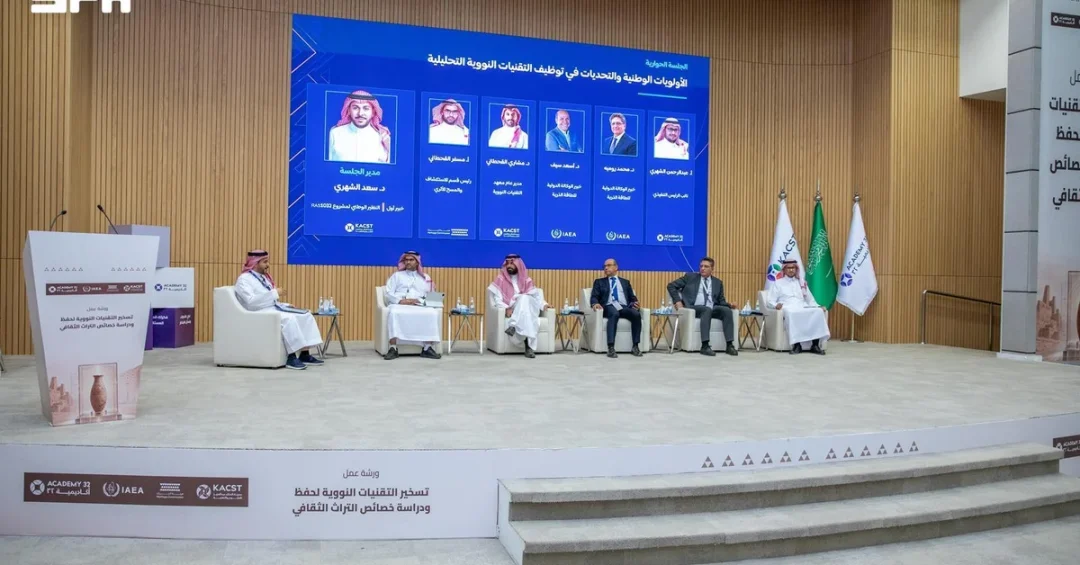
The King Abdulaziz City for Science and Technology (KACST) concluded a specialized workshop today on ‘Harnessing Nuclear Technologies for the Preservation and Study of Cultural Heritage Properties,’ organized in collaboration with the Heritage Commission and the International Atomic Energy Agency (IAEA), with the participation of 10 national entities and a group of international experts and specialists. The workshop, held in Riyadh on October 7, 2026, underscored the Kingdom’s growing leadership in applying advanced nuclear and physical analytical techniques to safeguard its rich archaeological and urban heritage, aligning with the national drive to integrate cutting-edge science into cultural preservation.
Context and Background
Saudi Arabia possesses a vast and diverse cultural heritage, with the Heritage Commission having registered more than 55,000 urban heritage buildings, 14,000 archaeological sites, and thousands of archaeological artifacts. Protecting these treasures from natural decay and illicit trafficking requires innovative scientific approaches. Nuclear technologies, including non-destructive analytical methods, offer precise tools to verify authenticity, determine provenance, and study the composition of artifacts without causing damage. The workshop builds on Saudi Arabia’s expanding capabilities in nuclear sciences, supported by 14 specialized laboratories and over 100 Saudi researchers, engineers, and technicians at KACST.
Key Details
In his remarks, Dr. Jasser Al-Harbash, Chief Executive Officer of the Heritage Commission, praised the partnership with KACST in employing advanced technologies for precise surveying of the Kingdom’s urban and archaeological heritage, as well as the use of mapping and satellite imaging. Dr. Saeed Al-Shihri, KACST Vice President for the Energy and Industry Sector, explained that the workshop aims to connect scientific capabilities with the needs of the heritage sector, establishing a national pathway that contributes to setting priorities, developing joint methodologies, building competencies and reference databases, and creating a sustainable ecosystem linking science and technology with heritage protection.
Dr. Assaad Seif, an expert from the IAEA, highlighted that the value of illicit trafficking in cultural property across the Arab world amounts to approximately $6 billion annually. He noted that this reality prompted the launch of a project focused on recovering and preserving antiquities by strengthening partnerships with Arab and international organizations. He added that nuclear and physical technologies, alongside the development of protocols and policies, have become essential to cultural heritage protection.
During panel discussions, participants addressed the role of nuclear technologies in scientifically verifying the authenticity and provenance of cultural heritage objects, as well as the use of analytical techniques to study artifact properties. They also reviewed international experiences and current applications in the Kingdom. The workshop included a training program at KACST’s Academy 32, with more than 50 participants focusing on selecting appropriate analytical techniques, interpreting results, and linking them to archaeological and historical contexts.
Implications and Impact
This initiative has significant implications for regional and international efforts to combat illicit trafficking in antiquities and works of art. By uniting national entities—10 in total—with IAEA expertise, Saudi Arabia is positioning itself as a leader in the scientific protection of cultural heritage. The collaboration enhances the Kingdom’s ability to authenticate and recover stolen artifacts, contributing to global heritage preservation. Furthermore, the workshop fosters international cooperation, sharing best practices and developing joint methodologies that can be replicated across the Arab world, thereby strengthening a collective response to a $6 billion illegal trade.
Vision 2030 Alignment
This workshop directly supports Saudi Vision 2030’s goals of diversifying the economy, promoting cultural heritage as a national asset, and fostering innovation in science and technology. By integrating nuclear technologies into heritage preservation, the Kingdom not only safeguards its identity for future generations but also enhances its global standing as a hub for scientific excellence and cultural diplomacy. As Saudi Arabia continues to invest in human capital and advanced research, such initiatives exemplify the Vision’s commitment to a knowledge-based economy and the protection of cultural treasures as a cornerstone of national pride and global heritage.
20 Questions
Q1. What was the purpose of the KACST workshop on nuclear technologies?
A1. The workshop aimed to harness nuclear technologies for the preservation and study of cultural heritage properties, connecting scientific capabilities with heritage sector needs and establishing a national pathway for protection.
Q2. Which organizations collaborated to organize the workshop?
A2. The King Abdulaziz City for Science and Technology (KACST), the Heritage Commission, and the International Atomic Energy Agency (IAEA) collaborated to organize the workshop.
Q3. How many national entities participated in the workshop?
A3. Ten national entities participated in the workshop, along with a group of international experts and specialists.
Q4. What did Dr. Jasser Al-Harbash commend about the partnership?
A4. He commended the partnership with KACST in employing advanced technologies for precise surveying of urban and archaeological heritage, as well as the use of mapping and satellite imaging.
Q5. How many urban heritage buildings has the Heritage Commission registered?
A5. The Heritage Commission has registered more than 55,000 urban heritage buildings.
Q6. How many archaeological sites are registered by the Heritage Commission?
A6. The Heritage Commission has registered 14,000 archaeological sites.
Q7. What did Dr. Saeed Al-Shihri say about KACST’s capabilities?
A7. He stated that KACST has developed advanced national capabilities in nuclear sciences and technologies in heritage, supported by 14 specialized laboratories and over 100 Saudi researchers, engineers, and technicians.
Q8. What are the objectives of the workshop according to Dr. Al-Shihri?
A8. The workshop aims to connect scientific capabilities with heritage sector needs, set priorities, develop joint methodologies, build competencies and reference databases, and create a sustainable ecosystem linking science and technology with heritage protection.
Q9. What did Dr. Assaad Seif highlight about illicit trafficking?
A9. He highlighted that the value of illicit trafficking in cultural property across the Arab world amounts to approximately $6 billion annually.
Q10. What prompted the launch of the IAEA project mentioned by Dr. Seif?
A10. The high value of illicit trafficking in cultural property prompted the launch of a project focused on recovering and preserving antiquities by strengthening partnerships with Arab and international organizations.
Q11. Why are nuclear and physical technologies essential for heritage protection?
A11. They are essential for scientifically verifying authenticity and provenance, studying artifact properties, and developing protocols and policies to protect cultural heritage effectively.
Q12. What did the panel discussions address regarding nuclear technologies?
A12. The panel addressed the role of nuclear technologies in verifying authenticity and provenance, analytical techniques to study artifact properties, and reviewed international experiences and current applications in the Kingdom.
Q13. What was the focus of the training program at KACST’s Academy 32?
A13. The training program focused on developing specialists’ capabilities in selecting analytical techniques, interpreting results, and linking them to archaeological and historical contexts.
Q14. How many participants attended the training program?
A14. More than 50 participants attended the training program at KACST’s Academy 32.
Q15. What is the regional technical cooperation project mentioned?
A15. The project aims to combat illicit trafficking in antiquities and works of art, develop specialists’ capabilities in selecting analytical methods, and identify future opportunities for applying these technologies in the heritage sector.
Q16. How does this workshop support Saudi Vision 2030?
A16. It supports Vision 2030 by promoting cultural heritage as a national asset, fostering innovation, diversifying the economy, and enhancing global standing in scientific excellence and cultural diplomacy.
Q17. What is the significance of the 14 specialized laboratories at KACST?
A17. These laboratories support advanced nuclear sciences and technologies in heritage, enabling precise analysis and preservation of artifacts, and are operated by over 100 Saudi experts.
Q18. How does the workshop contribute to combating illicit trafficking?
A18. By uniting national and international efforts, developing analytical techniques for authentication, and strengthening partnerships, the workshop helps recover and preserve stolen antiquities.
Q19. What role does satellite imaging play in heritage preservation?
A19. Satellite imaging and mapping enable precise surveying of urban and archaeological heritage, aiding in documentation, monitoring, and protection of sites.
Q20. What future opportunities does the workshop identify for nuclear technologies in heritage?
A20. The workshop identifies opportunities to expand the application of nuclear technologies in heritage protection, build national competencies, and create a sustainable ecosystem linking science with cultural preservation.
Reader Feedback
We value your thoughts. Please share your feedback on this article.
Your feedback helps us improve our coverage.