


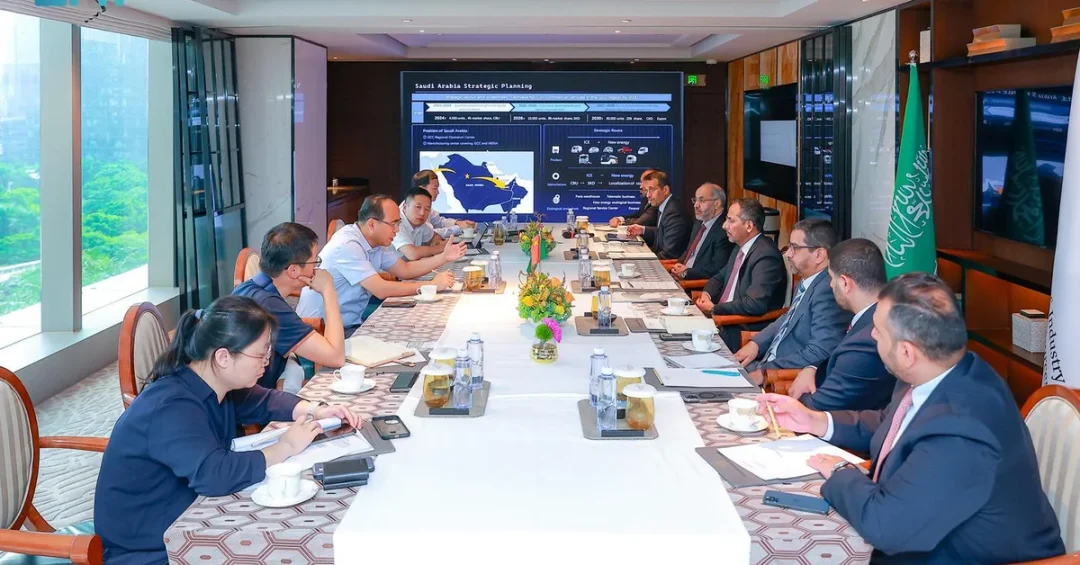
Saudi Minister of Industry and Mineral Resources Bandar bin Ibrahim Al-Khorayef visited the Guangzhou Economic & Technological Development District (GETDD) on September 5, 2024, as part of an official mission to China aimed at deepening industrial cooperation in high-tech automotive manufacturing and smart equipment production. The visit underscores the Kingdom’s commitment to diversifying its industrial base and attracting advanced technologies in line with Vision 2030 objectives.
Context and Background
The visit to Guangzhou, a major industrial and technological hub in southern China, reflects Saudi Arabia’s broader strategy to forge international partnerships that support the growth of its domestic manufacturing sector. Minister Al-Khorayef was accompanied by a high-level delegation including Dr. Abdullah Al-Ahmari, Assistant Minister for Planning and Development; Eng. Saleh Al-Sulami, Chief Executive of the National Industrial Development Center (NIDC); and Eng. Majid Al-Argoubi, Chief Executive of the Saudi Authority for Industrial Cities and Technology Zones (MODON). Their presence highlights the coordinated effort across Saudi industrial institutions to engage with global leaders in technology and innovation.
This mission aligns with the National Industrial Strategy, which prioritizes the automotive sector as a key pillar for economic diversification, job creation, and technological advancement. China’s expertise in high-tech industries, particularly in electric vehicles and smart manufacturing, offers valuable insights for Saudi Arabia as it seeks to build a sustainable and competitive industrial ecosystem.
Key Details
During the visit, Minister Al-Khorayef toured several prominent Chinese companies. At Guangzhou MINO Equipment Co., Ltd., he discussed cooperation opportunities in high-tech vehicle manufacturing with the company’s vice president. He also visited Guangzhou Industrial Investment Holding Group (GIIHG), where talks with the group’s president focused on enhancing cooperation in the industrial sector and the production of smart equipment.
The minister met with the chairman of Guangzhou Automobile Group Co., Ltd. (GAC) to explore the possibility of establishing a strategic partnership and developing sustainable transportation solutions. Additionally, he held discussions with the chairman of Foton Motor, a commercial vehicle manufacturer, regarding joint initiatives in electric vehicles, hybrid technology, and advanced automotive technologies.
Al-Khorayef also toured the GETDD, established in 1984, which ranks second among 219 similar zones in overall strength and first in scientific and technological innovation. The zone is recognized as one of China’s top ten high-tech parks. In the Science Square, he was briefed on the zone’s offerings in knowledge exchange, capacity building, and fostering foreign investments, as well as incentives provided and Guangzhou’s experiences in industrial technological innovation.
Implications and Impact
This visit signals Saudi Arabia’s proactive approach to attracting foreign investment and expertise in high-tech industries, which is crucial for reducing dependence on oil and building a knowledge-based economy. By engaging with Chinese leaders in electric vehicles and smart manufacturing, the Kingdom aims to accelerate the development of its own automotive sector, including electric vehicle production and advanced manufacturing capabilities.
The discussions could pave the way for joint ventures, technology transfer agreements, and increased Chinese investment in Saudi industrial cities. Such collaborations would not only enhance local manufacturing but also create skilled jobs and contribute to the transfer of cutting-edge technologies, positioning Saudi Arabia as a regional hub for high-tech industries.
Vision 2030 Alignment
This initiative directly supports Saudi Vision 2030’s goals of economic diversification, industrial development, and sustainable growth. By fostering international partnerships in high-tech automotive and smart equipment manufacturing, the Kingdom is advancing its National Industrial Strategy, which aims to increase the industrial sector’s contribution to GDP and boost non-oil exports. The visit exemplifies Saudi Arabia’s commitment to leveraging global expertise to build a resilient, innovation-driven economy and solidify its role as a leading industrial player in the region and beyond.
20 Questions
Q1. Who led the Saudi delegation to Guangzhou?
A1. Minister of Industry and Mineral Resources Bandar bin Ibrahim Al-Khorayef led the delegation. He was accompanied by Dr. Abdullah Al-Ahmari, Eng. Saleh Al-Sulami, and Eng. Majid Al-Argoubi.
Q2. What was the purpose of the visit to Guangzhou?
A2. The visit aimed to enhance industrial cooperation in targeted sectors, particularly high-tech automotive manufacturing and smart equipment production, as part of Saudi Arabia’s efforts to diversify its economy.
Q3. Which Chinese companies did the minister visit?
A3. He visited Guangzhou MINO Equipment Co., Ltd., Guangzhou Industrial Investment Holding Group (GIIHG), Guangzhou Automobile Group Co., Ltd. (GAC), and Foton Motor.
Q4. What is GETDD?
A4. GETDD stands for Guangzhou Economic & Technological Development District, established in 1984. It ranks second among 219 similar zones in overall strength and first in scientific and technological innovation.
Q5. What did the minister discuss with Guangzhou MINO Equipment?
A5. He discussed cooperation opportunities in the manufacturing of high-tech vehicles with the company’s vice president.
Q6. What was the focus of talks with GIIHG?
A6. The discussions centered on enhancing cooperation in the industrial sector and the production of smart equipment, aiming to leverage Chinese expertise for Saudi industrial development.
Q7. What partnership possibilities were explored with GAC?
A7. The minister and GAC chairman discussed establishing a strategic partnership and developing sustainable transportation solutions, including electric and hybrid vehicles.
Q8. What joint initiatives were discussed with Foton Motor?
A8. They discussed joint initiatives in developing and advancing electric vehicles, hybrid technology, and advanced automotive technologies.
Q9. How does this visit align with Saudi Vision 2030?
A9. It supports economic diversification, industrial development, and sustainable growth by fostering international partnerships in high-tech sectors, key goals of Vision 2030.
Q10. What is the National Industrial Strategy?
A10. It is Saudi Arabia’s plan to diversify the industrial base, with the automotive sector as a priority. It aims to increase industrial GDP contribution and boost non-oil exports.
Q11. Why is Saudi Arabia focusing on high-tech automotive manufacturing?
A11. To reduce oil dependence, create skilled jobs, and build a knowledge-based economy. It also positions the Kingdom as a regional hub for advanced manufacturing.
Q12. What incentives does Saudi Arabia offer to foreign investors?
A12. The Kingdom offers various incentives to encourage foreign investment, including financial benefits, infrastructure support, and streamlined regulations, as highlighted during the visit.
Q13. What is the significance of GETDD’s ranking?
A13. GETDD ranks second among 219 similar zones in overall strength and first in scientific and technological innovation, making it a model for industrial development and a valuable partner for Saudi Arabia.
Q14. How can Chinese expertise benefit Saudi Arabia?
A14. Chinese expertise in high-tech automotive manufacturing, smart equipment, and electric vehicles can help Saudi Arabia accelerate its industrial modernization and technology transfer.
Q15. What role does MODON play in this cooperation?
A15. MODON, the Saudi Authority for Industrial Cities and Technology Zones, develops industrial cities and technology zones. Its CEO’s participation highlights its role in facilitating foreign investment and partnerships.
Q16. What is the expected impact on Saudi-China relations?
A16. The visit strengthens bilateral ties, paving the way for increased Chinese investment in Saudi Arabia and collaborative projects in high-tech industries, benefiting both nations economically.
Q17. How does this visit support job creation in Saudi Arabia?
A17. By attracting foreign investment and developing high-tech industries, new factories and joint ventures will create skilled jobs for Saudi nationals, supporting Vision 2030’s employment goals.
Q18. What are the next steps following this visit?
A18. Further discussions and agreements are expected, including potential memoranda of understanding and joint ventures, as Saudi Arabia continues to engage with Chinese partners.
Q19. What other sectors are targeted by the National Industrial Strategy?
A19. Besides automotive, the strategy targets sectors like renewable energy, pharmaceuticals, mining, and advanced manufacturing, aiming to diversify the economy and boost non-oil GDP.
Q20. How does this visit reflect Saudi Arabia’s global engagement?
A20. It demonstrates the Kingdom’s proactive approach to international partnerships, showcasing its commitment to Vision 2030 and its role as a leading industrial player on the global stage.
Reader Feedback
We value your thoughts. Please share your feedback on this article.
Your feedback helps us improve our coverage.