


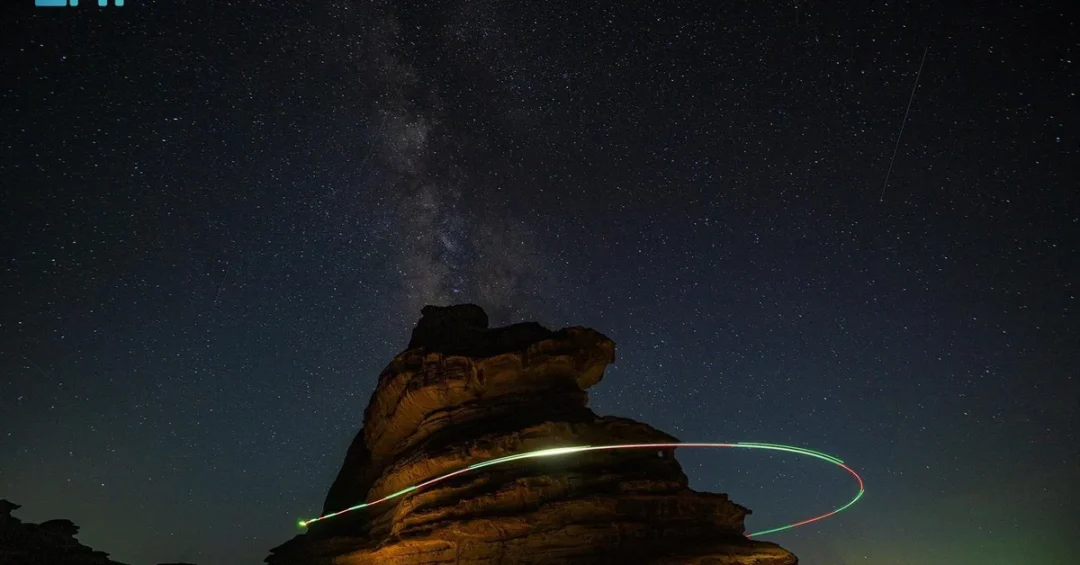
The Saudi Press Agency (SPA) has captured the celestial beauty of the Hasma Desert, west of Tabuk, using drone photography with lights to create stunning light shapes against the galaxy and stars. The Hasma Desert, renowned for its towering mountains and diverse landscapes, provided a unique natural canvas for this innovative blend of art and technology. This initiative underscores Saudi Arabia’s commitment to showcasing its natural wonders and promoting cultural and artistic expression, in line with Vision 2030’s goals to enhance tourism and quality of life.
Context and Background
The Hasma Desert, located west of Tabuk city, is a region celebrated for its dramatic mountains and varied terrain. It has long been a site of natural beauty, attracting explorers and photographers. The Saudi Press Agency (SPA), the Kingdom’s official news agency, has a history of documenting Saudi Arabia’s landmarks and developments. This recent project highlights SPA’s role in not only reporting news but also contributing to the cultural narrative of the nation by leveraging modern technology. Photography, as a contemporary art form, merges science and artistry, and SPA’s use of drone technology exemplifies this fusion, capturing the desert’s majesty in a way that traditional methods cannot.
Key Details
In this endeavor, SPA employed a drone equipped with lights to illuminate the desert landscape while capturing the celestial wonders of the galaxy and stars. The drone’s lights created intricate light shapes that contrasted with the natural night sky, resulting in images that highlight the desert’s grandeur. This technique, which combines precise timing and advanced equipment, showcases the agency’s technical prowess and creative vision. The photographs serve as a testament to the Kingdom’s diverse environments and its potential as a destination for astrotourism and artistic photography. The SPA’s work aligns with broader efforts to promote Saudi Arabia’s natural and cultural heritage on international platforms.
Implications and Impact
The SPA’s successful capture of the Hasma Desert’s celestial beauty has significant implications for Saudi Arabia’s tourism and cultural sectors. It brings attention to the less-explored regions of the Kingdom, potentially attracting visitors interested in astrotourism, photography, and nature. This initiative also contributes to the global perception of Saudi Arabia as a country of remarkable landscapes and modern capabilities. By showcasing the desert’s beauty through innovative means, SPA reinforces the Kingdom’s message of openness and progress. Furthermore, it highlights the potential for similar projects that merge technology and art to promote other hidden gems across Saudi Arabia.
Vision 2030 Alignment
This project is a clear reflection of Saudi Arabia’s Vision 2030 objectives, particularly in the areas of tourism, culture, and quality of life. Vision 2030 seeks to diversify the economy and promote the Kingdom as a premier destination for travelers and artists. By utilizing advanced drone photography to capture the Hasma Desert, SPA contributes to these goals by showcasing a unique aspect of Saudi heritage and natural beauty. Such initiatives support the development of niche tourism markets and enhance the Kingdom’s global cultural presence, aligning with the vision’s aim to create a vibrant society and a thriving economy. As Saudi Arabia continues to invest in its tourism infrastructure, projects like this will play a crucial role in attracting international attention and fostering a deeper appreciation for the Kingdom’s diverse landscapes.
20 Questions
Q1. What is the Hasma Desert known for?
A1. The Hasma Desert, west of Tabuk city, is renowned for its towering mountains and diverse landscapes, making it a unique natural setting in Saudi Arabia.
Q2. What did the Saudi Press Agency recently do in the Hasma Desert?
A2. SPA employed drone photography with lights to capture stunning light shapes along with the celestial wonders of the galaxy and stars, showcasing the desert’s beauty.
Q3. What technology did SPA use for this project?
A3. SPA used a drone equipped with lights to create illuminated shapes against the night sky, blending technology with artistic vision.
Q4. Why is photography considered a contemporary art form?
A4. Photography blends science and artistry, encompassing over 20 genres, and allows photographers to reimagine scenes, entertaining and influencing viewers while freezing time.
Q5. How does this project align with Saudi Vision 2030?
A5. It supports Vision 2030 goals by promoting tourism, cultural expression, and quality of life, showcasing Saudi Arabia’s natural wonders to a global audience.
Q6. What is the significance of SPA’s use of drone technology?
A6. The use of drones demonstrates SPA’s technical prowess and creative approach, allowing for unique perspectives that traditional photography cannot achieve.
Q7. What types of landscapes can be found in the Hasma Desert?
A7. The desert features towering mountains and diverse terrains, providing a dramatic backdrop for photography and exploration.
Q8. How might this project impact tourism in Saudi Arabia?
A8. It could attract astrotourists and photography enthusiasts, highlighting the Kingdom’s potential as a destination for niche tourism and cultural experiences.
Q9. What is astrotourism?
A9. Astrotourism involves traveling to observe celestial phenomena, such as stars and galaxies, often in areas with low light pollution like the Hasma Desert.
Q10. Who is responsible for capturing these images?
A10. The Saudi Press Agency (SPA), the Kingdom’s official news agency, undertook this project to document and promote Saudi Arabia’s natural beauty.
Q11. What makes the Hasma Desert a unique location for photography?
A11. Its towering mountains, diverse landscapes, and clear night skies provide a stunning and unspoiled setting for capturing both terrestrial and celestial subjects.
Q12. How does this initiative reflect Saudi Arabia’s modernization?
A12. It showcases the Kingdom’s adoption of advanced technology and its commitment to cultural and artistic innovation, aligning with Vision 2030’s forward-looking goals.
Q13. What are light shapes in photography?
A13. Light shapes are patterns or designs created by manipulating light sources, often using drones or other tools, to add artistic elements to photographs.
Q14. What role does SPA play in Saudi Arabia’s media landscape?
A14. SPA is the official news agency, responsible for disseminating accurate information and promoting the Kingdom’s achievements and cultural heritage.
Q15. How does this project contribute to Saudi Arabia’s cultural narrative?
A15. By capturing and sharing the desert’s beauty, SPA enriches the cultural narrative, highlighting the Kingdom’s natural treasures and artistic potential.
Q16. What other regions in Saudi Arabia might benefit from similar projects?
A16. Other natural and historical sites, such as AlUla, NEOM, and the Red Sea coast, could benefit from similar technological and artistic showcases to boost tourism.
Q17. What is the significance of capturing the galaxy and stars in the desert?
A17. It emphasizes the pristine night skies of the Hasma Desert, which are ideal for astronomical observation and astrophotography, adding to its appeal.
Q18. How does this project align with Saudi Arabia’s environmental conservation efforts?
A18. By highlighting the desert’s beauty, it encourages appreciation and preservation of natural landscapes, supporting broader environmental awareness and sustainable tourism.
Q19. What impact might this have on international perceptions of Saudi Arabia?
A19. It presents Saudi Arabia as a country of stunning natural beauty and technological innovation, enhancing its global image and attracting international visitors.
Q20. What future projects can we expect from SPA?
A20. SPA is likely to continue using innovative techniques to document Saudi Arabia’s landmarks and events, contributing to the Kingdom’s cultural and tourism promotion.
Reader Feedback
We value your thoughts. Please share your feedback on this article.
Your feedback helps us improve our coverage.
Related articles
 IMF Report: Saudi Arabia Surpasses Vision 2030 Tourism Target
 AMAALA Luxury Destination Progress Announced by RSG
 Saudi Reserve Wins Excellence Award at ADIHEX
 Bish Valley: Jazan’s Scenic Autumn Retreat
 Saudi Tourism Ministry Woos Investors at IHIF Asia
 Ministry of Tourism Unveils AI Innovations at GAIN Summit