


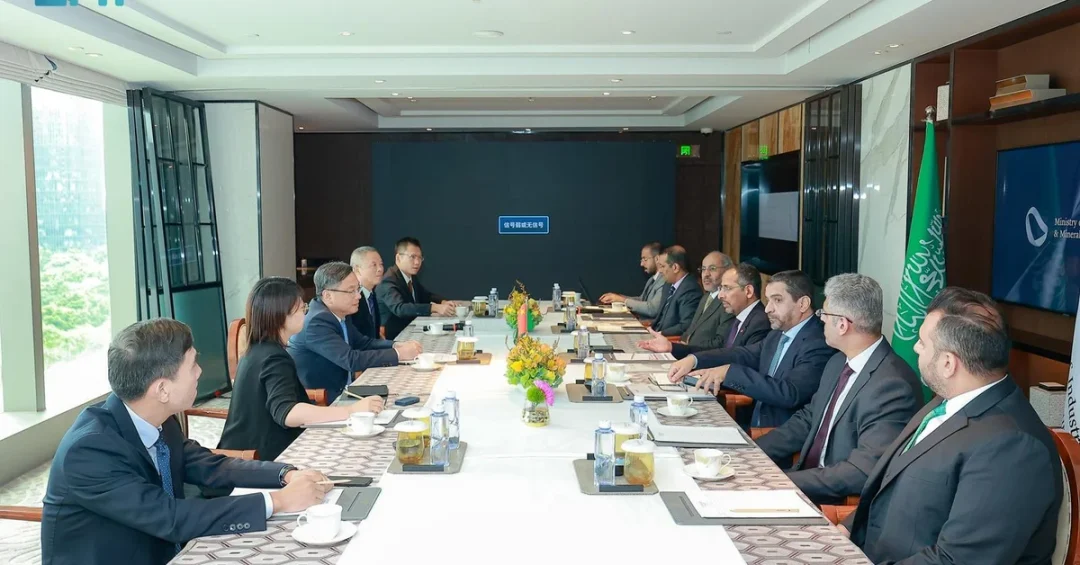
Saudi Arabia’s Minister of Industry and Mineral Resources, Bandar bin Ibrahim Alkhorayef, held high-level meetings with major Chinese mining and technology companies in China to discuss joint investment opportunities in lithium and copper production and processing, as part of the Kingdom’s efforts to become a global hub for electric vehicle manufacturing. The discussions, which took place during an official visit to China, focused on enhancing cooperation in the mining sector and attracting qualitative investments to Saudi Arabia, in line with the goals of Saudi Vision 2030.
Context and Background
The visit is part of an economic tour of East Asia that includes China and Singapore, where Minister Alkhorayef is leading a delegation of officials from the mineral wealth industry. The tour aims to strengthen bilateral ties, attract investments, and explore opportunities in the industrial sector. This follows a previous visit to Chile, the world’s second-largest lithium producer, underscoring Saudi Arabia’s commitment to securing key minerals for its growing electric vehicle industry.
Saudi Arabia is rapidly positioning itself as a key player in the global electric vehicle market, with plans to produce 500,000 electric vehicles annually by 2030. The National Industrial Strategy has identified the automotive industry as a promising sector, with a focus on environmentally friendly vehicles, including electric cars.
Key Details
During the meetings, Minister Alkhorayef discussed with the Chairman of General Lithium Corporation the Kingdom’s objectives in the electric car manufacturing sector and the importance of developing cooperation and exchanging knowledge in lithium production and processing. He also met with the Chairman of Jiangxi Copper Company, a global leader in copper extraction, smelting, and refining, to explore investment opportunities in copper processing and refining.
The minister held a series of meetings with leaders of major companies in smart manufacturing solutions, infrastructure development, and packaging. He met with the Chief Strategy Officer of Biwin Storage Technology Company to review cooperation opportunities in the packaging sector, and with the Co-founder and CEO of HeyGears, a company specializing in 3D printing and smart manufacturing solutions, which operates in over 30 countries.
Additionally, Minister Alkhorayef discussed initiatives to enhance digital skills and implement advanced technologies such as the Internet of Things, AI, and robotics with the CEO of Huawei Enterprise for Oil and Gas and Chairman of Huawei KSA, aiming to improve manufacturing efficiency and productivity.
Implications and Impact
These discussions are set to bolster Saudi Arabia’s mining and industrial sectors, creating new opportunities for economic diversification and job creation. The collaboration with Chinese companies in lithium and copper production is crucial for the development of a sustainable electric vehicle supply chain within the Kingdom. It also aligns with Saudi Arabia’s broader strategy to become a global hub for electric vehicle production and export, reducing reliance on oil and fostering a knowledge-based economy.
Moreover, the partnerships could enhance technology transfer and innovation, positioning Saudi Arabia as a leader in smart manufacturing and advanced industries. The involvement of companies like Huawei and HeyGears highlights the potential for integrating cutting-edge technologies into Saudi industries, driving efficiency and competitiveness.
Vision 2030 Alignment
Saudi Vision 2030 aims to diversify the economy away from oil, and the development of the mining and automotive sectors is a key pillar of this vision. The Kingdom’s goal to produce 500,000 electric vehicles annually by 2030, supported by investments in lithium and copper processing, demonstrates its commitment to sustainable industrialization. The collaborations with Chinese companies will accelerate the transfer of knowledge and technology, helping Saudi Arabia achieve its ambitions of becoming a global leader in electric vehicle manufacturing and a hub for mineral processing. As the Kingdom continues to attract foreign investment and foster international partnerships, it moves closer to realizing its Vision 2030 objectives and strengthening its role in the global economy.
20 Questions
Q1. What was the main purpose of Minister Alkhorayef’s meetings with Chinese companies?
A1. The main purpose was to discuss joint investment opportunities in lithium and copper production and processing, aiming to enhance cooperation in the mining sector and support Saudi Arabia’s electric vehicle industry.
Q2. Which Chinese company did the minister meet regarding lithium production?
A2. Minister Alkhorayef met with the Chairman of General Lithium Corporation to discuss cooperation in lithium production and processing, a key component for electric vehicle batteries.
Q3. What is Saudi Arabia’s target for electric vehicle production by 2030?
A3. Saudi Arabia plans to produce 500,000 electric vehicles annually by 2030 as part of its efforts to develop the electric vehicle industry and infrastructure.
Q4. Which company did the minister meet regarding copper processing?
A4. He met with the Chairman of Jiangxi Copper Company, a global leader in copper extraction, smelting, and refining, to explore investment opportunities in copper processing.
Q5. What other sectors were discussed during the meetings?
A5. The meetings also covered smart manufacturing solutions, infrastructure development, packaging, digital skills, and advanced technologies like IoT, AI, and robotics.
Q6. Which company specializes in 3D printing and smart manufacturing?
A6. HeyGears, a company that applies 3D printing technology and creates smart manufacturing solutions, was among the companies the minister met with.
Q7. What is the significance of lithium in Saudi Arabia’s plans?
A7. Lithium is essential for electric vehicle batteries, and securing its production and processing supports Saudi Arabia’s goal to become a hub for electric vehicle manufacturing.
Q8. How does this visit fit into Saudi Arabia’s broader economic strategy?
A8. The visit is part of an economic tour of East Asia to strengthen bilateral ties, attract investments, and explore industrial opportunities, aligning with Vision 2030’s diversification goals.
Q9. Which previous country did the minister visit for lithium cooperation?
A9. Minister Alkhorayef visited Chile, the world’s second-largest lithium producer, to enhance cooperation in lithium production before his China visit.
Q10. What is the role of the National Industrial Development Center?
A10. The National Industrial Development Center supports the development of industrial sectors, including the automotive industry, and was represented by its CEO, Saleh Al-Solami, during the meetings.
Q11. What is MODON’s involvement in these discussions?
A11. MODON, the Saudi Authority for Industrial Cities and Technology Zones, represented by CEO Majed Al-Argoubi, contributes to developing industrial infrastructure to support investments.
Q12. Which Saudi electric vehicle brand was licensed last year?
A12. Ceer, a joint venture between Foxconn and the Public Investment Fund, was licensed as the first Saudi brand for manufacturing electric cars.
Q13. What is the value of the contract signed by Ceer?
A13. Ceer signed a USD 1.3 billion contract to establish an electric car complex in King Abdullah Economic City, with production scheduled to start by 2025.
Q14. Which company inaugurated the first electric vehicle factory in Saudi Arabia?
A14. Lucid inaugurated the first electric vehicle manufacturing factory in the Kingdom, marking a milestone in the automotive sector.
Q15. How does Huawei contribute to these discussions?
A15. Huawei’s CEO for Oil and Gas and Chairman of Huawei KSA discussed initiatives to enhance digital skills and implement advanced technologies to improve manufacturing efficiency.
Q16. What are the incentives provided to industrial investors in Saudi Arabia?
A16. The Kingdom offers various incentives and capabilities to industrial investors, including infrastructure, regulatory support, and access to special economic zones.
Q17. What is the significance of copper in the global market?
A17. Copper is vital for electrical wiring, electronics, and renewable energy technologies; its demand is growing globally, making processing and refining key investment areas.
Q18. How does this cooperation benefit Saudi Arabia’s economy?
A18. It promotes economic diversification, creates jobs, attracts foreign investment, and fosters technology transfer, reducing reliance on oil revenues.
Q19. What is the role of the Ministry of Industry and Mineral Resources in Vision 2030?
A19. The ministry drives the development of mining and industry, key sectors for economic diversification under Vision 2030, by facilitating investments and partnerships.
Q20. What future steps are expected following these meetings?
A20. Further agreements and joint ventures are likely, as Saudi Arabia continues to engage with international partners to advance its industrial and mining capabilities.
Reader Feedback
We value your thoughts. Please share your feedback on this article.
Your feedback helps us improve our coverage.